
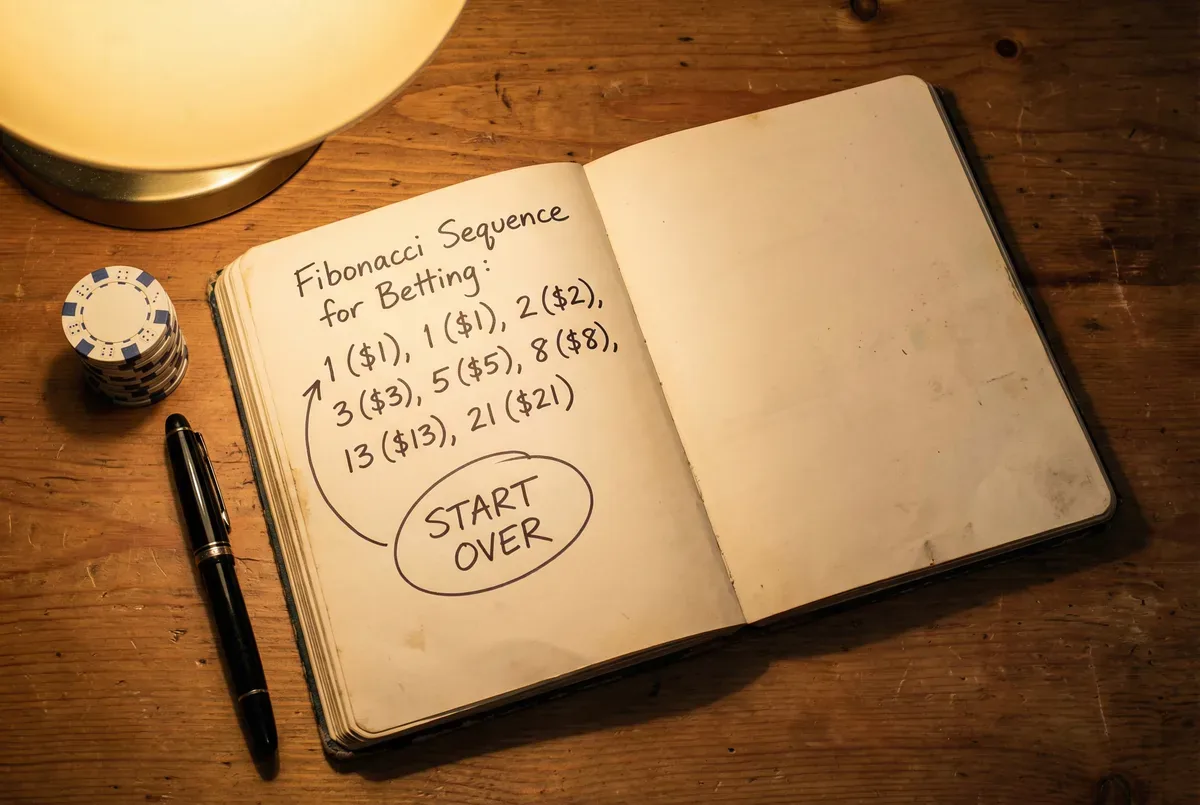
Why Your Minimum Bet Size Matters More Than Any Betting System
Before you choose a betting system, before you decide on a progression, before you set a win goal you need to get your base bet size right. The standard professional guideline is the 1% rule: your flat bet should represent no more than 1% of your session bankroll. Sit down with $200 and bet $2. Sit down with $500 and bet $5. This single rule does more to protect your bankroll from ruin than any betting system ever designed. It ensures that normal variance losing streaks of 5, 8, even 12 hands in a row cannot end your session before you have had a meaningful sample of play.

The 1% Rule: Your Most Important Betting Decision
- $100 session bankroll → $1 base bet (100-unit bankroll)
- $200 session bankroll → $2 base bet (100-unit bankroll)
- $500 session bankroll → $5 base bet (100-unit bankroll)
What Is Risk of Ruin?
Risk of ruin is the probability that a series of normal losing variance will eliminate your entire session bankroll before you recover. At a 0.5% blackjack house edge with a 100-unit bankroll (1% bets), risk of ruin in a session is low enough to be a minor consideration variance is unlikely to produce a 100-unit loss in a single session. But at 5% of bankroll per bet (20-unit bankroll), the risk of ruin in a single session climbs dramatically. At 10% of bankroll per bet, a run of 10 consecutive losses statistically normal, occurring roughly once every 500 hands wipes you out entirely.
The math compounds when you add a negative progression on top of a large base bet. If you are already betting 5% of your bankroll per hand and you double after each loss, a streak of four losses puts 80% of your bankroll on a single hand. This is not edge management; it is gambling bankruptcy in slow motion. No betting system can compensate for a base bet that is too large relative to your bankroll.
Risk of ruin at 1% bet size (100-unit bankroll)
session risk
How Do You Choose the Right Table Minimum for Your Bankroll?
Table minimums create a practical constraint on the 1% rule. A $25 minimum table requires a $2,500 session bankroll to maintain proper bet sizing. Most recreational players do not bring $2,500 to the table which means they are betting a much higher percentage of their session funds per hand, often 5–10%. This is not a moral failure; it is a structural reality. The practical solution is to seek tables with lower minimums: $5 or $10 minimum tables allow you to play with $500–$1,000 and stay within sound bet-sizing parameters. Never let table prestige override bet-sizing discipline.
If you walk up to a table and the minimum bet is more than 1% of what you brought, find a lower minimum table. There is no prestige value in a $25 minimum game that offsets the risk-of-ruin math. A $10 minimum table where you are properly funded beats a $25 table where you are overexposed every single time.
What Is Bet Sizing vs. Betting Systems?
If you are choosing between spending mental energy on your bet sizing or on your betting system, bet sizing wins every time. A correctly sized flat bet with no system outperforms an incorrectly sized Martingale, Paroli, or Fibonacci every single time in terms of risk-adjusted longevity. Betting systems are a layer of structure applied on top of a base bet. If the base bet is wrong, no system fixes it. Get the foundation right first, then decide whether you want to layer a progression on top.
Applying Bet-Sizing Discipline in a Live Game
Live casino environments create pressure to bet bigger the ambient excitement, other players wagering large amounts, and the desire to be in action on a meaningful scale. This pressure is one of the primary reasons players overblow their base bet. Decide your bet size before you sit down, based on the math of your actual bankroll, and treat it as fixed for the session. If you want to pressure-test your bet-sizing discipline in a real-money environment, apply this at a live betting session offers live dealer tables just be aware that every chip on that felt is real money, and bet-sizing errors there have immediate financial consequences.
Frequently Asked Questions
Keep your base bet at 1% of your session bankroll 100 units. This gives you enough cushion to survive normal variance without being wiped out by a losing streak.
Find a lower minimum table. Playing at a $25 minimum with less than $2,500 means you are overbetting your bankroll. The risk-of-ruin math worsens significantly with each step above the 1% threshold.
No. Betting systems operate on top of your base bet. If the base bet is too large relative to your bankroll, any system especially negative progressions accelerates ruin rather than preventing it.
Before you test these plays at a real table, run them through our free blackjack simulator practice unlimited hands at zero cost until every move becomes automatic.
Mathematical Risk Warning
Oversized base bets are the leading cause of single-session bankroll depletion. The 1% rule is not conservative it is the minimum standard for playing with statistical longevity. Betting more is not braver; it is just more expensive.
Blackjack Academy is an educational resource. All strategy is based on mathematical expectation. Always play within your means.
Learn More
Continue your education with these related lessons.
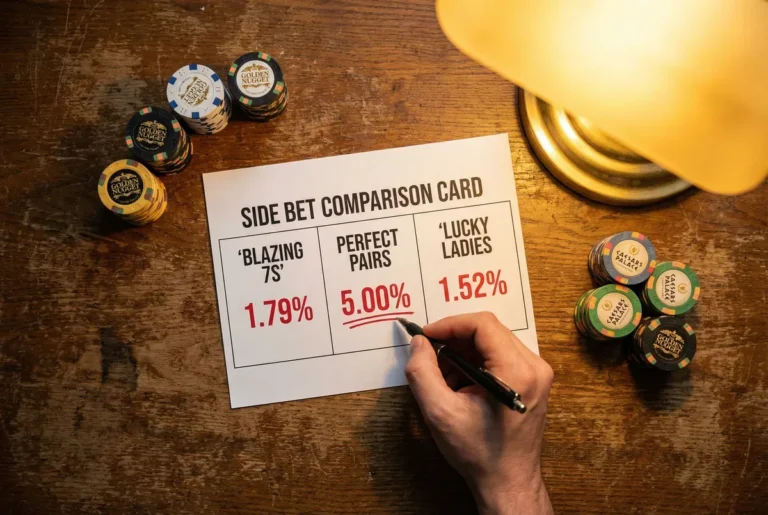
House Edge of Popular Side Bets Like Blazing 7s
Blazing 7s, Lucky Lucky, and Royal Match all carry house edges far above the main game. This post gives you…
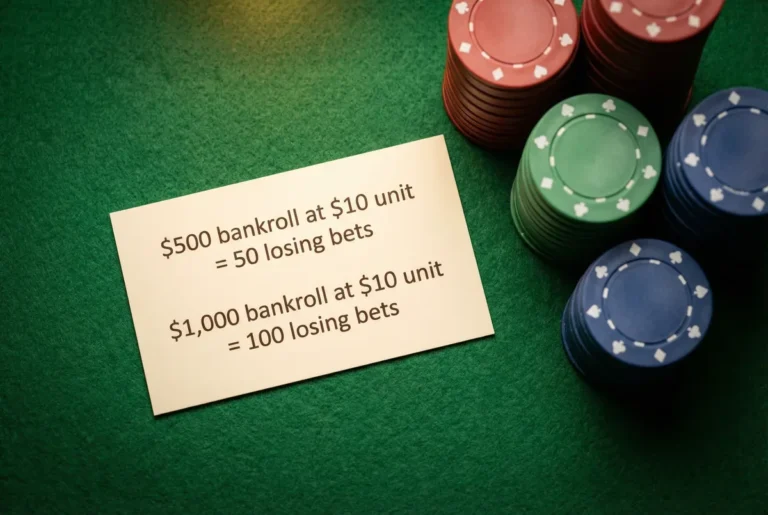
How to Handle a Large Blackjack Win at the Casino Cashier Safely
Winning big at blackjack is great until you handle it poorly. Learn when casinos report winnings, how to color up…

Why Past Hands Have No Effect on Your Future Results
Each blackjack hand is an independent statistical event. Past losses do not make future wins more likely, and winning streaks…