
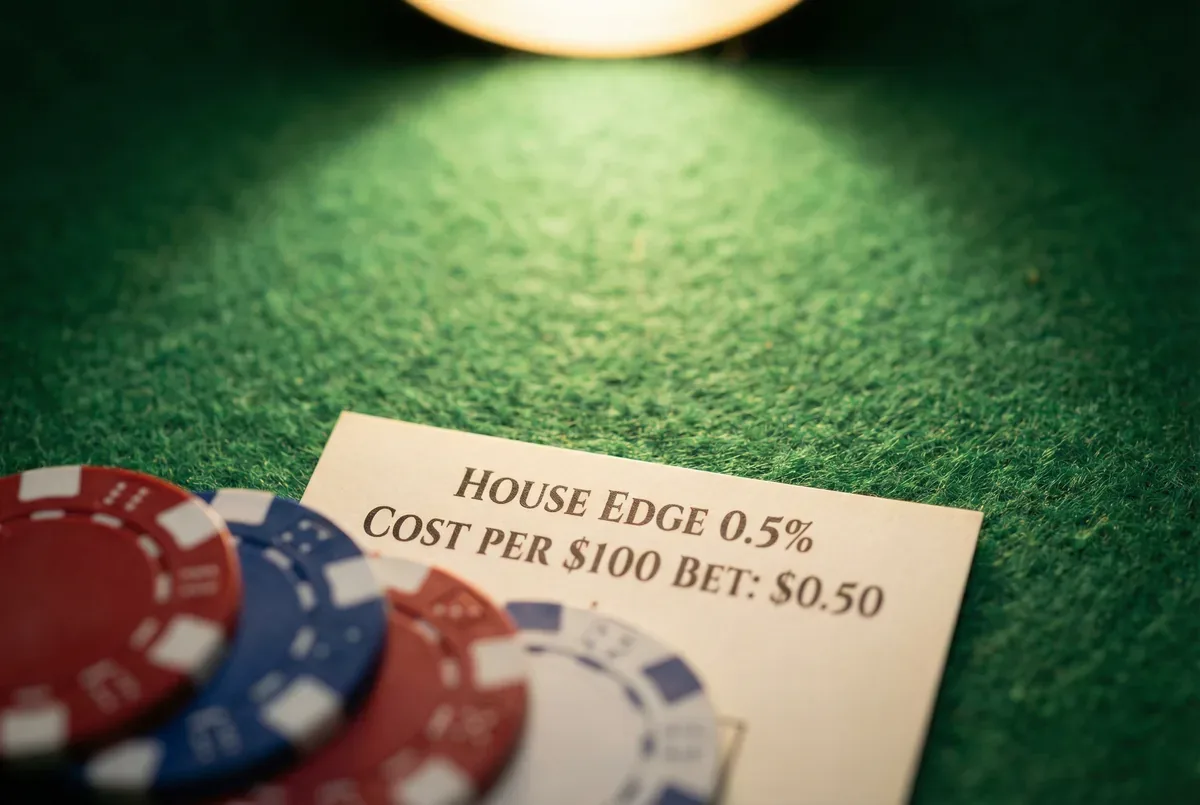
What the House Advantage Percentage Really Means for Your Bankroll
The house advantage, also called the blackjack house edge, and is the mathematical expected profit the casino earns on every dollar wagered, expressed as a percentage. In a game with a 1% blackjack house edge, the casino expects to keep $1 for every $100 wagered. The player’s corresponding expected loss is also $1 per $100. This figure is calculated over a large number of trials it does not mean you will lose exactly 1% of every bet, but rather that if you played the same game millions of times, the average outcome would converge to a 1% loss per dollar wagered.
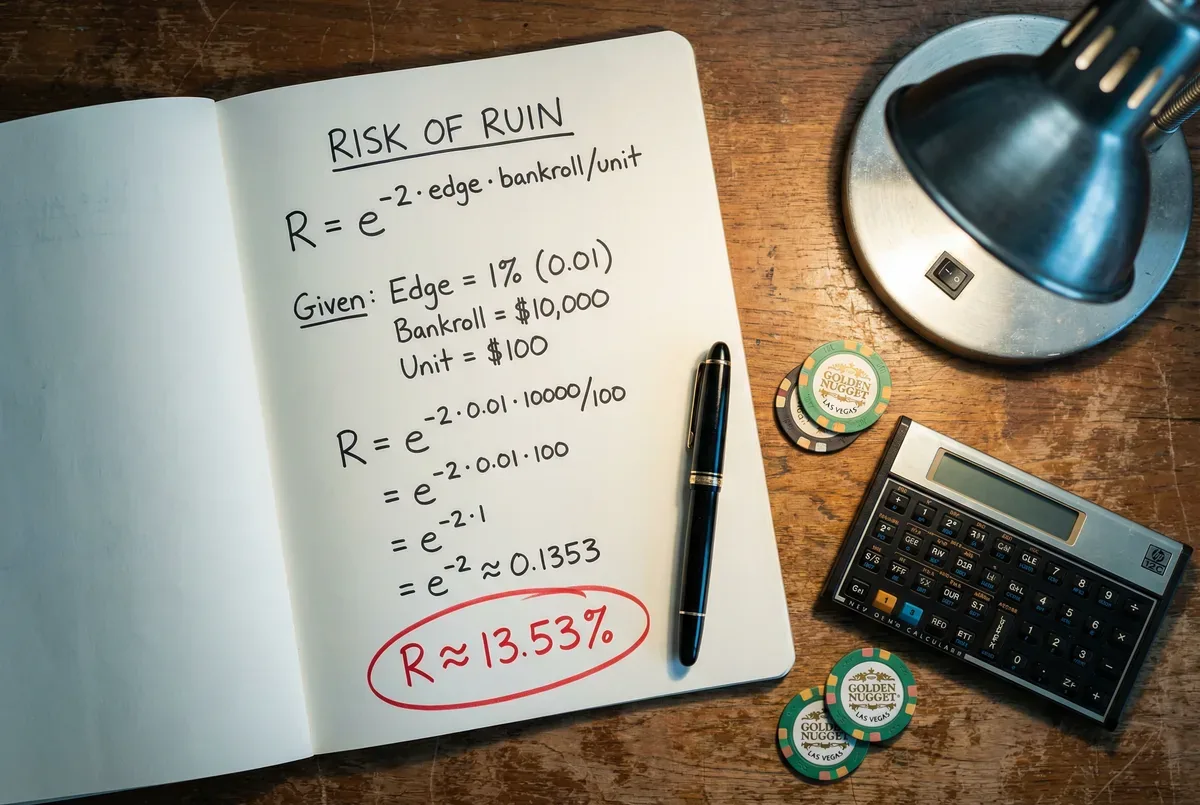
House Advantage is the Casino’s Expected Revenue as a Percentage of Every Dollar Wagered
Blackjack offers one of the lowest blackjack house edges available in any casino, provided you play with correct blackjack basic strategy. In a 6-deck game with standard rules (dealer stands on soft 17, 3:2 blackjack payout, double any two cards, split up to 4 hands), the blackjack house edge with perfect blackjack basic strategy is approximately 0.5%. That is 50 cents per $100 wagered dramatically better than slots (3–10%) or American roulette (5.26%).
The practical meaning of the 0.5% edge is often misunderstood. It is not a per-session guarantee of loss. It is a long-run average. In any given session, you can win significantly more than the edge would predict through positive variance. But across hundreds of sessions, the results converge to the edge direction.
Game
House Edge
- 0.5%
- 1.06%
- 2.7%
- 5.26%
- 3–10%
- 25–30%
How Rules Changes Alter the Edge in Dollar Terms?
The blackjack house edge is not fixed it changes with every rule variation. Switching from 3:2 to 6:5 blackjack payout increases the blackjack house edge by approximately 1.4 percentage points, from 0.5% to about 1.9%. On a $25 flat bet over 100 hands (total wagering $2,500), that change means expected loss increases from $12.50 to $47.50 a $35 difference from a single table rule that most casual players never notice when they sit down.
Other rule variations and their approximate edge impact: dealer hits soft 17 adds approximately 0.22% to the blackjack house edge. No re-splitting aces adds approximately 0.08%. No double after split adds approximately 0.14%. Each of these compounds: a table with all three negative variations adds 0.44% to the blackjack house edge, pushing a standard game from 0.5% to nearly 1%. The difference between the best and worst rule set is often over 1 percentage point significant at any stake level.
This is why game selection is the most immediately impactful improvement most players can make. Switching from a 6:5 table to a 3:2 table is worth far more than any betting system innovation, and it requires no additional skill or risk.
- 32 blackjack payout → baseline 0.5% edge
- 65 blackjack payout → adds +1.4% edge
- Dealer hits soft 17 → adds +0.22% edge
- No re-splitting aces → adds +0.08% edge
- No double after split → adds +0.14% edge
- Single deck + all favorable rules → can reduce to 0.17%
What Is the Edge Over Time?
At 80 hands per hour and a $25 flat bet, you wager $2,000 per hour. At 0.5% blackjack house edge, expected loss is $10. Over a 4-hour session, expected loss is $40. Over 100 sessions (approximately one year of regular monthly play), expected loss is $4,000. These are expected values, not guarantees actual results will distribute around these figures with considerable variance. But the direction is consistent: the expected result is always negative for non-counters, and the magnitude grows with time and stakes.
Budget Your Sessions Around the Edge
Understanding this math does not make blackjack less enjoyable it makes it more honest. The 0.5% edge means you are buying entertainment at a specific rate, and that rate is among the most favorable in the building. Viewing sessions through the lens of expected cost per hour rather than expected profit transforms the psychological experience of losing sessions from failure into normal variance.
Before every session, calculate your expected cost. At $25 flat bet, 80 hands per hour, 2-hour session: expected cost is $20 at 0.5% edge. If you budget $20 as your entertainment cost and end the session down $30, you are within normal variance of the plan. If you end up $50, variance ran in your favor. Neither result should feel like a failure or a triumph just math.
Seeing the Edge in Action at a Real Table
The best place to see the blackjack house edge operating in your own results over time is in a live environment with tracked results. At measure the blackjack house edge at a live real-money table, your hands and outcomes are tracked accumulate enough sessions and the edge will begin to reveal itself in your running total. Real money means real edges and real consequences; only play with funds fully allocated for entertainment, and use the accumulated data to verify whether your strategy execution matches the theoretical 0.5% benchmark or runs higher due to deviations.
Frequently Asked Questions
Single-deck blackjack with the most favorable rules possible can reduce the edge to approximately 0.17% with perfect basic strategy. However, single-deck games often come with offsetting rules like 6:5 payouts or restricted doubling that push the actual edge much higher than the theoretical single-deck minimum.
The edge applies to every hand independently and accumulates across a session. There is no single calculation for a session because variance interacts with the edge differently depending on how many hands are played. The edge is best understood as a rate that applies to the total dollars wagered, not the total buy-in.
Yes. Skilled card counters who track deck composition and spread bets appropriately can achieve a player advantage of 0.5% to 1.5% in favorable conditions. This turns the expected outcome from negative to positive. It is the only legal technique that mathematically overcomes the house edge in blackjack.
Before you test these plays at a real table, run them through our free blackjack simulator practice unlimited hands at zero cost until every move becomes automatic.
Mathematical Risk Warning
The house advantage in blackjack is a real, persistent mathematical expectation. While it can be reduced to 0.5% with perfect basic strategy and optimal game selection, it cannot be eliminated without card counting. All recreational play should be budgeted as an entertainment cost proportional to the house edge and total wagering.
Blackjack Academy is an educational resource. All strategy is based on mathematical expectation. Always play within your means.
Learn More
Continue your education with these related lessons.
Why Past Hands Have No Effect on Your Future Results
Each blackjack hand is an independent statistical event. Past losses do not make future wins more likely, and winning streaks…
Avoiding High Risk Betting Systems That Lead to Bankruptcy
Negative progression betting systems promise fast recovery from losses but deliver exponential ruin risk. This guide breaks down why Martingale,…
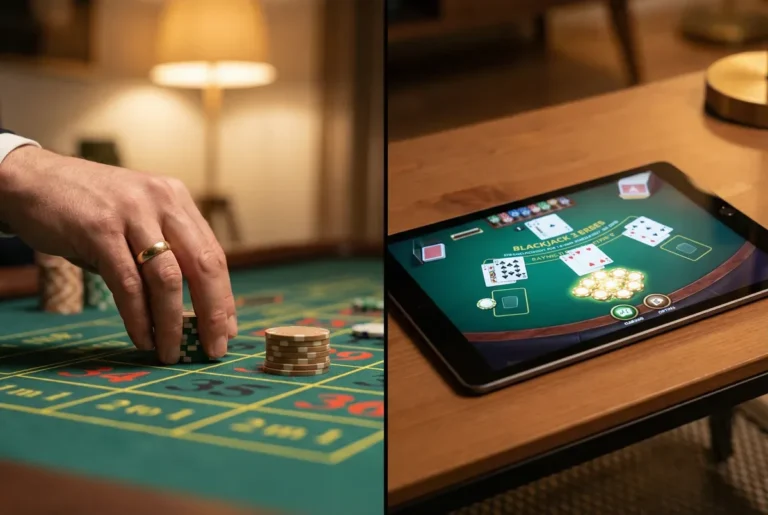
Why Betting Psychology Changes Dangerously with Virtual Chips vs Real Cash
Virtual chips in online blackjack reduce the psychological pain of loss, causing players to bet more recklessly than they would…