

Warning Signs When Blackjack Stops Being Fun and Becomes a Problem
Blackjack occupies an unusual position among casino games: it rewards study, discipline, and analytical thinking in ways that most gambling does not. This creates a particular psychological trap. Players who develop genuine skill can find it difficult to distinguish strategic commitment from compulsive behavior, because both can look identical from the outside and feel similar from the inside. The diagnostic question is not how much you play, how seriously you study, or how large your bankroll is. It is whether the activity is adding to your life or subtracting from it financially, relationally, and emotionally. Answering that question honestly requires knowing what the warning signs look like before they become crises.
The Line Between Strategy and Compulsion
- Chasing losses by extending sessions beyond planned stop-loss
- Borrowing money or liquidating savings to fund play
- Lying to family or colleagues about gambling frequency or amounts
- Playing to escape emotional distress rather than for strategic engagement
- Feeling anxious, irritable, or preoccupied when not playing
Why Does the Psychology of Los Chasing?
Loss chasing is the most diagnostic behavioral marker of problem gambling and the most common. It is the decision to continue or escalate play after a losing session in an attempt to recover losses a behavior that every established gambling framework identifies as a primary warning signal. From a mathematical standpoint, loss chasing is irrational because each hand has the same expected value regardless of what preceded it. From a psychological standpoint, it is driven by loss aversion: the pain of a realized loss is approximately twice as intense as the pleasure of an equivalent gain, according to behavioral economics research. This asymmetry creates powerful pressure to avoid crystallizing a loss by stopping play.
A player who occasionally stays fifteen minutes longer than planned after a bad run is experiencing normal psychological pressure. A player who cannot leave a table while losing who finds that the stop-loss rule they set evaporates in the moment is displaying a warning sign that deserves honest reflection. The difference is not one of willpower or character. It reflects the degree to which the dopaminergic reward system has become oriented around recovering losses rather than enjoying the mathematical challenge of the game.
Common Myth
“I only have a problem if I gamble every day or lose enormous amounts”
Media portrayals of problem gambling focus on extreme cases, making moderate harm easier to dismiss
The Reality
Problem gambling is defined by functional impairment and loss of control, not frequency or amount
A player losing $200/month they cannot afford has a problem; one losing $2,000/month within budget may not
What Are Self-Assessment Tools and When to Use Them?
The Problem Gambling Severity Index (PGSI) and the CAGE questionnaire adapted for gambling are validated screening instruments that provide structured self-assessment in ten questions or fewer. These tools are not diagnostic they do not replace professional evaluation but they provide an objective reference point against which to measure subjective impressions. A score in the moderate or high-risk range on the PGSI is a clear signal to seek professional guidance regardless of how well you believe you are managing play. Responsible gambling organizations in every regulated market provide free, confidential access to both these tools and trained counselors.
If you are reading this article because a specific session or pattern prompted the search that awareness itself is meaningful. The most protected players are those who take warning signs seriously at the first instance rather than waiting for an undeniable crisis.
What Is the Practical Protection Mechanisms Available Right Now?
Every licensed online casino is required in regulated markets to offer self-exclusion, deposit limits, session time limits, and cooling-off periods. These tools are most effective when used proactively before a problematic pattern establishes itself rather than reactively after significant harm has occurred. Setting a monthly deposit limit equal to your entertainment budget is a practical first step that has no downside for recreational players and provides genuine protection against impulse deposits during high-risk emotional states. Many operators also offer a reality check feature that displays elapsed session time at regular intervals, countering the time distortion effect that casino environments are deliberately designed to produce.
For immediate support in the UK, contact GamCare at 0808 8020 133 (free, 24/7). In the US, the National Problem Gambling Helpline is available at 1-800-522-4700. Gamblers Anonymous operates meetings and online support communities globally. These are not resources of last resort they exist precisely to help at the early stages when intervention is most effective.
Sustainable Play Starts With an Honest Baseline
If you want to continue enjoying blackjack as a long-term recreational or semi-professional activity, the foundation is an accurate picture of your current relationship with the game. Spend a month tracking every session with honest logs: planned session length vs actual, planned stop-loss vs actual exit point, emotional state before and after each session. Then review the data without rationalization. Players who engage with this discipline and find their play within healthy parameters have concrete evidence to feel confident about. Those who find persistent deviations have early-stage information that makes meaningful course correction possible before real harm accumulates. Before visiting use this with real money on the table in your next session or any real-money platform, complete this self-assessment first real stakes amplify existing patterns, healthy or not.
Frequently Asked Questions
The key distinction is control and consequence. Recreational gambling occurs within planned financial limits and does not cause distress or functional impairment. Problem gambling involves loss of control over frequency, duration, or spend, and causes harm in financial, relational, or psychological domains.
Yes. Skill does not provide immunity from problematic behavioral patterns. A player who uses blackjack expertise as rationalization for excessive play while experiencing financial or emotional harm is exhibiting problem gambling behavior regardless of their strategy competence.
In the UK, GamCare provides free 24/7 support at 0808 8020 133. In the US, the National Problem Gambling Helpline operates at 1-800-522-4700. BeGambleAware.org and Gamblers Anonymous provide additional online resources globally.
Before you test these plays at a real table, run them through our free blackjack simulator practice unlimited hands at zero cost until every move becomes automatic.
Mathematical Risk Warning
Blackjack carries real financial risk. If gambling is causing you distress, financial hardship, or relationship problems, please contact a responsible gambling support service before continuing play of any kind.
Blackjack Academy is an educational resource. All strategy is based on mathematical expectation. Always play within your means.
Learn More
Continue your education with these related lessons.

How to Use an EV Spreadsheet to Track Your Blackjack Sessions
An EV spreadsheet turns your session history into actionable data. Building one correctly takes thirty minutes. Using it consistently turns…
How Professional Counters Hedge Against Mathematical Variance
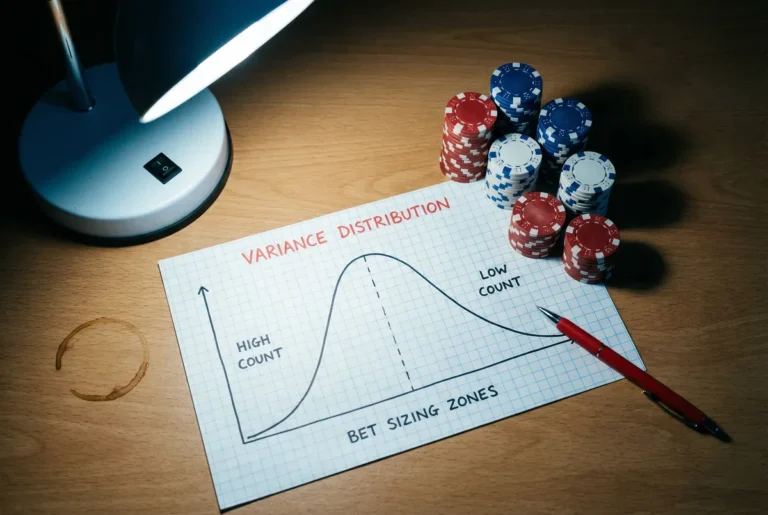
Even with a genuine mathematical edge, professional card counters face brutal short-term variance. The tools they use to hedge against…

Why the Martingale System is the Fastest Way to Go Broke
The Martingale sounds bulletproof just double after every loss and you must win eventually. But the math behind table limits…