
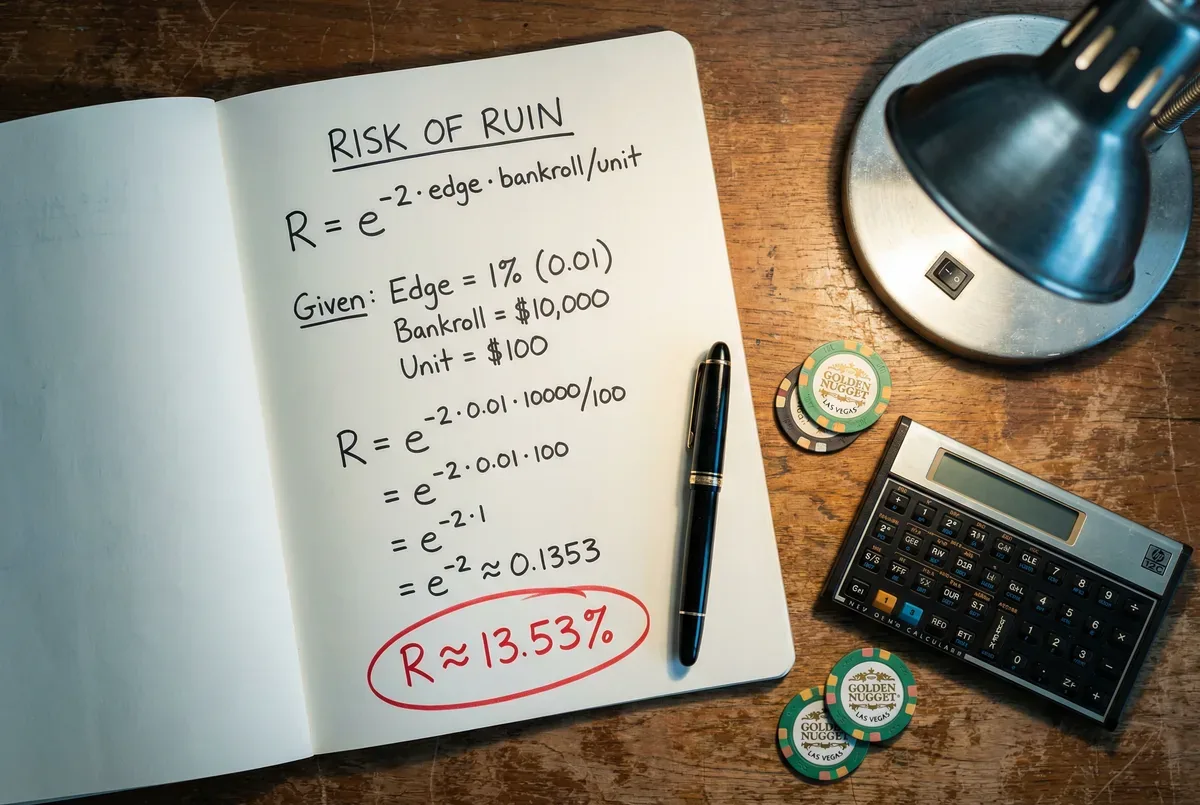
The Real Formula for Calculating Your Blackjack Risk of Ruin
Risk of ruin (ROR) is the probability that a player’s bankroll will be completely depleted during a session or series of sessions before reaching a specified goal or stopping point. In blackjack, it is one of the most important metrics for anyone playing with finite funds and a negative expected value game. Even with perfect blackjack basic strategy, the blackjack house edge is a persistent downward drag on your bankroll, and variance creates swings large enough to eliminate any finite fund with some probability.

Risk of Ruin Measures the Probability Your Bankroll Reaches Zero Before a Target
The simplified risk of ruin formula for a negative edge game is: ROR = ((1 − edge/std_dev) / (1 + edge/std_dev)) ^ (bankroll/unit). In this formula, edge is the blackjack house edge as a decimal (0.005 for 0.5%), std_dev is the standard deviation of outcomes per unit bet (approximately 1.1 for blackjack flat play), bankroll is your total fund in units, and unit is your bet size. The exponent is the bankroll in units.
The practical implication is direct: larger bankrolls in units dramatically reduce ROR, and higher blackjack house edge dramatically increases it. The single most effective way to reduce ROR is to increase the ratio of bankroll to bet size which is exactly what the 200-unit rule achieves.
- 50-unit bankrollROR approximately 31% extremely dangerous
- 100-unit bankrollROR approximately 9.6%
- 200-unit bankrollROR approximately 0.92%
- 300-unit bankrollROR approximately 0.09%
- 500-unit bankrollROR under 0.001% negligible
How House Edge and Variance Each Affect the Calculation?
The blackjack house edge is the persistent downward force: higher edge means every unit of bankroll is depleted faster on average, giving variance less time to produce recovery runs. A game with 2% blackjack house edge has dramatically higher ROR at a given bankroll depth than a 0.5% edge game with the same units. This is one of the primary reasons game selection matters: choosing a 6:5 payout table instead of 3:2 nearly triples the blackjack house edge from 0.5% to 1.4%, and that change alone roughly doubles the risk of ruin at any given bankroll depth.
Variance is the storm that creates short-term swings in both directions. High variance produces both the large downswings that threaten ruin and the large upswings that can take a player far ahead of their starting position. For flat bettors, variance is relatively controlled standard deviation of about 1.1 units per hand. Card counters with a 1–12 spread have standard deviations of 3–4 units per hand, which is why counter bankrolls need to be 400–500 units of the minimum bet rather than 200.
The interplay between edge and variance means that reducing the blackjack house edge (through game selection and perfect strategy execution) has more impact on ROR than most players realize. Moving from a 1% edge game to a 0.5% edge game while keeping bankroll and bet size constant roughly halves the risk of ruin over a long series of sessions.
Common Myth
“With good enough strategy, my risk of ruin is zero”
Perfect play minimizes the house edge to near zero, which feels like safety
The Reality
Even at 0.5% edge, a finite bankroll has a non-zero probability of ruin during any sufficiently long play series. The edge reduces ruin probability; it does not eliminate it
Only a mathematical edge (positive EV from counting) reduces long-run ruin probability below 100% for indefinitely long play
What Is the Practical Applications of the ROR Calculation?
Use ROR calculations to make concrete decisions about bankroll sizing. If you have a $1,000 bankroll and want to play $25 hands, you have 40 units an ROR of roughly 60%. That is unacceptably high. To reduce to under 5%, you need 100 units of your bet size: either a $2,500 bankroll or dropping to $10 bets with your $1,000 fund. The math makes the decision clear without requiring intuition.
Why Should You Run the ROR Formula Before Every New Stake?
For session-level ROR (the probability of losing a specific session buy-in), the calculation is simpler. With a 20-unit session stake and flat betting, the probability of losing all 20 units before completing a 200-hand session is approximately 15–20% which is why the 20-unit buy-in is the minimum, not the recommended amount. At 25 units, session ruin probability drops below 10%.
Run your ROR before your first session at any new stake level. The 30 seconds it takes to apply the formula will tell you whether your planned bet size and bankroll are a reasonable pairing or a high-probability path to ruin. The math is straightforward; refusing to check it is the only unforced error in bankroll planning.
Applying ROR Awareness in Live Sessions
Risk of ruin awareness changes how you experience downswings. A 15-unit loss that sits within your calculated variance range stops feeling catastrophic and starts feeling like information. At run this system with real table stakes, track your session results against your expected ROR. When real money is at stake, a 15-unit down session is financially significant only use funds fully budgeted for entertainment, and treat each downswing as a data point rather than a crisis, provided it is within your pre-calculated tolerance range.
Frequently Asked Questions
Expected loss is the average outcome over many sessions for a 0.5% edge game at $10 flat over 100 hands, it is $5. Risk of ruin is the probability of a specific catastrophic outcome losing the entire bankroll. These are different statistics. You can have a low expected loss and a high ROR if your bankroll is too small relative to your bet size.
Yes significantly. Counters with a positive edge have a ROR formula that produces results under 100% for indefinitely long play meaning their bankroll can theoretically survive forever. The formula changes: edge becomes positive, and the bankroll required to achieve acceptable ROR is much larger because the standard deviation from large bets is much higher.
Most bankroll management guides target ROR under 5% for the full playing career and under 10% for individual sessions. Anything above 20% means the bet size is too large for the bankroll and should be reduced immediately.
Before you test these plays at a real table, run them through our free blackjack simulator practice unlimited hands at zero cost until every move becomes automatic.
Mathematical Risk Warning
Risk of ruin is a real statistical property of every blackjack bankroll. With a house edge and finite funds, there is always some probability of total loss. Proper bet sizing keeping bets at 1/200th to 1/300th of total bankroll reduces this to near-negligible levels but never to zero.
Blackjack Academy is an educational resource. All strategy is based on mathematical expectation. Always play within your means.
Learn More
Continue your education with these related lessons.
Why the D’Alembert Betting System Fails Most Blackjack Players Long-Term
The D'Alembert system raises your bet by one unit after a loss and lowers it by one after a win.…
Why the Reverse Martingale and Parlay System Fails Most Players
The Reverse Martingale doubles bets after wins instead of losses. It protects your base bankroll from catastrophic loss. Here is…
How Long Your Blackjack Bankroll Will Last with Worked Calculations
How long will your blackjack bankroll last? The formula is bankroll divided by (house edge × average bet × hands…