
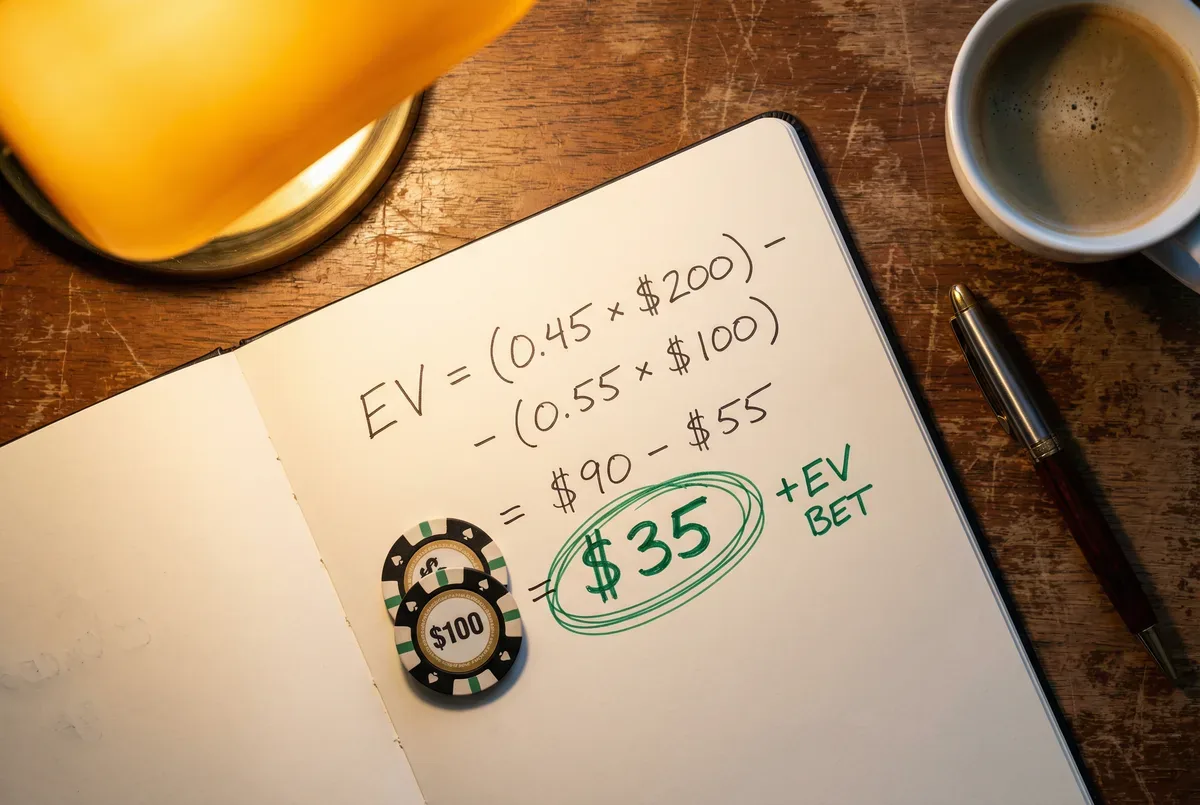
The Proven Rule of Only Betting When You Have Positive Expected Value
Expected value is the mathematical average outcome of a bet over infinite repetitions. A bet with positive EV will produce net profit over a large enough sample. A bet with negative EV will produce net loss. This is not a probabilistic opinion it is arithmetic. The professional approach to blackjack betting is to place large bets only when EV is positive or close to neutral, and minimum bets when EV is negative. For a blackjack basic strategy player with no counting ability, every hand in a standard game carries a small negative EV at the blackjack house edge approximately -0.5% per hand. This means strict flat betting is the rational choice, not bet variation based on intuition, streaks, or hunches. For a card counter, positive EV emerges when the count reaches a threshold that shifts the player’s edge positive. That is the only mathematically valid trigger for bet escalation.

Expected Value Is the Only Legitimate Reason to Bet
Common Myth
“Varying bet size based on winning streaks improves long-run results”
Hot streaks feel meaningful and players want to capitalize on apparent momentum
The Reality
Past outcomes carry zero predictive value for future hands; bet variation only increases variance
Every hand at negative count has the same negative EV regardless of the previous 10 results
When Positive EV Actually Exists in Blackjack?
Positive expected value in blackjack arises in a small number of well-defined circumstances. Card counting is the most reliable: at a Hi-Lo true count of +2 or higher in a standard six-deck game, the player’s edge crosses zero and becomes positive. The magnitude of the advantage grows with the count at true count +4, the player advantage reaches approximately 1%. This is the moment to place larger bets, because the expected value of the hand is now mathematically in your favor.
Promotional opportunities also create positive EV: certain casino bonuses, match-play coupons, and free bet offers can temporarily shift the expected value of a session positive when the mathematical terms are evaluated correctly. Rule variations that strongly favor the player surrender on any two cards, dealer stands on soft 17, double down after split, 3:2 blackjack payout collectively reduce the blackjack house edge to below 0.3% in the best games, approaching but rarely reaching true parity. Understanding exactly which conditions produce positive EV lets you seek out those conditions and deploy capital at them specifically.
| Rule | Player Effect | EV Change |
|---|---|---|
| Dealer hits soft 17 | ||
| Bad for player | ||
| -0.22%;6 | 5 blackjack payout | |
| Very bad for player | ||
| -1.39%;Late surrender allowed | ||
| Good for player | ||
| +0.08%;Double after split allowed | ||
| Good for player | ||
| +0.14%;Single deck vs 6 deck | ||
| Good for player | ||
| +0.59% |
What Is the Bet Sizing Proportional to Edge Magnitude?
When positive EV exists, bet size should be proportional to the magnitude of the edge. This is the Kelly Criterion in practice. A true count of +2 represents a modest player edge of roughly 0.5% a Kelly bet of 0.5% of bankroll. A true count of +5 represents an edge approaching 2% a Kelly bet of 2% of bankroll. Betting a fixed large amount regardless of edge magnitude ignores the variance-minimizing mathematics of Kelly sizing and exposes the bankroll to unnecessary risk on hands where the edge is real but small.
Positive EV is not a guarantee it is a long-run statistical expectation. At true count +3, you still lose approximately 46% of hands. The discipline of betting correctly when EV is positive requires accepting that individual hand outcomes are irrelevant to the correctness of the bet-sizing decision.
What Are the Minimum Betting During Negative EV Phases?
The flip side of maximizing bets at positive EV is minimizing them at negative EV. At a true count of -2 or lower, the blackjack house edge exceeds 1% each hand has meaningful negative expectation. Professional counters reduce to minimum bets in these phases, not as a capitulation but as disciplined capital preservation. The money not lost on negative-EV hands is money available to deploy on the next positive-EV opportunity. This mechanical discipline maximum at positive count, minimum at negative count is what converts a 1% counter advantage into realized long-run profit.
Recreational players without a counting system can apply a simplified version of this principle: never increase bets based on anything other than a formal, defined trigger. If no positive EV trigger exists in your game, flat betting at minimum is always the optimal recreational choice.
Deploy Capital Only When the Math Supports It
The most honest test of EV discipline is a live session where the count runs negative for an extended period while you maintain table minimum. At test the math at a live real-money table tonight, practice tracking conditions and deploying capital only when a formal positive-EV trigger is met. Real money on the line ensures the discipline is genuine the temptation to bet larger on a gut feeling will be present throughout, and resisting it when the count does not justify it is the core professional skill being tested.
Frequently Asked Questions
Not consistently in standard games. However, specific promotions, match-play coupons, and blackjack tournaments can create positive EV for non-counters. Outside those defined opportunities, basic strategy players face a small consistent house edge on every hand.
In a standard six-deck game with typical Las Vegas rules, a true count of approximately +1 to +2 is the break-even threshold depending on specific rules. Above that point, the player advantage grows at approximately 0.5% per true count point.
Full Kelly is mathematically optimal for long-run growth but generates high variance. Most players use quarter to half Kelly to reduce variance at a modest cost to expected growth rate. The principle of proportional bet sizing still applies larger bets at higher edges.
Before you test these plays at a real table, run them through our free blackjack simulator practice unlimited hands at zero cost until every move becomes automatic.
Mathematical Risk Warning
Positive expected value is a long-run statistical property, not a hand-by-hand guarantee. Even at true count +4, individual hands will lose at normal frequency. Never oversize bets based on a single high-count hand.
Blackjack Academy is an educational resource. All strategy is based on mathematical expectation. Always play within your means.
Learn More
Continue your education with these related lessons.

How Table Speed Increases or Decreases Your Variance
Table speed measured in hands per hour directly controls how quickly variance resolves and how quickly house edge accumulates. Knowing…
Why Your Minimum Bet Size Matters More Than Any Betting System
The 1% rule for bet sizing keeping each bet at 1% of session bankroll matters more than any system you…

Bankroll Management Secrets Every Professional Blackjack Player Needs
Professional blackjack longevity depends entirely on disciplined bankroll management. Learn the exact unit sizing, session limits, and reserve rules that…