
Staying Solvent with the 50 Unit Session Betting Rule
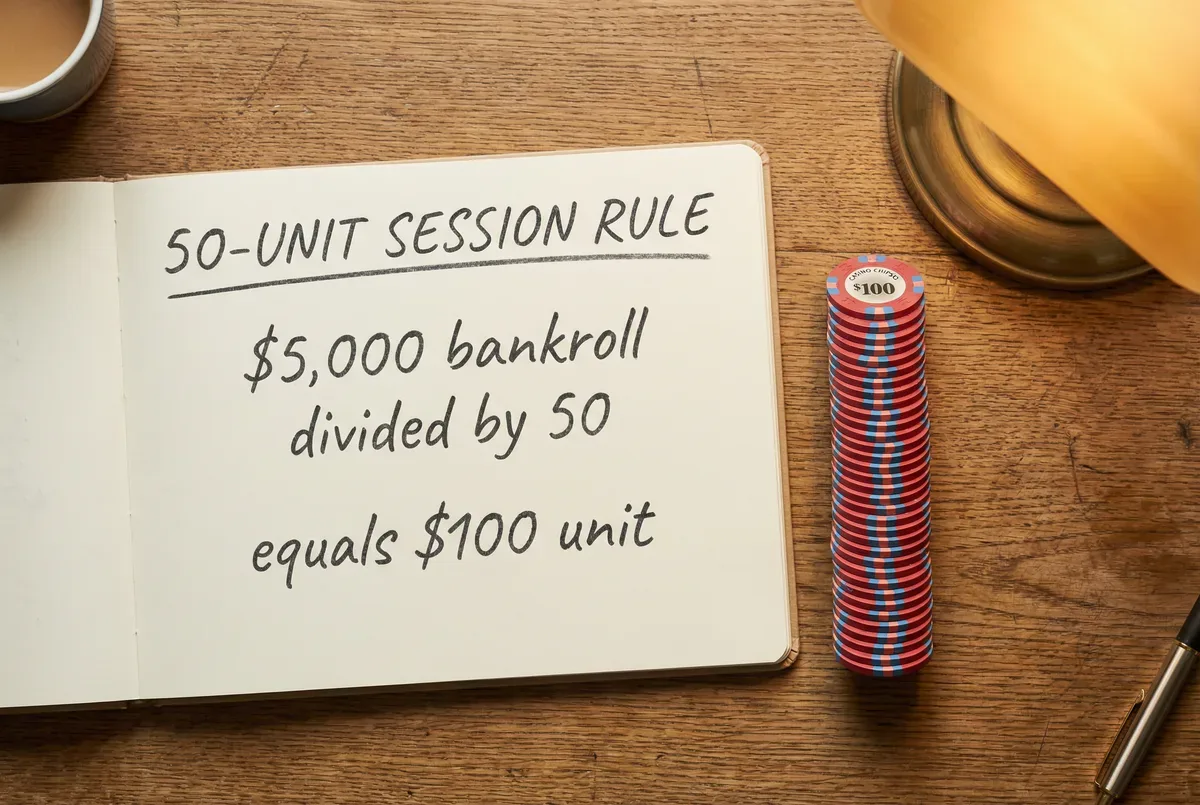
The 50-unit session betting rule specifies that any single blackjack session should be funded with exactly 50 units no more and played until either the session bankroll is depleted (stop-loss at 50 units) or a predetermined stop-win is reached. The unit is defined as your standard flat bet. For a $10 player, 50 units is $500; for a $20 player, $1,000. The rule is effective for two reasons simultaneously. First, it caps maximum single-session loss at 50 units, protecting the total bankroll from catastrophic drawdowns that would require months of winning sessions to recover. Second, it enforces bet-sizing discipline since the session fund is defined upfront, there is no ambiguity about whether a bet is proportionally appropriate. Every bet is 1/50th of the session allocation by construction.
What the 50-Unit Rule Is and Why It Works
The 50-unit session rule is not a strategy for winning it is insurance against losing the entire bankroll in a single variance event.
Solvency Rule
What Are the Mathematics of Session Ruin at 50 Units?
In a standard blackjack game at 0.5% blackjack house edge, the probability of losing 50 consecutive units in a session is extremely low but the probability of losing 50 units through the normal variance process of a multi-hundred hand session is non-trivial. At a standard deviation of 1.15 units per hand, the probability of being down 50 units or more after 200 hands is approximately 2–5% per session. This is the stop-loss threshold that the 50-unit rule activates. By naming 50 units explicitly and pre-committing to stop at that level, the rule converts a frightening abstract risk into a defined, manageable parameter. When the stop-loss is hit at 50 units, the session has ended as expected and the remaining 90–95% of total bankroll is intact.
The complementary benefit is bankroll longevity calculation. With a 300-unit total bankroll and a 50-unit session rule, the theoretical maximum number of consecutive full-loss sessions before total ruin is 6. In practice, most sessions do not reach the 50-unit stop-loss typical sessions end within a ±20 unit range of starting balance. The six-session maximum is a worst-case scenario that forces an honest question: is my total bankroll large enough to sustain this session unit size? If six consecutive maximum-loss sessions would deplete your bankroll, you are over-sized at your current unit level.
Dealer Shows
Your Hand
You have hard 16 (9-7) vs dealer Ace. You are at 45 units down this session, 5 units from your stop-loss. Do you surrender?
Hard 16 vs dealer Ace should be surrendered wherever available. Expected value of surrender (-50%) exceeds expected value of hitting (-51% to -56% depending on shoe composition). Being near your session stop-loss does not change the correct strategy decision it makes correct execution even more important. Surrender here; honor your stop-loss if the next hand completes the depletion.
How Do You Implement the Rule Across Different Player Levels?
The 50-unit rule scales cleanly across bet sizes. A $5 player operating with a $250 session fund faces $250 maximum loss per session on a $1,000 total bankroll (25% session risk per session). A $25 player operating with a $1,250 session fund on a $5,000 total bankroll faces the same 25% proportional risk. The proportional structure is what makes the rule universally applicable it does not depend on absolute dollar amounts, only on the relationship between session allocation and total bankroll.
If you find the 50-unit rule feels too restrictive that $500 does not feel like enough for a four-hour session at $10 the correct adjustment is to reduce your unit size, not increase the session allocation. A $10 player who wants a more comfortable session at a higher limit is a $5 player at that table, not a $10 player with a 100-unit fund.
What Are Common Modifications and Their Risk Implications?
Some experienced players modify the 50-unit rule with a rolling stop-loss once the session is up by 10 units, the effective stop-loss moves from starting balance to -10 units from peak, protecting partial profits while allowing continuation. This modification is psychologically satisfying but adds complexity and can create inconsistent session termination behavior. For players who find the rigid 50-unit rule difficult to honor, the simpler version is more protective in practice than the modified version used inconsistently.
Increasing the session fund to 75 or 100 units after a strong winning period is a common error it expands session risk at precisely the moment when variance may be preparing a correction. Session fund size should change only when the total bankroll has grown enough to support the larger allocation at the same proportional risk. Never increase session allocation in response to recent results.
Prove the Rule Works at Real Stakes
The 50-unit rule is most convincingly tested at test this approach with real stakes tonight in your next session, where real money ensures the session stop-loss carries genuine financial weight. Load the session with exactly 50 units at your current bet size, track the running balance against your stop-loss, and honor the stop precisely when it is reached. Do this for ten consecutive sessions and review the results: how many sessions hit the stop-loss, how many hit your stop-win, and what the net outcome across all ten sessions looks like in units and dollars. That data set is the most convincing argument for or against your current session sizing.
Frequently Asked Questions
50 units balances session duration against solvency protection. 30 units depletes too quickly in normal variance, reducing session playing time below practical minimums. 100 units provides no meaningful ruin protection relative to total bankroll. 50 units gives approximately 2–4 hours of play at typical hands-per-hour rates while capping single-session maximum loss at a manageable fraction of total bankroll.
Stop playing. The rule has no exceptions for time remaining, streak corrections, or any other consideration. The stop-loss exists precisely for the situation you are in: variance has run against you to the maximum the rule defines. Continuing past the stop-loss converts a managed loss into an unmanaged one.
No. Mid-session replenishment defeats the entire purpose of the stop-loss. If you replenish after hitting 50 units down, you have a 100-unit stop-loss dressed as a 50-unit rule. Define your session fund before you sit down and treat it as inviolable.
Before you test these plays at a real table, run them through our free blackjack simulator practice unlimited hands at zero cost until every move becomes automatic.
Mathematical Risk Warning
The 50-unit session rule caps single-session loss risk but does not eliminate it. Variance will eventually hit maximum stop-loss sessions. The rule protects your total bankroll from single-session catastrophe it does not prevent losses entirely.
Blackjack Academy is an educational resource. All strategy is based on mathematical expectation. Always play within your means.
Learn More
Continue your education with these related lessons.

10000 Hour Roadmap to Becoming a Professional Player
The path from recreational player to professional blackjack advantage player takes years of deliberate practice, substantial capital, and an honest…

Why the Labouchere Betting System Fails Long-Term Blackjack Players
The Labouchere system uses a number sequence to determine bet sizes. Wins cancel numbers from the ends. Losses add numbers.…
Simple 5 Minute Strategy Check Before You Sit Down
A five-minute pre-session check is the single highest-return investment a blackjack player can make before risking a dollar. Most players…