
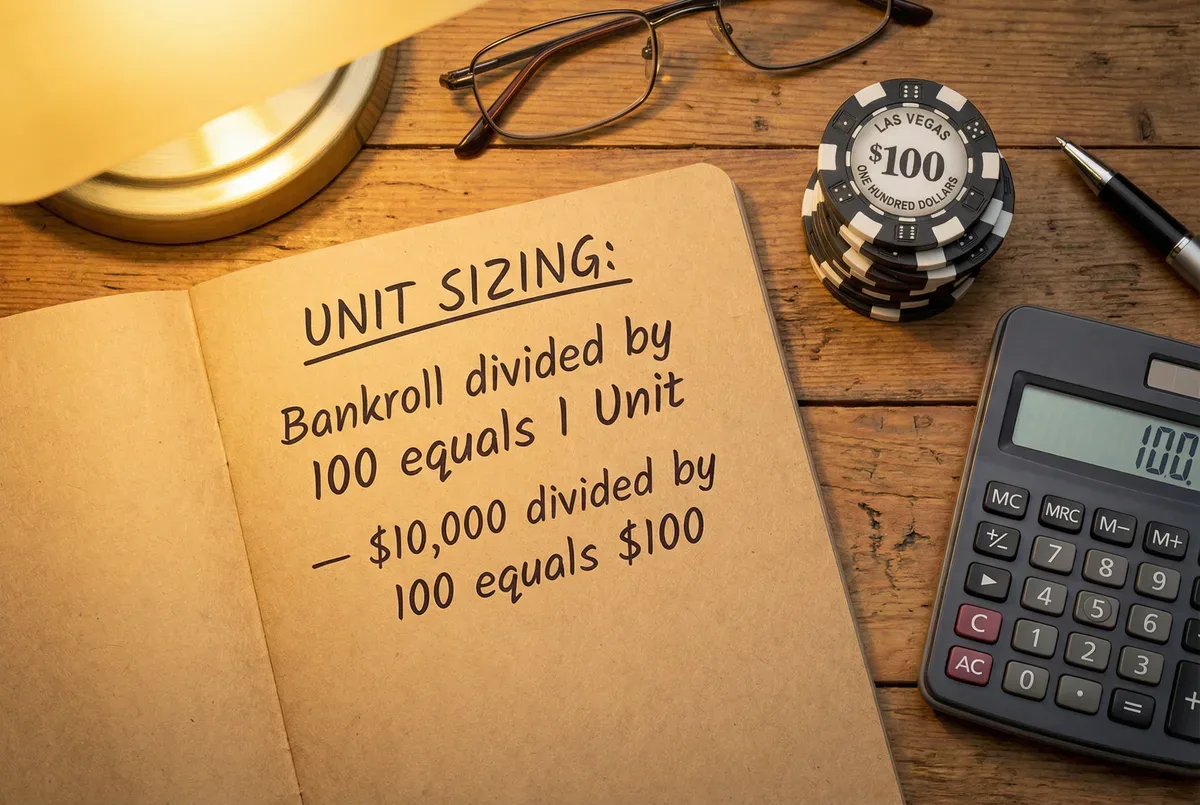
How to Size Your Units for Professional Blackjack Play
The Kelly Criterion is a mathematical formula for calculating the optimal bet size that maximizes long-run bankroll growth. For a player with edge e (expressed as a decimal) and standard deviation s per unit, the Kelly fraction is e/s². For a card counter with 1% edge and 3-unit standard deviation per hand: Kelly fraction = 0.01 / 9 = 0.0011, or approximately 0.11% of bankroll per unit. A $100,000 bankroll produces a Kelly unit of approximately $110 a figure that feels small relative to the bankroll but is mathematically optimal for growth rate maximization.
Professional Unit Sizing Starts With the Kelly Criterion as a Reference Point
In practice, professional players use fractional Kelly typically 25–50% of the full Kelly fraction to reduce variance while sacrificing a limited amount of growth rate. At 50% Kelly, the same $100,000 bankroll produces a $55 unit. At 25% Kelly, a $27 unit. The variance reduction from fractional Kelly is substantial: at 25% Kelly, the standard deviation of bankroll outcomes is roughly half of full Kelly, which means fewer periods of deep drawdown and more sustainable long-run play.
For non-counting recreational players, Kelly does not apply because there is no positive edge to size around. Recreational unit sizing uses the 1/200th rule (bankroll ÷ 200 = unit) as a proxy for the bankroll survival requirements described in risk of ruin calculations.
- Recreational (flat bet)bankroll ÷ 200 = unit size
- Conservative counter25% Kelly × edge / variance²
- Standard counter50% Kelly × edge / variance²
- Aggressive counterfull Kelly (maximum volatility)
- Team playper-player bankroll allocation varies by bank structure
What Is SCORE?
SCORE (Standardized Comparison Of Risk and Expectation) is a metric developed by Don Schlesinger in “Blackjack Attack” to compare game conditions for counters. SCORE combines win rate, risk, and standard deviation into a single number that allows comparison across different blackjack table rules, deck counts, and penetration levels. A game with SCORE of 50 is twice as good as a game with SCORE of 25, assuming the same bankroll and unit sizing.
For professional unit sizing, SCORE provides the optimal bet spread and base unit for a given bankroll and risk tolerance target. A counter targeting a 13.5% risk of ruin over a given bankroll lifetime uses SCORE tables to determine the correct bankroll-to-unit ratio for their specific game conditions. This level of precision matters because different games with identical felt-level conditions (same table minimum, same number of decks) can have dramatically different optimal unit sizes due to penetration, rule variations, and reshuffling frequency.
SCORE calculations are beyond the scope of casual play they require access to simulation data for specific game conditions. The practical takeaway is that professional unit sizing is not a one-size-fits-all calculation. It is game-specific, and the difference between the best and worst available game in a casino can double the optimal unit for the same bankroll.
Dealer Shows
Your Hand
You are counting cards and the true count is +4. You have soft 17 (A-6) against dealer 2. What is the correct play at a table where you should stand on soft 17 against 2?
Basic strategy says stand on soft 17 vs dealer 2 (in many shoe games). However, the counting index for this deviation is approximately TC +1 meaning at TC +4, doubling soft 17 vs dealer 2 is the correct play. Professional unit sizing ensures your double bet here is within your calculated spread.
What Is the Bet Spread Design for Maximum Edge Extraction?
Professional counters design bet spreads that maximize win rate while minimizing casino detection. A 1–12 spread in a 6-deck game means betting 1 unit at neutral or negative counts and 12 units at high positive counts. The exact bet-ramp design (which count level triggers which bet size) affects both win rate and heat management. Steep ramps (jumping from 1 to 12 in two steps) generate more win rate but are more obviously unnatural to surveillance. Smooth ramps (1, 2, 4, 8, 12 across a range of count levels) generate slightly less win rate but are harder to detect.
Lock In Your Unit Size Before the First Hand
The base unit in the spread is the Kelly-derived unit at the minimum bet level. The spread’s maximum is 12 times that unit. Both are bounded by the same bankroll calculation: the maximum bet in the spread should stay within 2% of your total playing bankroll, and the overall bankroll should contain 400–500 units of the minimum bet.
Start every counting career at a 1–4 spread rather than 1–12. The lower spread generates less edge but far less heat, longer playing career at each casino, and more time to refine bet-ramp execution before the larger bets attract attention. A player who lasts 200 sessions at 1–4 generates more total EV than one who is backed off after 20 sessions at 1–12.
Applying Professional Sizing Standards in Live Conditions
Professional unit sizing is only valuable if it is applied consistently across every session. At test this in a live session with real money under pressure, test your calculated unit size in live conditions before committing it to higher-stakes games. Real money reveals whether your unit sizing feels comfortable under actual variance and discomfort with your unit size during a drawdown is a strong signal that the size is too large relative to your psychological risk tolerance. Only play with funds completely budgeted for entertainment, and treat each live session as a calibration exercise to confirm that your bankroll math and your emotional reality are in alignment.
Frequently Asked Questions
The Kelly Criterion is designed for players with a positive edge and optimizes bankroll growth rate. The 1/200 rule is designed for players with a negative edge (recreational players) and optimizes bankroll survival. They address different problems. Applying Kelly to a negative-edge game produces a bet of zero because Kelly says never bet on a negative edge if you can avoid it.
No. Betting above Kelly produces reduced expected growth rate and increased variance simultaneously a double penalty. Even believers in aggressive Kelly sizing typically cap at full Kelly. Overbetting Kelly is one of the most reliable ways to destroy a counting bankroll faster than expected despite having a genuine edge.
Consult a betting index table for your counting system (Hi-Lo, KO, etc.) at your specific deck count and penetration. These tables list the true count values at which each bet increment becomes mathematically justified. Many blackjack strategy books include these tables, and several online resources provide them for common counting systems.
Before you test these plays at a real table, run them through our free blackjack simulator practice unlimited hands at zero cost until every move becomes automatic.
Mathematical Risk Warning
Professional unit sizing and Kelly-based calculations apply to players with a verified positive edge through card counting. Recreational players have a negative edge and should size bets using the 1/200 bankroll rule for survival rather than growth optimization. Applying growth-optimization sizing to a negative edge game accelerates bankroll depletion.
Blackjack Academy is an educational resource. All strategy is based on mathematical expectation. Always play within your means.
Learn More
Continue your education with these related lessons.
How to Lock in Profits Using Positive Progression Betting
Positive progression betting locks in profits by pressing bets only with winnings, so any loss returns you to your starting…
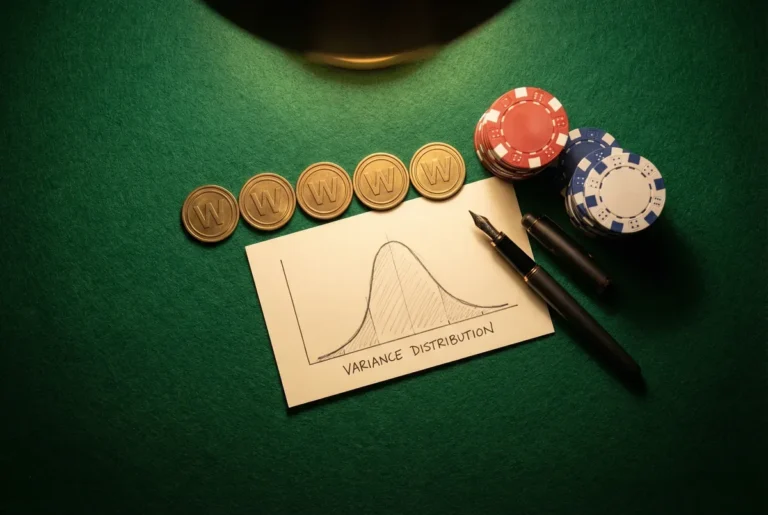
Why Winning Streaks are Just Short Term Statistical Variance
Winning streaks feel like momentum, but the mathematics say otherwise. Every hot run in blackjack is a cluster of positive…
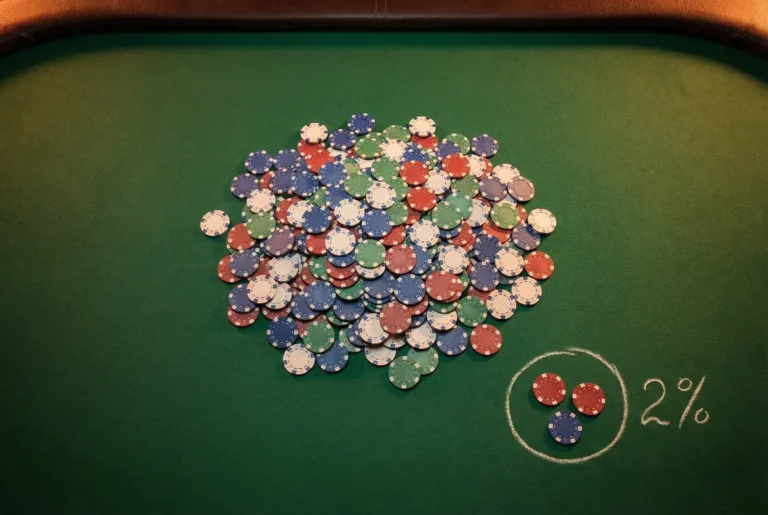
Why You Should Never Bet More Than 2 Percent of Your Bankroll
The 2% rule is the mathematical ceiling that keeps your blackjack bankroll alive through losing streaks. This post explains exactly…