
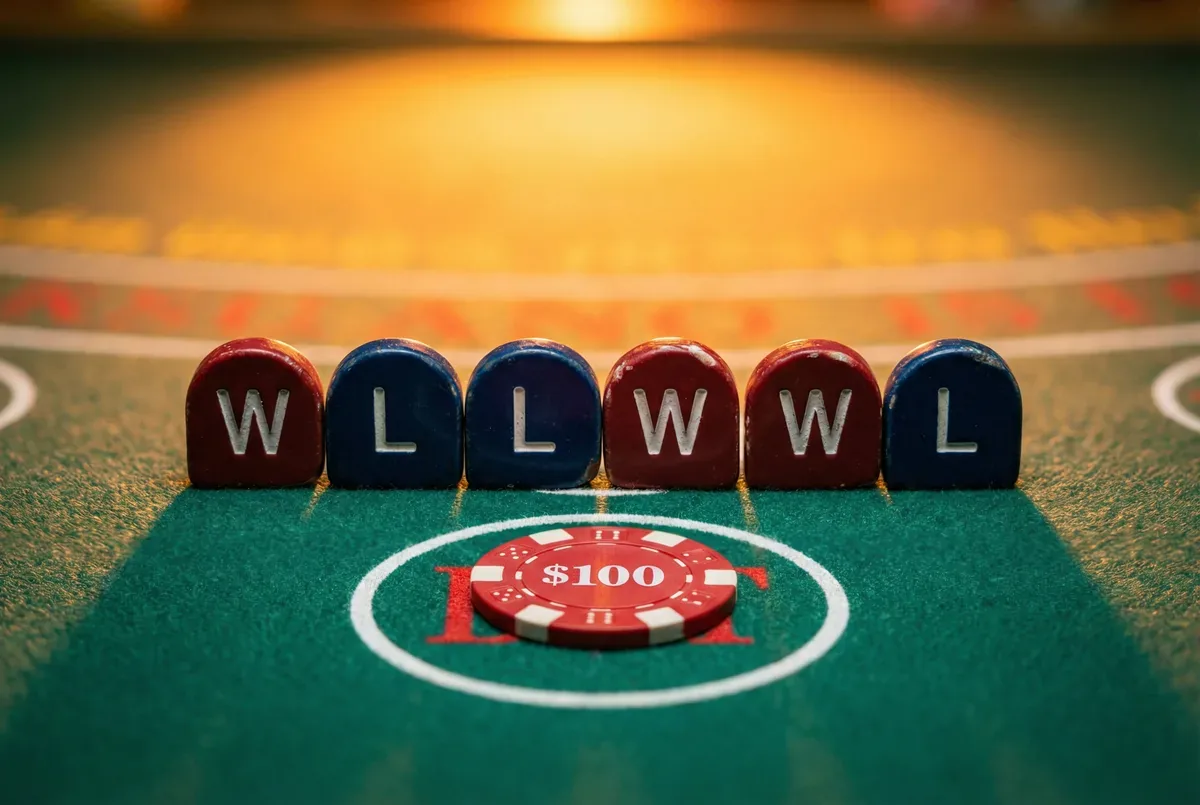
Why Past Hands Have No Effect on Your Future Results
Statistical independence means that the outcome of one event has zero effect on the probability of the next event. Each blackjack hand after a shuffle is drawn from a shuffled deck with fixed probabilities. The dealer does not know that you just lost five hands, and the cards do not know either. The probability of winning your next hand is determined entirely by the deck composition and the rules in play, not by the result of any previous hand you have played at that table or any other.
Each Blackjack Hand is a Statistically Independent Event
This principle is the mathematical foundation that makes the gambler’s fallacy the belief that a losing streak makes a win more likely, or that a winning streak must eventually end provably false. The fallacy arises because humans are pattern-recognition machines. We see five consecutive losses and feel that the probability distribution must compensate. It does not. The shuffled cards carry no debt to previous outcomes.
This is not just philosophical it has direct, measurable consequences for how you should size your bets and make decisions at the table. Any strategy that adjusts bet size based on previous outcomes rather than current deck composition is operating on a false premise.
A deck of cards has no memory. It cannot owe you a win, and it cannot punish you for winning too much. Every hand begins from a mathematically neutral position relative to prior results.
Axiom
What Is the One Exception?
There is a critical nuance to statistical independence in blackjack: it applies to fully shuffled fresh decks. Within a single shoe that has not been reshuffled, the cards dealt in previous hands do affect the composition of the remaining deck. A shoe that has produced many small cards in early hands contains proportionally more high cards in the remaining deck and that composition shift is real and exploitable.
This is the mathematical basis for blackjack card counting. Counters are not tracking patterns or streaks they are tracking card composition changes that genuinely alter the probability of favorable hands. A positive count means the remaining shoe contains more high-value cards, which benefits the player through more blackjacks, better doubles, and more dealer busts. This is different from the gambler’s fallacy because it is based on actual remaining deck composition, not imagined debt for past outcomes.
For non-counters, this distinction does not provide actionable information tracking composition accurately enough to use it requires specific training. The practical takeaway for all players: do not adjust bets based on recent win/loss patterns. Adjust bets based on bankroll rules and if counting based on the true count only.
Common Myth
“After five losses in a row, I am due for a win”
Streaks feel like they must balance out too many heads means tails is 'overdue'
The Reality
A fair coin has a 50% chance of heads on every flip regardless of previous results. Blackjack hands are not fair coins (the house has an edge), but they are equally independent of prior outcomes
The expected value of the next hand after five losses is identical to the expected value after five wins. History does not change probability.
Why This Truth Matters for Betting Decisions?
The practical implication is that betting systems based on previous outcomes any system that says “bet more after a loss” or “bet more after a win because the streak is continuing” are making bets based on information that has no statistical validity. The Martingale doubles after losses on the false premise that a win is more likely after losses. Streak-following systems press bets after wins on the equally false premise that streaks continue with higher probability.
Why Should You Hold Your Bet Steady Through Every Streak?
Flat betting avoids both errors entirely. When you bet the same amount on every hand, you are implicitly acknowledging that past results have no bearing on current decisions which is the mathematically correct position for non-counters.
Each blackjack hand is statistically independent the previous 50 hands have literally zero effect on hand 51. A coin flip never 'knows' it just landed heads seven times. The gambler's fallacy costs recreational players more money than poor strategy decisions.
Testing Independence Resistance in Live Play
The gambler’s fallacy is most powerful when you are at the table and feeling it. At run this with real money at a live table immediately, observe your instincts during a cold streak the sense that the next hand must go your way. Notice it, name it, and consciously hold your bet size steady. Real money on the line makes the fallacy feel urgent rather than abstract. Only risk funds budgeted entirely for entertainment, and treat every hand where you maintain flat-bet discipline despite the urge to “press for the comeback” as a successful execution of the principle.
Frequently Asked Questions
Confirmation bias. You remember losing streaks more vividly and emotionally than winning streaks of equal length. Losing streaks feel like patterns; winning streaks feel like natural results. Mathematically, positive and negative variance clusters are equally probable and equally common our perception is simply not neutral.
Yes, in theory. Expert shuffle trackers who can predict the approximate position of clumps of cards after a non-random shuffle are working with genuine compositional information, similar to counting. This is legal but extremely rare and difficult. For standard shuffled-deck play, independence applies completely.
Mathematically, no. A different table does not reset your probability or improve your odds. However, if a table is producing emotional distress that is affecting your decision-making, leaving is a sensible psychological reset just not because the new table will be 'luckier.'
Before you test these plays at a real table, run them through our free blackjack simulator practice unlimited hands at zero cost until every move becomes automatic.
Mathematical Risk Warning
Betting systems that adjust stakes based on previous hand outcomes have no mathematical basis for doing so. Past results do not influence future hand probabilities in a shuffled deck. All strategic betting should be based on bankroll rules and card counting (when applicable), not on perceived streaks or patterns.
Blackjack Academy is an educational resource. All strategy is based on mathematical expectation. Always play within your means.
Learn More
Continue your education with these related lessons.
Why Sticking to Your Tactical Plan and Leaving Early Wins More Money
Walking away early before a session ends naturally is one of the most underrated professional skills in blackjack. A tactical…
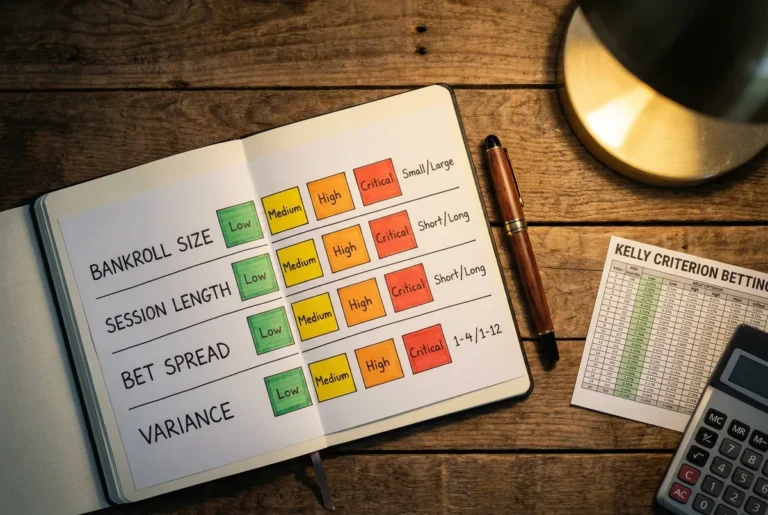
Proven Risk Assessment Frameworks for Better Blackjack Betting Decisions
Professional gamblers do not rely on intuition for risk decisions. They use structured frameworks to quantify exposure before committing capital.…
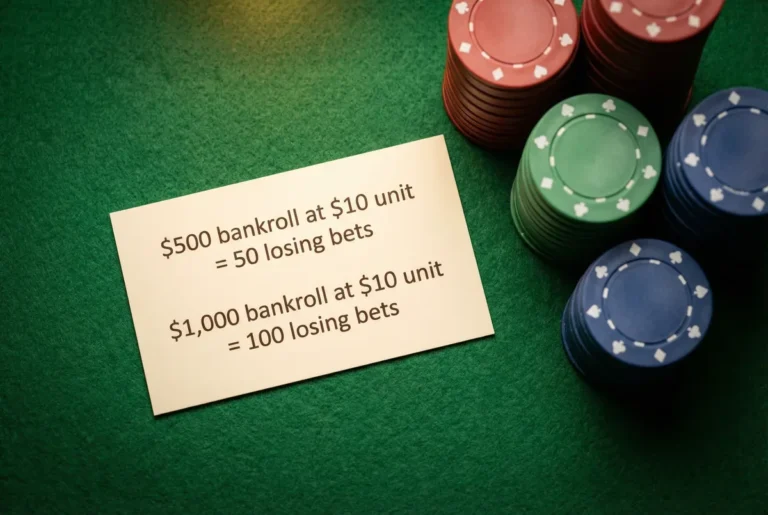
How Long Your Blackjack Bankroll Will Last with Worked Calculations
How long will your blackjack bankroll last? The formula is bankroll divided by (house edge × average bet × hands…