
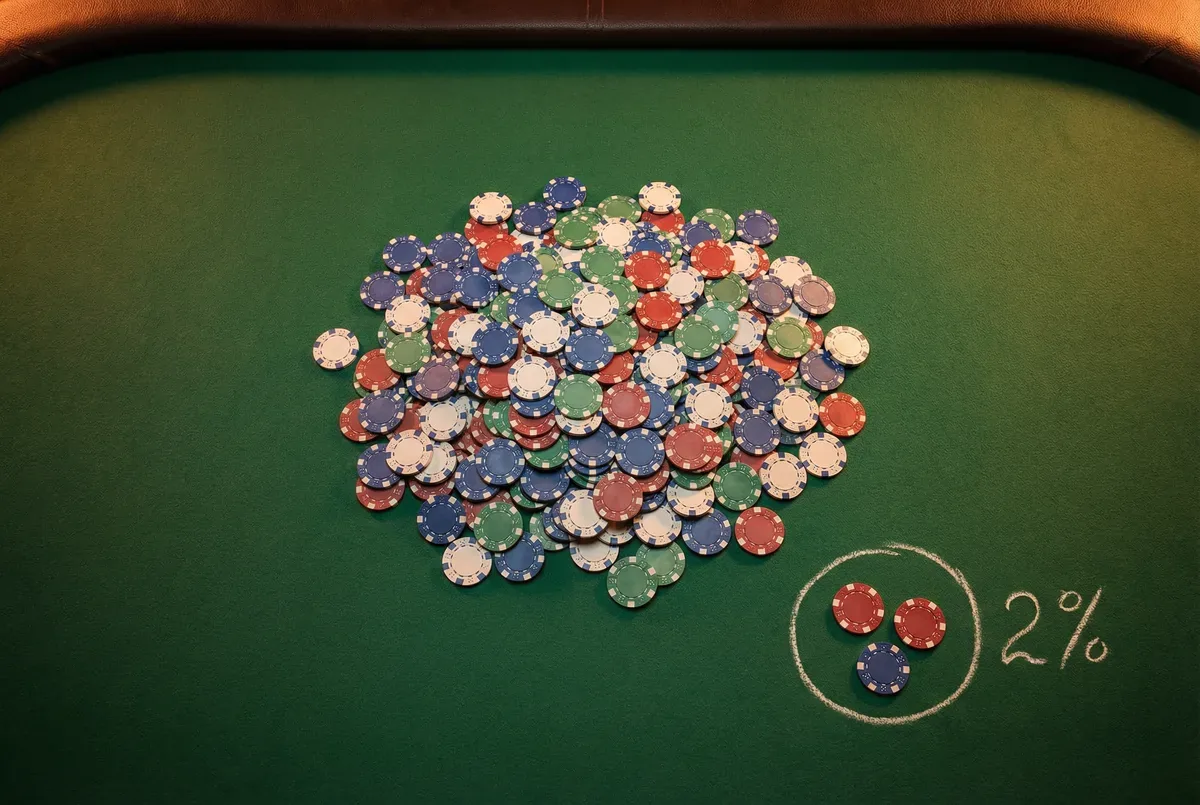
Why You Should Never Bet More Than 2 Percent of Your Bankroll
Betting more than 2% of your total bankroll on any single blackjack hand is the fastest path to ruin that does not involve a cheating dealer. The mathematics are unambiguous: as your bet size increases relative to your bankroll, the probability that a routine losing streak eliminates your entire stake climbs sharply and non-linearly. A player betting 5% of their bankroll faces roughly four times the bust-out risk of a player betting 2%, even though the actual bet difference seems trivial in dollar terms.
The 2 Percent Rule is the Most Important Number in Gambling Finance
This rule exists because blackjack is a game of small edges and high variance. Even with near-perfect blackjack basic strategy, a single session can produce a 15–20 unit downswing through completely normal statistical fluctuation. At 2% per unit, a 20-unit loss is a 40% bankroll reduction painful but survivable. At 5% per unit, the same cold streak is a complete wipeout.
The rule applies equally to flat bettors and progression bettors. The percentage constraint is a ceiling, not a floor. Betting 1% or 0.5% is always safer but 2% is the outer boundary that quantitative gambling analysts use when modeling survival probability over thousands of hands.
- 1% per hand → Risk of ruinunder 1%
- 2% per hand → Risk of ruinapproximately 3%
- 3% per hand → Risk of ruinapproximately 12%
- 5% per hand → Risk of ruinapproximately 40%
- 10% per hand → Risk of ruinover 80%
Why Variance Makes Oversizing Catastrophic Even for Skilled Players?
Standard deviation in blackjack is approximately 1.1 units per hand for a flat bettor. Over 100 hands, the one-standard-deviation range is roughly plus or minus 11 units. That means in a normal session, you could easily be down 22 units at the two-sigma level and that happens to skilled players all the time without any mistakes involved. If each of those units represents 5% of your bankroll, you are already broke at the two-sigma mark, and no one would label that session unusual.
Oversizing also distorts decision-making at the table. When a single hand represents a meaningful portion of your total funds, the psychological pressure changes your choices. You stand when you should hit, skip doubles when the math screams for them, and refuse splits that have positive expected value. The 2% ceiling is partly about math and partly about keeping decisions emotionally neutral.
Card counters using a 1–12 spread have an additional constraint: the maximum bet in the spread should also stay within 2% of the total bankroll. This sounds conservative, but counting bankrolls are typically calculated at 400–500 units of the maximum spread bet precisely because the variance at high bets is severe enough to require that cushion.
Common Myth
“Bigger bets mean I recover losses faster”
It feels logical larger bets should produce larger wins to offset recent losses
The Reality
Bigger bets also mean larger losses on every subsequent bad hand, and the probability of those losses is identical to the probability of wins
Oversizing a bet to recover losses has zero effect on EV and dramatically increases ruin probability
How Do You Calculate Your Personal 2 Percent Ceiling?
The calculation is arithmetic: take your total dedicated blackjack bankroll and multiply by 0.02. A $500 bankroll produces a $10 maximum bet. A $1,000 bankroll produces a $20 maximum bet. A $5,000 bankroll produces a $100 maximum bet. These are hard ceilings you never cross them regardless of how good you feel about the shoe or how badly you want to recover a deficit.
How Do You Build a Session Plan Around the 2 Percent Rule?
If the table minimum exceeds your 2% ceiling, the table is wrong for your current bankroll. Playing a $25 minimum table with a $500 bankroll means risking 5% per hand a size that will produce ruin in a typical session. The correct response is to find a lower-limit table, not to ignore the rule because it is inconvenient. Many online casinos offer $1 and $5 minimums specifically because players need access to tables that match their bankroll math.
Before every session, write your 2% number on your phone notes. When you sit down and feel the urge to size up because 'the count is good' or 'I'm due for a win,' look at that number. The mechanical reminder breaks the emotional override before it takes hold.
Putting the Rule Into Practice at a Real Table
The discipline of staying at or below 2% per hand is best tested in live conditions before you apply it for real. At test this stake level at a live table under pressure, you can practice exact bet sizing against real dealer mechanics. Remember that once real money is involved, every session carries genuine financial consequences only play with funds you have fully budgeted for entertainment, and treat each hand as a chance to build the habit of constraint rather than a chance to make back yesterday’s session.
Frequently Asked Questions
Yes, and arguably it applies more strictly to bonus play because wagering requirements can force you to play more hands than planned. Calculate your maximum bet based on your total bankroll including the bonus, and stay within 2% even if the bonus terms allow larger bets.
Walk away from that table. Playing at a minimum that exceeds your 2% ceiling is accepting a dramatically elevated risk of ruin. Find a lower-limit table, or reduce your session to a smaller buy-in at a lower-stakes venue until your bankroll grows to match the table.
Yes. Some analysts recommend dropping to 1% or even 0.5% during extended downswings to preserve capital. The 2% figure is the maximum in good conditions during a rough stretch, shrinking your unit further extends your bankroll survival and keeps you in the game long enough for variance to mean-revert.
Before you test these plays at a real table, run them through our free blackjack simulator practice unlimited hands at zero cost until every move becomes automatic.
Mathematical Risk Warning
No bet-sizing rule eliminates the house edge. The 2% rule reduces the speed at which that edge erodes your bankroll, but does not reverse it. Extended play at any percentage will trend toward the mathematical expectation, which is negative for all non-counting strategies.
Blackjack Academy is an educational resource. All strategy is based on mathematical expectation. Always play within your means.
Learn More
Continue your education with these related lessons.
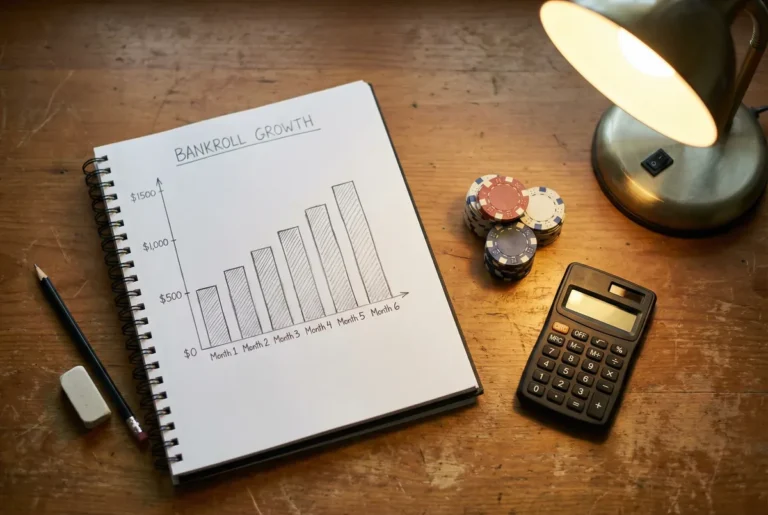
Proven Bankroll Growth Strategy for Recreational Blackjack Players
When should a recreational player move up to higher stakes? The 300-unit rule, how to manage winnings, and the structural…

How Table Speed Increases or Decreases Your Variance
Table speed measured in hands per hour directly controls how quickly variance resolves and how quickly house edge accumulates. Knowing…

What 100 Million Hand Simulations Teach Us About Winning
Running 100 million hand simulations reveals truths about blackjack that no single session can show. From strategy deviations to betting…