
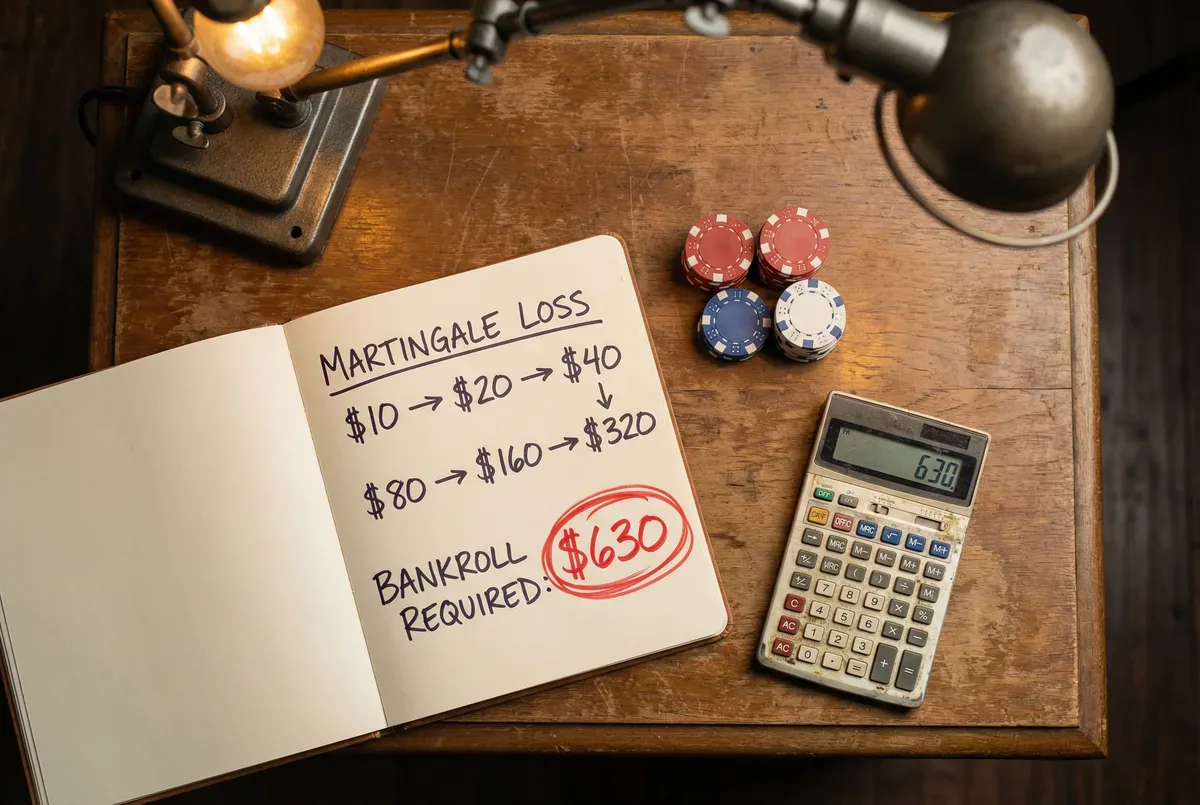
Why Negative Progression Systems Require a Massive Bankroll
A negative progression betting system is any system that increases bet size following a loss. The logic is that after a loss, the next win will more than recover previous losses. The mathematical reality is that negative progressions require a bankroll large enough to survive the worst-case losing streaks that naturally occur in normal play and those streaks are far deeper than most players plan for. The capital requirement to use any negative progression safely is dramatically higher than most users realize.
Negative Progressions Require Enough Capital to Survive Losing Streaks That Always Arrive
The Martingale requires doubling after every loss. Starting at $10, a 7-loss streak (which happens roughly once every 128 sequences) demands an $1,280 bet on the eighth hand. To be safe against 10 consecutive losses at a $10 start, you need $10,230 in reserve just to make a net $10 profit. The capital-to-profit ratio is grotesquely inefficient for any realistic stake level.
Less extreme negative progressions the D’Alembert (add one unit after a loss), the Labouchere (cross off a number sequence) require smaller capital additions per loss but still demand substantial bankroll depth because losing streaks extend further than the systems’ typical design assumes.
| System | Capital for 7-loss streak ($10 start) | Capital for 10-loss streak ($10 start) |
|---|---|---|
| Martingale | ||
| $1,270 on table | ||
| $10,230 at risk;Labouchere (typical) | ||
| $150–$350 depending on sequence | ||
| $300–$700;D'Alembert | ||
| $280 (10+9+8...+4) | ||
| $550;Flat betting | ||
| $70 max | ||
| $100 max |
What Is the D’Alembert and Labouchere?
The D’Alembert system adds one unit after a loss and subtracts one unit after a win, aiming for a natural balance. It is far less extreme than the Martingale, but still produces significant capital requirements during extended losing runs. After 10 consecutive losses starting at 1 unit, a D’Alembert player is betting 11 units per hand and has accumulated losses of 55 units. A $10 base at 55 units means $550 at risk to recover $10 per win still an inefficient use of capital.
The Labouchere system is more complex: you write a sequence of numbers (such as 1-2-3-4), and your bet is the sum of the first and last numbers. After a win, you cross them off. After a loss, you add the bet amount to the end of the sequence. Completing the sequence earns the sum of all original numbers as profit. The problem is that multiple losses extend the sequence, and the required bets can grow substantially before the sequence closes. Extended bad runs can produce sequences of 15–20 numbers requiring large bets to reach completion.
Both systems share the fundamental flaw of all negative progressions: they assume losing streaks are short. When losing streaks are longer than designed for which they regularly are in real blackjack play the capital requirement exceeds both the player’s bankroll and often the table’s maximum bet.
Common Myth
“The D'Alembert is safe because it only adds one unit after a loss”
One unit at a time sounds small and manageable
The Reality
During a 20-loss sequence, a D'Alembert player is betting 21 units per hand. Starting at $10, that is $210 per hand to recover $10 per win
Any system that increases bet after losses will eventually encounter a losing streak deep enough to exhaust either the bankroll or the table maximum
How Do You Calculate the True Capital Requirement for Your System?
Before adopting any negative progression, calculate the maximum bet you would need to place after a 10-loss streak and the total capital required to reach that point. Then ask: does this amount exist in your actual bankroll? If the answer is no, the system will eventually force you into a situation where you cannot make the required bet at which point the system’s theoretical recovery mechanism breaks down entirely.
What Happens When Your Bankroll Cannot Cover the Next Required Bet?
The honest capital requirement calculation for the Martingale at $10 base: you need $10,230 available to safely ride out a 10-loss streak. If you have $1,000, your Martingale at $10 base will fail on any 7-loss streak ($1,270 required vs $1,000 available). 7-loss streaks happen approximately once in every 128 independent sequences. At 60 sequences per hour, you will hit one in roughly 2 hours of play not a rare event.
Before using any negative progression, do this calculation: starting bet × 2^10 (for Martingale) or starting bet × 55 (for D'Alembert after 10 losses). Compare to your actual bankroll. If the required capital exceeds your bankroll, the system will fail before a significant losing streak ends. Most players discover at this point that their chosen system requires far more capital than they have.
Testing Negative Progression Capital Requirements in Real Conditions
The moment a negative progression fails when the bankroll cannot cover the required next bet is far more common than theory suggests. At test this stake level at a live table in your next session, test any negative progression with a realistic session bankroll and observe exactly how many hands it takes before a normal losing streak exceeds your prepared capital. Real money sessions provide the genuine consequence of this discovery. Only use funds fully budgeted for entertainment, and treat the capital failure point as education rather than catastrophe it is better to learn the system’s limit in a budgeted session than to encounter it for the first time at high stakes.
Frequently Asked Questions
All negative progressions require capital proportional to the depth of potential losing streaks. Slower progressions (D'Alembert, 1-unit-add systems) require less capital than Martingale for equivalent streak depth, but still require substantially more than flat betting. No negative progression eliminates the capital requirement for streak survival.
Yes. Using a negative progression with a loss limit stopping when total losses hit a pre-set amount rather than continuing to completion limits capital exposure but also limits the system's recovery mechanics. At the hard stop, any accumulated losses are realized rather than potentially recovered. This reduces capital risk at the cost of removing the system's theoretical recovery advantage.
At a starting sequence of 1-2-3, the Labouchere minimum starting bankroll is approximately 50–100 units to provide reasonable depth for losing sequences to extend and close. At $10 per unit, that is $500–$1,000 minimum substantially more than flat betting requires for the same expected loss rate.
Before you test these plays at a real table, run them through our free blackjack simulator practice unlimited hands at zero cost until every move becomes automatic.
Mathematical Risk Warning
Negative progression betting systems require substantially larger bankrolls than flat betting to survive normal losing streaks. The capital requirements for systems like the Martingale are beyond most recreational players' budgets at any stake level where real profit is meaningful. Always calculate required capital before adopting a negative progression.
Blackjack Academy is an educational resource. All strategy is based on mathematical expectation. Always play within your means.
Learn More
Continue your education with these related lessons.

How Much Money You Really Need for a Blackjack Session
The answer to 'how much should I bring?' depends entirely on your bet size, session length, and risk tolerance. This…

Warning Signs When Blackjack Stops Being Fun and Becomes a Problem
Problem gambling is not always dramatic. It often begins as small pattern shifts that are easy to rationalize. Learning to…

Why Setting a Stop Win is a Critical Professional Skill
A stop-win rule is not pessimism about your ability to keep winning. It is the mathematical recognition that every hand…