
How to Lock in Profits Using Positive Progression Betting
Locking in profits through positive progression betting works because when you press your bet after a win, the increased wager is funded by the prior hand’s winnings rather than your original stake. If that pressed bet loses, you return to your base unit, having netted a profit on the hand you won and lost the profit on the subsequent hand but your original stake remains intact. This is the fundamental profit protection mechanism that makes positive progressions structurally safer than negative ones for managing session gains.
Positive Progressions Lock in Profits by Funding Escalations Entirely from Winnings
The key distinction is between pressing with profit and pressing with capital. Pressing with profit: you win $10, let it ride for $20 next hand, lose you are back to your original position ($0 net change from two-hand sequence). Pressing with capital: you lose $10, bet $20 to recover, lose again you are down $30 from the same two-hand sequence. Positive progressions exclusively do the first; negative progressions exclusively do the second. The asymmetry of outcomes is dramatic.
The practical profit-locking rule: treat every base unit bet as playing with your bankroll. Treat every escalated bet in a positive progression as playing with winnings. When the progression resets to base unit, no matter what happened above base level, your original stake is intact.
A positive progression bet above your base unit is a profit already banked being placed back at risk. If it loses, only that profit is gone. Your bankroll is exactly where it was when the progression started.
Axiom
What Are the Mechanics of Profit Protection in the Paroli and 1-3-2-6?
In the Paroli, after two consecutive wins with a 1-unit base, you have $30 in front of you (original $10 + $10 win + $10 win on $20 bet) and are about to bet $40 on hand 3. If hand 3 loses: you return $10 to your stack (the $40 loses, leaving you with the $30 minus $40 = −$10 net from the $40 bet, but you started with $10 so the net from the sequence is +$10). The escalated bets preserve your base unit in all scenarios while only risking accumulated profit.
In the 1-3-2-6, the step 3 bet of 2 units is explicitly designed so that losing at step 3 leaves you exactly break-even on the sequence steps 1 and 2 generated 4 units of profit, step 3 risks 2 units, net at break-even if step 3 loses. This is built-in profit protection at the halfway point. Step 4’s 6-unit bet is funded by the 4-unit profit already banked, meaning even a complete step 4 loss still leaves the sequence positive at +2 units net.
Understanding these structural profit floors in each system is what separates disciplined positive progression play from random bet variation. The floors are not accidents they are deliberately engineered into the bet-size sequences to create specific break-even and profit-lock points.
Paroli (1-unit base)
1-3-2-6 (1-unit base)
- −1 unit
- −1 unit
- +1 unit
- +7 units
- −1 unit
- −2 units
- Break even
- +12 units
Why Does the Discipline Required to Bank Profit Rather Than Press Further?
The greatest threat to profit locking in positive progressions is the impulse to extend sequences beyond their designed length. A player completing a Paroli 3-step sequence and banking 7 units may feel that a 4th or 5th step would produce even more. This is factually true but the 4th and 5th steps are no longer funded by a sequence with a guaranteed profit floor. They are funded by the 7 units already won and represent a full return of those winnings to risk at 47% win probability per hand.
When Should You Reset and Bank Your Sequence Profits?
The reset rule returning to base unit and banking all sequence profit after the sequence completes or fails is the profit lock mechanism. Skipping the reset in pursuit of additional gain is not an extension of the strategy; it is abandonment of the strategy while retaining the name. Bank the sequence profit, start fresh at base unit, and let the next winning streak fund the next sequence.
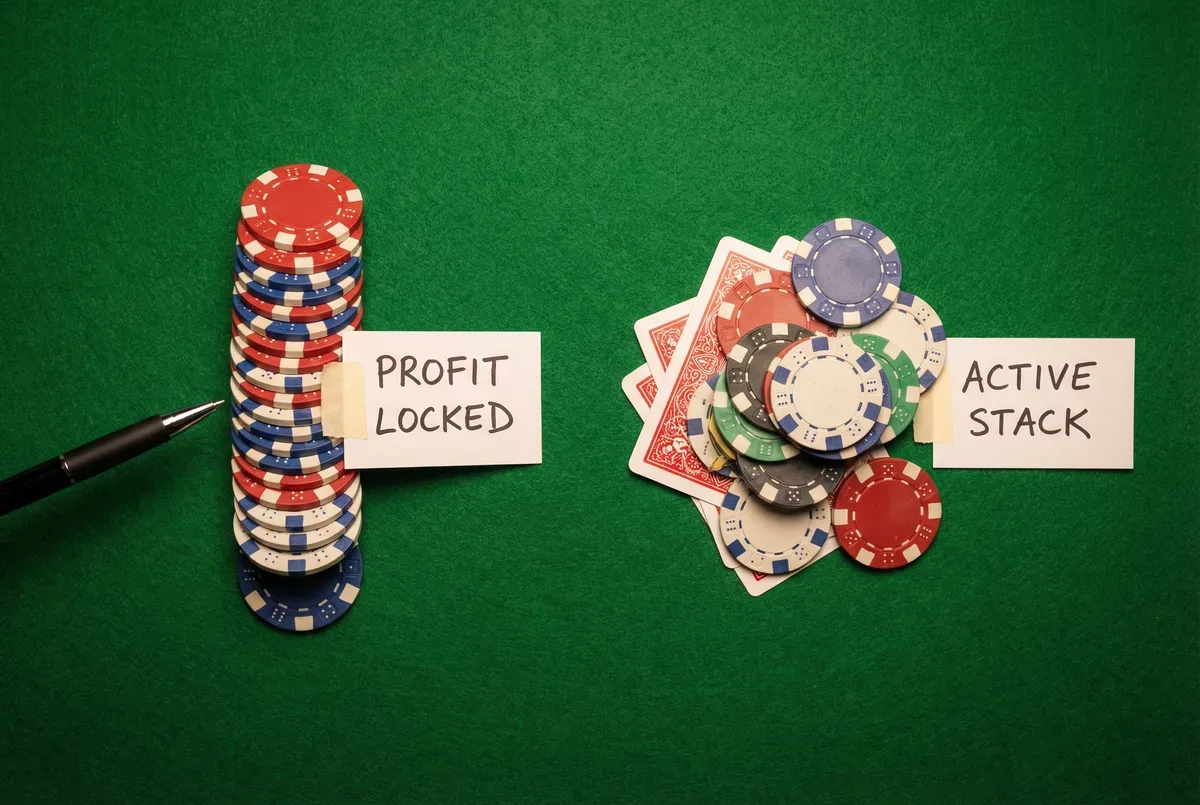
After completing a successful sequence, physically stack the profit chips separately from your playing chips before starting the next base-unit hand. The physical separation reinforces the mental separation those chips are banked profit, not ammunition for the next sequence. They go home with you regardless of the rest of the session.
Training the Reset Habit Before It Matters
The reset after a successful sequence is the hardest moment in positive progression play. At run this system at a real money table this week, complete at least 20 real sequences and execute the reset on every one. The first few times you bank profit and return to base unit during a clearly hot run, it will feel wrong. That discomfort is the test. Real money stakes make the sequence completion feel more real and the reset feel more costly only use funds fully budgeted for entertainment, and treat every correctly executed reset as the evidence that your profit-protection discipline is operational.
Frequently Asked Questions
No, in terms of expected value. Positive progressions produce the same expected value as flat betting at equivalent average stake. What they improve is the frequency of profitable sessions and the maximum single-session loss relative to maximum single-session gain. The profit-locking effect is real but limited to session variance distribution, not long-run expectation.
Variance is not predictable at the monthly level any more than at the session level. A positive month does not mean the next month will be equally positive. Apply positive progressions based on session mechanics the documented prior performance of the progression in your own tracked sessions not based on recent monthly results.
Three steps is the mathematically optimal Paroli sequence length. At four steps, the probability of completing the sequence drops to approximately 4.9%, and the escalated bet on step 4 represents a significantly higher risk-to-reward ratio than the 3-step design. The 3-step reset is the standard for a reason.
Before you test these plays at a real table, run them through our free blackjack simulator practice unlimited hands at zero cost until every move becomes automatic.
Mathematical Risk Warning
Profit locking through positive progressions reduces the size of session losses during cold runs but does not change expected value. All session profits locked by positive progression resets remain subject to loss in subsequent sessions. No betting strategy permanently protects winnings from the house edge over extended play.
Blackjack Academy is an educational resource. All strategy is based on mathematical expectation. Always play within your means.
Learn More
Continue your education with these related lessons.

How to Stay Calm and Control Your Emotions at the Table
Emotional control is a skill that directly affects your blackjack results. Tilt, fear, and overconfidence each cause specific strategy errors.…
Avoiding High Risk Betting Systems That Lead to Bankruptcy
Negative progression betting systems promise fast recovery from losses but deliver exponential ruin risk. This guide breaks down why Martingale,…

Why Past Hands Have No Effect on Your Future Results
Each blackjack hand is an independent statistical event. Past losses do not make future wins more likely, and winning streaks…