Why Insurance is a Sucker Bet with a Huge House Edge
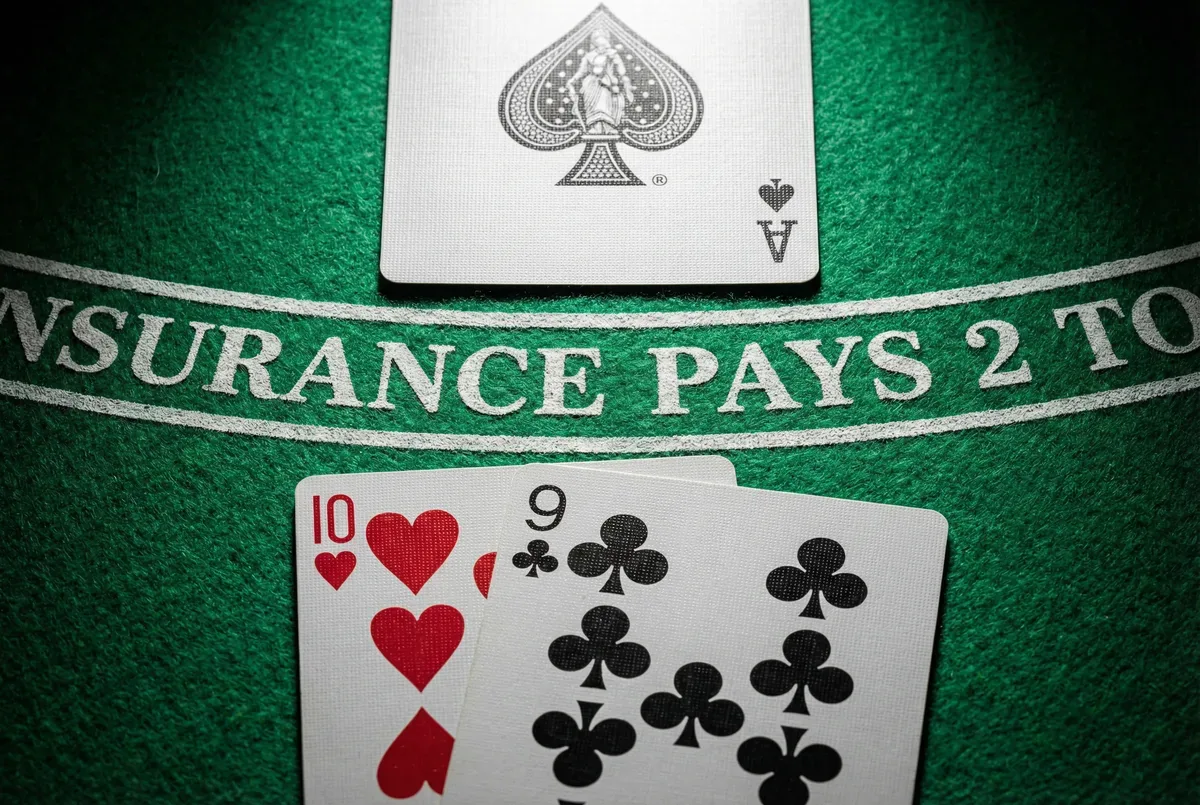
Blackjack insurance is a side bet offered whenever the dealer shows an ace. You are wagering up to half your original bet that the dealer’s hole card is a 10-value card, which would complete a blackjack and win you 2:1 on the insurance bet (while losing your main bet). The blackjack house edge on this wager is approximately 5.8% in a 6-deck game more than 10 times the 0.5% edge on the main bet when you play perfect blackjack basic strategy. Insurance is, by any standard measure, the worst bet routinely offered at a blackjack table.
Insurance Carries a 5.8 Percent House Edge in a Standard Six-Deck Game
The reason is simple arithmetic. In a 6-deck shoe, there are 312 cards: 96 ten-value cards and 216 non-ten cards. When the dealer shows an ace, one card is removed from consideration. The remaining deck has approximately 96 tens out of 311 cards a probability of about 30.9% that the hole card is a ten. Insurance pays 2:1, which is a fair bet only if the probability of a ten in the hole is 33.3% or greater. At 30.9%, you are getting worse than fair odds on a bet that is not likely to win.
The insurance marketing is clever: it sounds like protecting your hand. But you are not insuring anything you are making an entirely separate bet with a bad payoff, while your original hand plays out independently regardless of whether you buy insurance.
House edge on insurance bet
% (6-deck game)
House edge on main bet with basic strategy
%
Probability dealer has ten in hole
%
What Is the Even Money Trap When You Hold a Blackjack?
The most seductive version of insurance is offered when you hold a blackjack and the dealer shows an ace. The dealer or pit boss will offer you even money an immediate 1:1 payout on your bet instead of waiting to see if the dealer also has blackjack (which would result in a push). Accepting even money feels like a safe guarantee of profit. Mathematically, it is the identical insurance bet dressed in different language.
If you decline even money and the dealer checks for blackjack: 69.1% of the time the dealer does not have blackjack and you collect 3:2. 30.9% of the time the dealer has blackjack and you push (win nothing). Your expected value from declining is 0.691 × 1.5 = 1.037 times your bet. The expected value of taking even money is 1.0 times your bet. Declining produces 3.7% more value on average. The guarantee feels better than the math justifies.
The psychological appeal is loss aversion the fear of pushing a blackjack feels worse than the gain of collecting full odds. Casinos know this and promote even money aggressively. The correct response is to politely decline every time, without exception, in any non-counting context.
Common Myth
“Insurance protects your hand when the dealer shows an ace”
The name 'insurance' implies protection, like covering a financial risk
The Reality
Insurance is an independent side bet with a 5.8% house edge. It does not interact with or protect your original hand
Taking insurance consistently adds 5.8% house edge to the additional money wagered, dramatically increasing your session expected loss
Why Is the Only Time Insurance Mathematically Valid?
Card counters who track deck composition are the only players for whom insurance can have positive expected value. Insurance becomes a good bet when the remaining deck is rich enough in ten-value cards that the probability of a ten in the hole exceeds 33.3%. In Hi-Lo counting, this occurs when the true count reaches plus 3 or higher. At that point, taking insurance is mathematically correct and profitable on average.
Outside of that specific counting context, insurance is never correct. Not when you have a good hand. Not when you have a bad hand. Not when your gut says the dealer has a ten. Not when you are on a losing streak and want to cover your losses. The 5.8% edge exists on every insurance wager placed without count justification, regardless of circumstances.
Practice your response before sitting down: when the dealer asks about insurance, say 'no thank you' immediately, without hesitation or eye contact. A confident, quick refusal discourages the follow-up pitch. Appearing uncertain opens the door to pressure from dealers who are trained to upsell these bets.
How Do You Build Discipline Around This Rule in Your Sessions?
The principle becomes valuable only when it holds under pressure. Players who apply it when things are going well but abandon it when sessions turn difficult are not using a system they are using it selectively, which produces neither the expected returns nor the expected protection. Commit to the rule before the session starts, not during it.
What to Watch for in Live Play
Insurance offers happen fast in a live game, and the social pressure especially when other players at the table are all taking it can make refusal feel awkward. At apply the insurance math at a real table, practice the moment of the insurance offer until declining feels automatic. In real-money games, that ingrained habit protects you from both dealer pressure and peer influence. Real money on the table makes the “guarantee” of even money feel far more tempting than practice sessions suggest be prepared for that shift.
Frequently Asked Questions
Approximately 5.8%. In a 6-deck shoe, there are 96 ten-value cards out of 312 total. When the dealer shows an ace, roughly 96 of the remaining 311 cards are tens a probability of about 30.9%. Insurance pays 2:1, which requires a 33.3% probability to break even. The gap between 30.9% and 33.3% produces the 5.8% house edge.
At a true count of approximately +3 or higher in the Hi-Lo system. At TC +3, the deck is sufficiently rich in 10-value cards that the probability of the dealer holding a 10 rises above the 33.3% breakeven threshold. Below TC +3, insurance is always a losing wager.
Because framing it as protection exploits the natural human preference for certainty over expected value. Players holding strong hands feel compelled to guard against losing. The word 'insurance' implies a safety mechanism when it is mathematically a high-cost side bet with a house edge more than 10 times the main game.
Before you test these plays at a real table, run them through our free blackjack simulator practice unlimited hands at zero cost until every move becomes automatic.
Mathematical Risk Warning
Insurance and even money bets carry a house edge of approximately 5.8% in standard blackjack games. Accepting these offers consistently increases your session expected loss significantly beyond what basic strategy produces on the main bet.
Blackjack Academy is an educational resource. All strategy is based on mathematical expectation. Always play within your means.
Learn More
Continue your education with these related lessons.
What the House Advantage Percentage Really Means for Your Bankroll
House advantage is not an abstract casino term it is the exact rate at which your money transfers to the…
How to Size Your Blackjack Bets on a Fixed Entertainment Budget
Playing blackjack on a fixed monthly budget requires the 1% per-bet rule, a 100-unit minimum bankroll, and a clear allocation…
How to Size Your Units for Professional Blackjack Play
Professional unit sizing goes beyond the simple 1/200th rule. This post covers the Kelly Criterion, fractional Kelly, SCORE-based sizing for…