
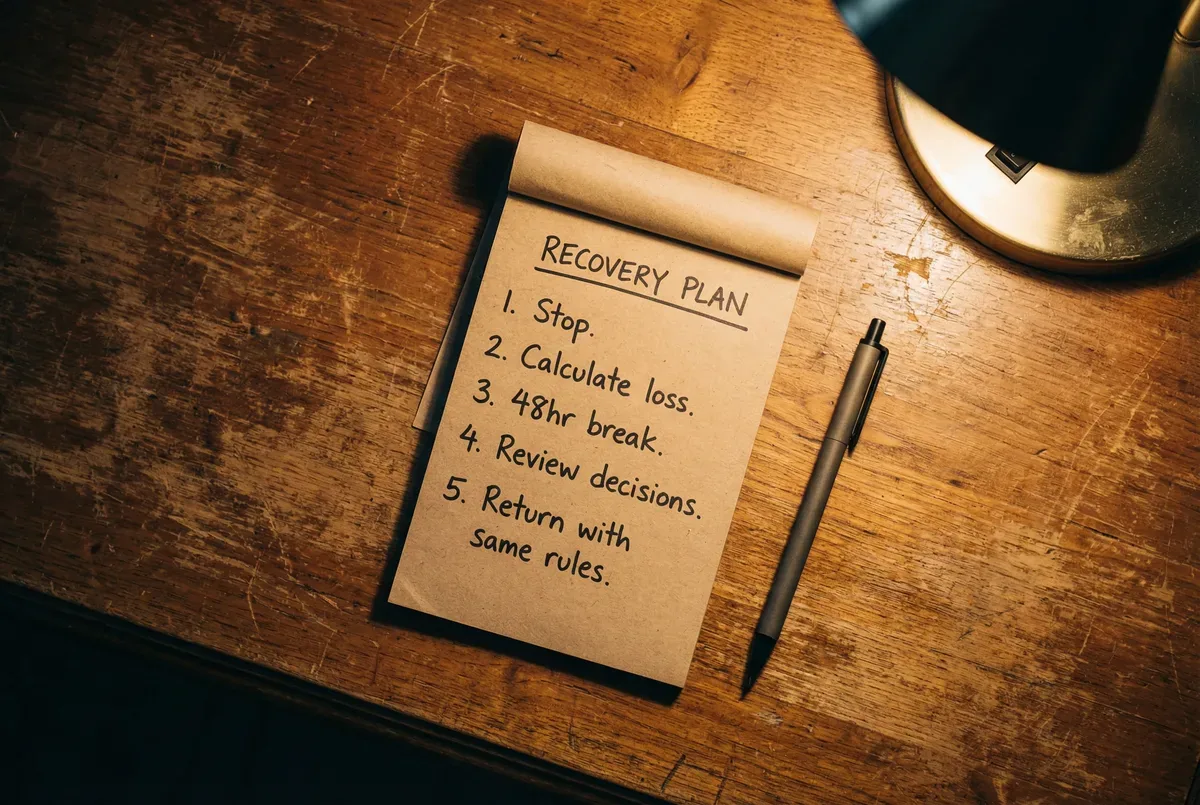
How to Recover from a Losing Blackjack Session
Attempting to recover a losing blackjack session by continuing to play is the single most reliable way to turn a bad session into a catastrophic one. Every hand you play after your mental stop point carries the same blackjack house edge as every hand before it the table does not know you are behind, and it does not care. The math has no obligation to balance in your favor. What does change when you are chasing losses is your decision-making: bet sizing becomes erratic, blackjack basic strategy gets bent under pressure, and risk tolerance inflates. The session that should have cost $80 ends up costing $300, and it happens one “just one more” at a time.
You Cannot Recover Losses in the Same Session
Common Myth
“If I play long enough after a big loss, variance will swing back and I will break even”
Feels true because short runs do reverse but each new hand is independent and the deficit grows as bets increase
The Reality
Future hands have no awareness of past results. Expected recovery time extends as you wager more. Chasing accelerates expected losses.
Each additional hand at 2× base bet = 2× expected loss rate per hand
What Variance Actually Means for Your Session?
Variance in blackjack is the natural, expected fluctuation around the mean outcome. With a blackjack house edge of 0.5% and a standard deviation of roughly 1.15 units per hand, a 200-hand session produces a one-standard-deviation range of approximately ±16 units. That means losing 16 units in a session is a completely normal outcome not a sign that something went wrong, not a deficit that “owes” you a correction. It happened. It will happen again. Roughly one in three sessions will fall outside one standard deviation on the negative side.
The concept players miss is that variance does not revert within a session it reverts across sessions over a very large sample. The law of large numbers operates on thousands of hands, not on the next fifty. If you are down 20 units after 150 hands, the most likely outcome for the remaining hands is not recovery it is continuation at approximately the blackjack house edge rate. You might win back 10 units. You might lose 10 more. The expected value of playing additional hands when you are behind is identical to the expected value of playing them when you are ahead: negative.
Session std deviation (200 hands)
at 1 unit base
Loss beyond 1 SD probability
per session
Loss beyond 2 SD probability
per session
What Is the Correct Mental Framework for a Losing Session?
Losing sessions are not failures. They are the statistically inevitable cost of playing a game with a blackjack house edge. Every professional gambler, card counter or otherwise, and takes losing sessions. The measure of a skilled player is not whether they lose; it is whether they lose close to the expected amount and walk away when the session is over. A recreational player with solid blackjack basic strategy who loses their session cap cleanly and walks away has played correctly. A player who extends the session by 90 minutes and loses three times their cap has played poorly, regardless of what the final card did.
Recovery happens across sessions, not within them. The correct response to a losing session is to close the account, leave the table, and let the next session begin fresh. Your bankroll absorbs the loss that is its function. The session cap you set prevented the loss from being catastrophic. Next session, same base bet, same cap, same strategy. Over time, with a 0.5% blackjack house edge and competent blackjack basic strategy, your expected loss rate is predictable and manageable. Chasing within a session blows the entire model by introducing variable bet sizing at the exact moment when discipline is hardest to maintain.
After any session win or lose wait at least 24 hours before your next session. The gap prevents the psychological carryover that turns one bad day into a spiral. Fresh start, same rules, same cap.
What Is Structural Recovery?
If your bankroll has taken a significant hit more than 20% the correct structural response is to drop down in bet size, not increase it. A player running a $25 base who has lost 25% of their bankroll should move to $15 or $10 until the bankroll recovers. This is the opposite of what the recovery impulse demands, which is exactly why it works. Smaller bets mean smaller expected losses per hand, which means the bankroll lasts longer and variance has more room to produce positive swings. Increasing bets to recover faster is risk-of-ruin math working against you in the most literal sense.
Build the Walk-Away Muscle Before Real Stakes
The hardest skill in blackjack is not memorizing the blackjack strategy chart it is stopping when you are supposed to stop. At test your tells at a live real-money session immediately you can practice setting a session cap and walking away the moment you hit it, building the stop reflex in a zero-consequence environment because the first time you need to walk away from a real table down $200 with chips still in your hand, you want that muscle to already be trained.
Frequently Asked Questions
No. Increasing bets after losses whether within a session or across sessions amplifies expected losses proportionally. Recovery across sessions happens at your normal base bet over a large sample, not by taking on more risk in a compressed window.
Review your hand decisions after the session, not during it. If you played basic strategy correctly and lost, it was variance. If you find hands where you deviated from basic strategy under pressure, that is the area to correct not your bet sizing.
With a 0.5% house edge, even a skilled player will experience three to five consecutive losing sessions with some regularity. This is normal variance over a small sample. If sessions are consistently worse than expected over 20 or more sessions, review strategy for systematic errors.
Before you test these plays at a real table, run them through our free blackjack simulator practice unlimited hands at zero cost until every move becomes automatic.
Mathematical Risk Warning
Blackjack has a negative expected value for the player in every hand regardless of session history. There is no statistical mechanism that causes past losses to be offset by future wins within a defined time window. Every additional hand played while chasing losses extends total expected loss at the house edge rate.
Blackjack Academy is an educational resource. All strategy is based on mathematical expectation. Always play within your means.
Learn More
Continue your education with these related lessons.
Why Insurance is a Sucker Bet with a Huge House Edge
Insurance in blackjack carries a house edge of 5.8% in a standard 6-deck game roughly 10 times the edge on…
The Real Math Behind the Bust It Side Bet and Why You Should Avoid It
The Bust It side bet pays when the dealer busts with three or more cards. It sounds appealing dealers bust…
How to Calculate Your Blackjack Expected Loss Per Session
Learn the exact formula for calculating your expected loss at the blackjack table. House edge × average bet × hands…