

How to Keep Blackjack Sustainable and Fun for Years
Most players who burn out on blackjack financially, emotionally, or both do not quit because they lack discipline. They quit because they never built structural systems to support sustainable play. Session length is arbitrary, bet sizes drift upward over time, and the line between entertainment budget and essential money blurs gradually. Sustainable long-term blackjack requires the same approach you would bring to any financially and emotionally significant hobby: a clear budget, defined engagement rules, regular honest reviews, and the flexibility to adapt when circumstances change. Players who build this infrastructure in the first year of serious play are still playing productively five or ten years later. Those who do not typically concentrate large losses into short periods and associate the game with financial stress rather than strategic enjoyment.
Sustainability Is a Design Problem, Not a Willpower Problem
Timeline
Year 1
Foundation: Master basic strategy, set annual entertainment budget, establish session tracking habit
Year 2
Optimization: Identify best available games in your market, refine bet sizing, review year-1 data
Year 3
Advanced study: Learn count fundamentals if interested, evaluate whether professional-level study fits your life
Year 4+
Maintenance: Annual strategy review, bankroll replenishment from earnings, adjust engagement level to life circumstances
What Is the Entertainment Budget Framework?
The foundation of sustainable play is defining your blackjack activity as a discretionary entertainment expense with a fixed annual budget. This budget should be set the same way you would set any entertainment allocation based on what you can genuinely afford to lose without affecting essential financial goals. A useful exercise: what would happen to your life if you lost the entire annual budget? If the honest answer is nothing material, the budget is appropriate. If the answer involves stress, disruption, or compromise, the budget needs revision before you play a single hand.
Within that annual budget, session allocations prevent depletion through a single unlucky period. A $2,400 annual budget divided into 24 monthly sessions of $100 each means no single session can destroy the year’s participation capacity. The monthly structure also creates natural review points where cumulative results can be assessed against expectations without the distortion of individual session outcomes.
Advantages
- Fixed annual budget prevents financial overextension
- Monthly session caps preserve year-round participation
- Strategy mastery compounds in enjoyment over years
- Clear stop rules prevent tilt-driven erosion
Disadvantages
- Fixed budgets feel restrictive to advantage players in winning periods
- Long-term tracking requires consistent administrative discipline
- House edge means even sustainable play has expected negative financial outcome
How Do You Keep the Strategic Engagement Fresh?
Blackjack sustains long-term interest because the strategic depth is genuinely layered. Players who exhaust blackjack basic strategy find blackjack card counting. Those who master counting explore betting theory, variance management, and game selection. Those who master those find team play, hole-card play, or shuffle tracking. Each layer provides a new intellectual challenge that keeps the game interesting independent of financial outcomes. Structuring your study as an ongoing project with defined learning goals each quarter prevents the plateau effect that leads many recreational players to disengage through boredom before they reach the game’s more sophisticated strategic levels.
The players who remain sharp and engaged at blackjack for a decade are the ones who always have a specific improvement project underway. If your strategy is perfectly memorized, your next project is count accuracy. If your count is solid, your next project is bet spread optimization. The game rewards perpetual students.
What Are Annual Review and Recalibration?
The most important sustainability tool is an honest annual review. Once per year, examine your session logs as a body of data: total hands played, cumulative profit or loss in units, expected profit or loss at your blackjack house edge, number of strategy deviations, and your subjective assessment of whether the activity brought net positive engagement over the year. This review serves multiple functions simultaneously it provides statistical context for results, identifies whether strategy quality is improving over time, and forces the most important sustainability question: is this activity still worth what it costs me?
If the review shows strategy is improving, variance is within normal bounds, and the activity remains enjoyable, you have the data to continue with confidence. If it shows a systematic pattern of deviations that inflate losses beyond expectation, or a trend toward sessions that end in frustration, you have early warning to recalibrate before the pattern deepens.
Sustain the Habit by Knowing What Real Play Feels Like
Sustainable blackjack habits form under real conditions, not comfortable practice modes. Visit experience this with real stakes and run a session within your defined entertainment budget with money you can genuinely afford. The combination of real financial stakes and structured session limits, stop-win, stop-loss, time boundary, and is the environment where sustainable habits either form or fail. If you find the session enjoyable and leave within your rules, you have confirmed the sustainability of your current framework. If you find the rules difficult to honor under pressure, you have identified the exact adjustment needed before the next session.
Frequently Asked Questions
Set the annual budget equal to what you can lose entirely without material financial consequence. Divide it into monthly session allocations to prevent depletion in a single period. Review the budget annually and adjust based on life circumstances, not session results.
The game has multiple distinct strategic layers: basic strategy, card counting, betting theory, game selection, variance management, and advanced techniques like shuffle tracking. Approaching each as a distinct learning project provides ongoing intellectual engagement independent of financial outcomes.
Annually at minimum, with informal quarterly check-ins. The annual review should be a formal data analysis actual vs expected results, strategy deviation frequency, and a subjective engagement assessment. It should inform the next year's budget and study priorities.
Before you test these plays at a real table, run them through our free blackjack simulator practice unlimited hands at zero cost until every move becomes automatic.
Mathematical Risk Warning
Long-term blackjack play carries cumulative expected losses at the prevailing house edge. Sustainability requires treating the activity as an entertainment expense with a firm annual budget, not as a profit-seeking investment.
Blackjack Academy is an educational resource. All strategy is based on mathematical expectation. Always play within your means.
Learn More
Continue your education with these related lessons.
How Table Speed Increases or Decreases Your Variance
Table speed measured in hands per hour directly controls how quickly variance resolves and how quickly house edge accumulates. Knowing…
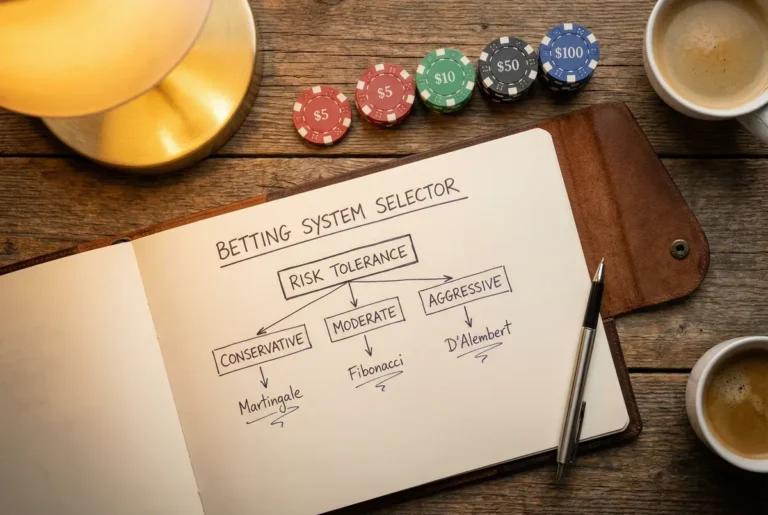
How to Choose the Right Betting System for Your Personal Risk Tolerance
The best betting system for you is the one that matches your risk tolerance, not the one with the most…
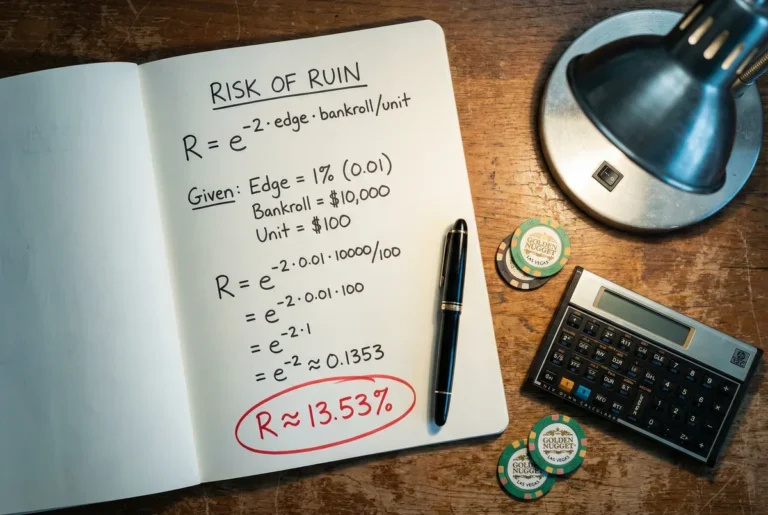
The Real Formula for Calculating Your Blackjack Risk of Ruin
Risk of ruin is the probability that a losing streak will eliminate your entire bankroll before you can recover. This…