
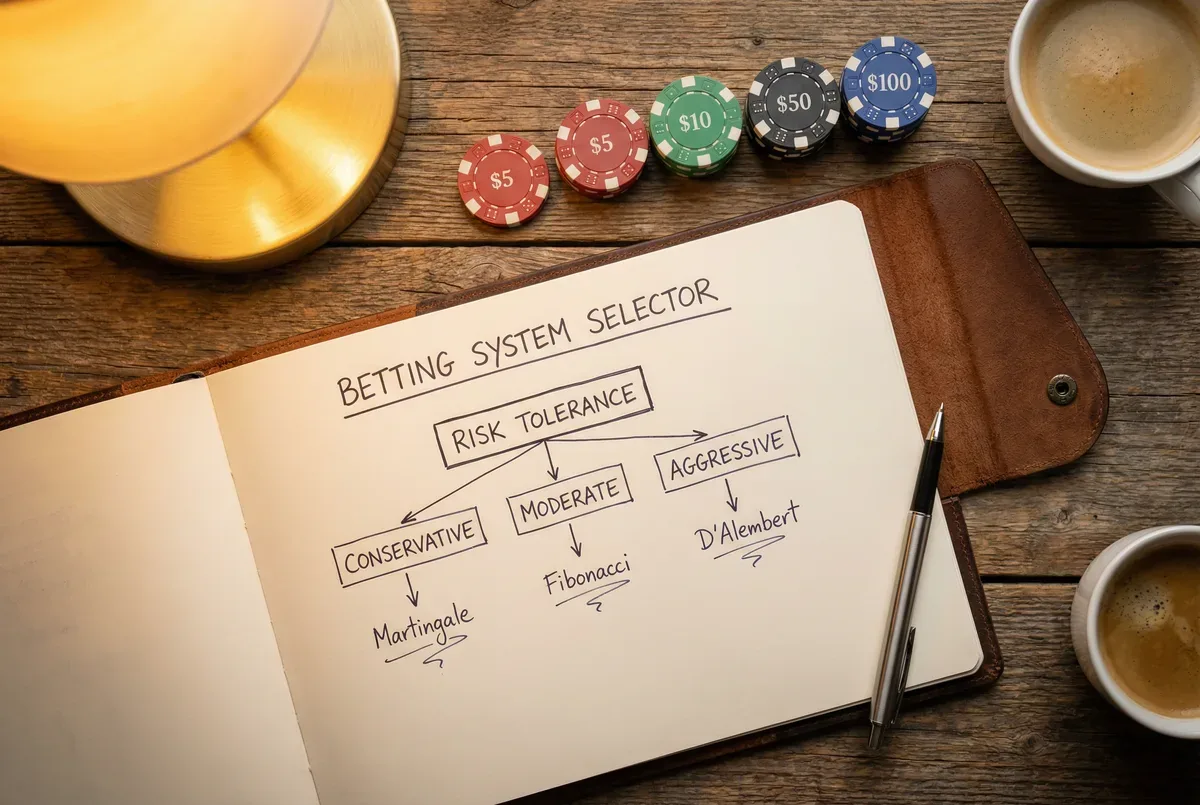
How to Choose the Right Betting System for Your Personal Risk Tolerance
Risk tolerance in gambling refers to how much variance you are comfortable experiencing in pursuit of a given outcome. A low-risk-tolerance player wants minimal downswings, predictable session results, and low probability of ruin and is willing to sacrifice upside potential to get that. A high-risk-tolerance player accepts the possibility of large losses in exchange for the chance of larger wins in a single session. No betting system changes the expected value of the game, but they do dramatically different things to the distribution of that value across a session.
Risk Tolerance Determines Which Betting System Fits Your Goals
The mistake most players make is choosing a system based on its story rather than its risk profile. The Martingale sounds logical. The 1-3-2-6 sounds structured. But the question to answer first is: what does your bankroll and your psychological comfort actually require? A system that produces the occasional spectacular session at the cost of occasional total loss events is only suitable if both outcomes are financially and emotionally acceptable.
Below is a framework for mapping the five major systems to risk profiles, based on their variance characteristics and typical session outcome distributions.
System
Risk Level
- Lowest minimum variance
- Low-moderate linear loss profile
- Moderate capped downside, streak upside
- Moderate structured sequence, break-even safety
- Extreme catastrophic loss risk in normal play
How Do You Map Systems to Session Goals?
Players whose primary goal is to extend session time with minimum financial risk should use flat betting. The predictable 1-unit-per-hand loss profile means the session lasts as long as the buy-in divided by the expected loss rate, with variance causing the actual endpoint to distribute around that figure. The emotional experience is calm and controlled, which is appropriate for players who treat blackjack primarily as leisure rather than pursuit of large wins.
Players who want the possibility of meaningful session wins while capping their downside should consider Paroli or 1-3-2-6. Both systems exploit hot streaks for larger profits while keeping cold-streak costs at flat-bet levels. The trade-off is that most sessions produce smaller wins than a lucky flat-bet session would, because the escalating bets only appear after wins which means you only profit from streaks that actually occur, not from average sessions.
Players with high risk tolerance and a large bankroll who want the best chance of a large single-session win might explore Oscar’s Grind with an aggressive cycle target. The slow press and linear loss floor make it suitable for players who have the patience for grinding cycles but want structured progression. This requires genuine patience the system cannot be rushed without abandoning its protective mechanics.
Advantages
- Understanding your risk profile prevents choosing the wrong system
- Matching system to personality reduces tilt and emotional decisions
- Low-risk systems preserve bankroll for more sessions
- Systems with structured rules make discipline easier to maintain
Disadvantages
- No system changes expected value all produce the same long-run result
- High-risk systems feel exciting until the catastrophic session arrives
- Risk tolerance changes with stress levels what feels acceptable calm may be wrong under pressure
What Is the Questions to Identify Your True Risk Tolerance?
Four questions clarify risk profile before system selection. First: how would losing your entire session buy-in in the first 30 minutes make you feel? If the answer is “devastated” or “I would need to rebuy,” your risk tolerance is low and flat betting or Oscar’s Grind is appropriate. Second: do you want the session to be exciting or predictable? Excitement comes with variance. Predictability comes with flat play. Third: how important is winning a large amount in a single session versus lasting the full planned time? Large-win chasers suit positive progressions. Session duration maximizers suit flat play. Fourth: do you have the patience to execute complex rules without deviation? Oscar’s Grind and 1-3-2-6 require exact adherence. Flat betting requires none.
How Do You Match a Betting System to Your True Risk Profile?
Honest answers to these four questions will point to a system more reliably than any recommendation. A system that matches your actual psychology will be followed correctly; one that fights your instincts will be abandoned at the worst possible moment.
Test your chosen system through 10 simulated sessions before using it with real money. If you find yourself wanting to deviate from the rules after 3 losing sequences, the system is not the right fit for your risk tolerance regardless of its mathematical characteristics.
Finding Your System Through Live Experimentation
Risk tolerance is best discovered in conditions that replicate real stakes, not in free play where losses feel abstract. At test this system at a live blackjack table, run each system you are considering through 50–100 hands with genuine money on the line and observe your emotional response to its variance. The system that produces calm, disciplined execution rather than anxiety and deviation impulses is the one that fits your tolerance. Only use funds budgeted entirely for entertainment system evaluation with real stakes is valuable precisely because it costs something when the system has a cold run.
Frequently Asked Questions
Technically yes, but it is rarely a good idea. Mid-session system switches almost always happen in response to emotional reactions to recent results exactly the conditions where decision-making is least reliable. Choose your system before the session, test it for the full session regardless of results, and evaluate it after, not during.
Only if two conditions are met: your bankroll is large enough that hitting the table limit during a losing streak does not damage your finances, and you have no emotional reaction to total session loss events. Most people discover during their first catastrophic Martingale session that their actual risk tolerance is lower than they believed.
Yes. Flat betting requires no system tracking, no in-session calculations, and no sequence management. It lets new players direct all cognitive resources to basic strategy decisions, which are far more valuable to learn and far more impactful than system selection at the early stage.
Before you test these plays at a real table, run them through our free blackjack simulator practice unlimited hands at zero cost until every move becomes automatic.
Mathematical Risk Warning
No betting system changes the house edge or expected value. System selection affects the distribution of outcomes specifically variance and tail risk not the average result over thousands of hands. Match your system to your financial situation and emotional tolerance, not to perceived winning potential.
Blackjack Academy is an educational resource. All strategy is based on mathematical expectation. Always play within your means.
Learn More
Continue your education with these related lessons.

How to Keep Blackjack Sustainable and Fun for Years
Blackjack is most rewarding as a long-term pursuit strategic, intellectually engaging, and financially manageable. Sustainability requires intentional structure that most…

Why Winning Streaks are Just Short Term Statistical Variance
Winning streaks feel like momentum, but the mathematics say otherwise. Every hot run in blackjack is a cluster of positive…

The Real Difference Between Progressive Betting and Flat Betting
Progressive and flat betting produce the same EV over time. The real difference is variance. Here's who each approach suits,…