
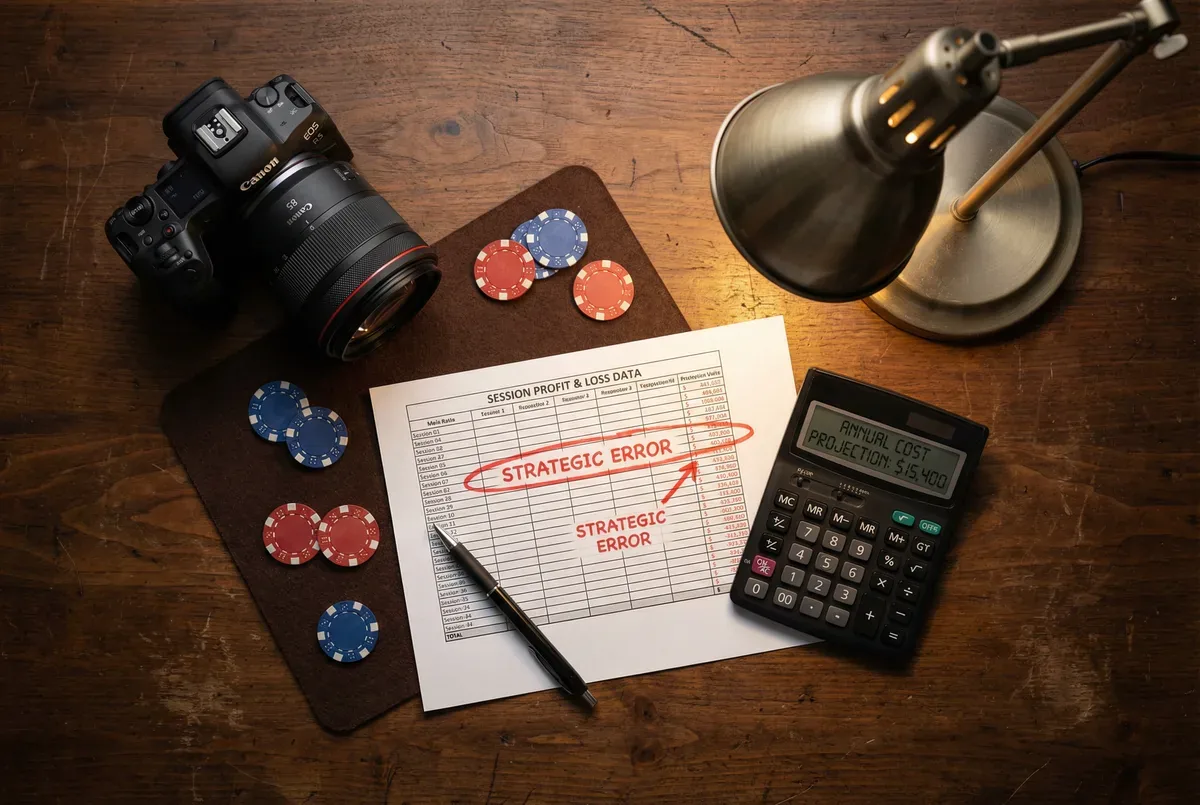
How One Bad Strategic Move Destroys Your Annual Profit
The blackjack house edge in a well-run blackjack game with good rules is approximately 0.5% against a player using perfect blackjack basic strategy. Any deviation from that strategy increases the effective blackjack house edge by a calculable amount that depends on the specific error, the frequency of that hand situation, and the bet size. The mathematics are unforgiving because errors compound: a single decision that costs 4% EV on a hand that appears once every fifty deals costs 0.08% in annual blackjack house edge inflation. At 200 hands per session and 50 sessions per year, that is 10,000 hands annually. An error costing 0.08% of annual edge translates to 0.08% × $20 bet × 10,000 hands = $160 in additional annual expected loss from one specific strategic error, applied consistently every time that hand occurs.
Strategy Errors Compound Across Thousands of Hands
- Standing on soft 18 vs dealer 3 instead of doubling−3.2% EV
- Standing on 16 vs dealer 10 instead of surrendering−2.1% EV
- Not doubling 11 vs dealer 6−4.1% EV
- Taking insurance−5.8% EV on the insurance bet
- Not splitting 8s vs dealer 10−2.8% EV
Why Do the Most Expensive Strategic Error in Frequency-Adjusted Terms?
Not all strategic errors are equally costly in practice. Cost = (EV loss per error) × (frequency of the hand). Insurance is the highest EV-cost error per occurrence at 5.8%, but dealers only show an ace on approximately 7.7% of hands. Not doubling hard 11 against a dealer 6 costs 4.1% EV and occurs with moderate frequency. Standing on a soft 17 against a dealer 7 a common error because soft totals feel safe to stand costs 1.9% EV and occurs regularly. The frequency-adjusted annual cost of consistently making any one of these errors at $20 per hand over 10,000 hands ranges from $50 to $300. Making two or three of them simultaneously adds those costs together not averaging them.
Insurance deserves special attention because it triggers under emotional pressure the dealer shows an ace, the player holds a strong hand, and protecting that hand feels rational. Insurance costs 5.8% EV every time it is taken. A player who accepts insurance just twice per session across 50 sessions accepts insurance 100 times annually. At $10 per insurance bet, expected annual loss from insurance alone is $58 from a bet that takes five seconds and feels protective. The math makes this one of the cleanest arguments for rigid rule adherence: the emotional rationalization for taking insurance costs $0.58 per $10 wagered, every single time.
Dealer Shows
Your Hand
You have soft 18 (Ace-7) vs dealer 6. Do you stand or double?
Soft 18 vs dealer 6 is a positive-EV double. Ace-7 totals 18, but with the ace flexible you can draw without busting. Dealer 6 has highest bust rate of all upcards. Doubling captures the maximum value from this favorable situation. Standing gives up approximately 3.2% EV on this hand.
How Do You Identify Your Personal Error Pattern?
Every player has a characteristic error pattern the specific decision categories where their strategy consistently breaks down. For many players it is soft totals, because soft-hand strategy has more exceptions than hard-hand strategy and requires a different mental framework. For others it is surrender decisions, which require accepting a small guaranteed loss to avoid a larger expected one psychologically difficult even when mathematically obvious. For counters, it is index play at extreme counts, where deviations from blackjack basic strategy are theoretically correct but easy to second-guess under pressure.
Run 500 hands on a strategy simulator with deviation alerts turned on before your next live session. Review the deviation log immediately after. The hands where you deviated most frequently are your personal error pattern drill them specifically until the correct play is automatic.
What Is the Annual Cost Calculation as Motivation Tool?
Calculating the annual EV cost of your specific error pattern converts abstract strategy advice into a concrete financial incentive. If you play 10,000 hands annually at $20 per hand and your error rate adds 0.3% to your effective blackjack house edge, that is $600 in additional expected annual loss all attributable to strategic deviations that blackjack basic strategy eliminates. Correcting those deviations does not guarantee you will win $600 annually, but it reduces your expected annual loss by $600. On a $2,000 annual entertainment budget, that correction represents a 30% improvement in budget utilization from strategy alone.
This framing, annual cost rather than per-hand cost, and is how professional players evaluate strategy quality. Per-hand costs feel negligible. Annual costs in dollar terms make the value of perfect execution undeniable.
Measure Your Error Rate Under Real Pressure
Strategy errors under simulation pressure and strategy errors under real-money pressure are fundamentally different in frequency and type. At apply this at a live professional table tonight, the combination of live-dealer pace, real money at stake, and genuine session outcomes creates the full pressure environment where your characteristic errors will surface. Play a 100-hand session with explicit attention to the specific decision categories where you know you are vulnerable. Every deviation costs real money which is precisely why live sessions are the only definitive test of whether your strategy training has produced reliable execution.
Frequently Asked Questions
Taking insurance whenever the dealer shows an ace is the most consistently expensive error, carrying a 5.8% house edge on the insurance bet. At $10 per insurance bet taken over 100 occurrences annually, the expected annual cost is $58 from this error alone.
Multiply the EV loss per occurrence × frequency of the hand × average bet size × annual hands played. For a 4% EV error occurring once per 50 hands at $20 bet over 10,000 annual hands: 0.04 × (10,000/50) × $20 = $160 in annual additional expected loss.
The most common errors are: taking insurance, standing on soft totals that should be doubled (A,7 vs 3–6), not surrendering 15 or 16 vs dealer 9–ace, and failing to split pairs correctly (especially 8s vs high dealer cards). Soft total decisions are the most frequently missed category.
Before you test these plays at a real table, run them through our free blackjack simulator practice unlimited hands at zero cost until every move becomes automatic.
Mathematical Risk Warning
Strategic errors increase house edge above baseline. Even perfect strategy execution does not eliminate the house edge it minimizes it. Perfect play reduces expected loss but does not produce a winning game for non-counters.
Blackjack Academy is an educational resource. All strategy is based on mathematical expectation. Always play within your means.
Learn More
Continue your education with these related lessons.
How to Lock in Profits Using Positive Progression Betting
Positive progression betting locks in profits by pressing bets only with winnings, so any loss returns you to your starting…

How to Keep Blackjack Sustainable and Fun for Years
Blackjack is most rewarding as a long-term pursuit strategic, intellectually engaging, and financially manageable. Sustainability requires intentional structure that most…
How to Size Your Blackjack Bets on a Fixed Entertainment Budget
Playing blackjack on a fixed monthly budget requires the 1% per-bet rule, a 100-unit minimum bankroll, and a clear allocation…