
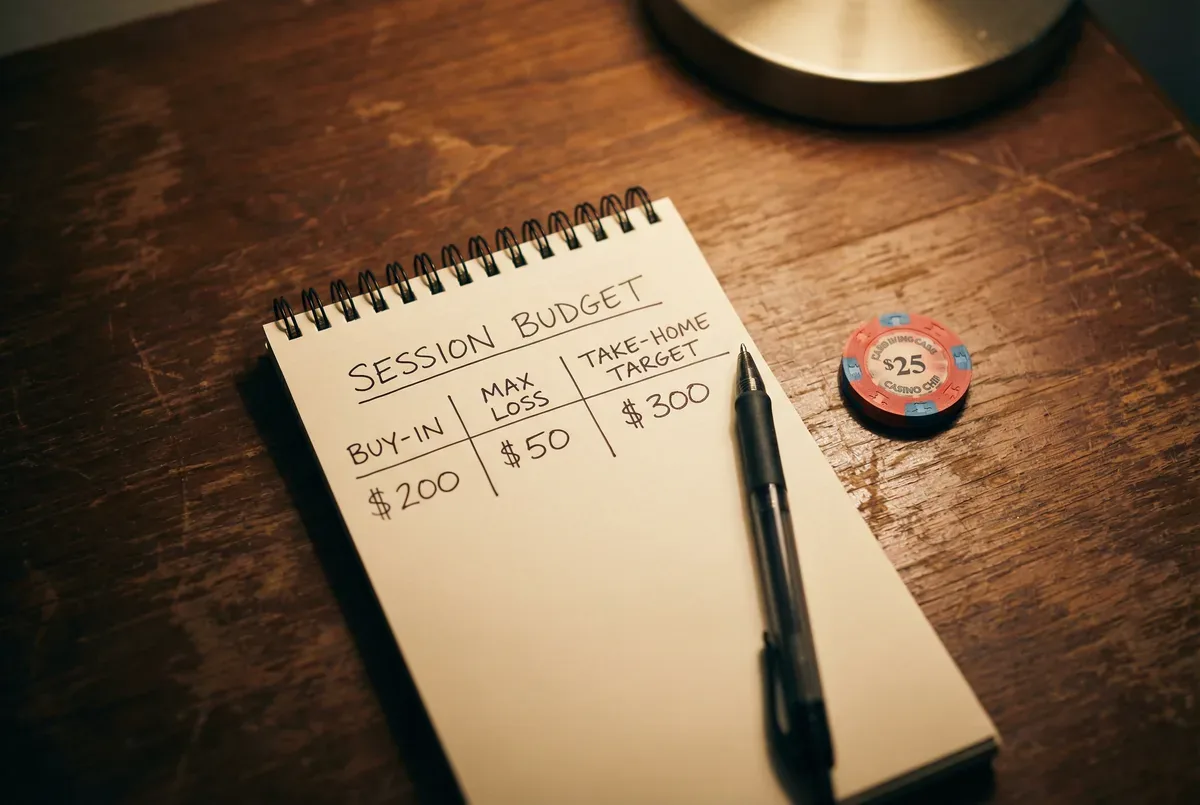
How Much Money You Really Need for a Blackjack Session
The standard recommendation for a blackjack session buy-in is 20 to 25 units where one unit equals your planned flat bet for the session. If you plan to bet $10 per hand, bring $200–$250. If you plan to bet $25 per hand, bring $500–$625. This range gives your session enough depth to survive a standard variance downswing of 10–15 units without forcing premature exit or panicked bet adjustment, while keeping the amount small enough that losing it does not damage your overall bankroll.
Your Session Buy-In Should Equal 20 to 25 Times Your Planned Bet Size
The relationship between session buy-in and overall bankroll matters. Your session buy-in should represent a fraction of your total blackjack fund ideally one tenth or less. If losing the entire session stake does not materially affect your ability to play next week, the buy-in is sized correctly. If losing it would require a significant pause or bankroll reload, it is too large.
These numbers assume flat betting with blackjack basic strategy. Card counters and progression bettors need adjustments, detailed in sections below.
| Table Minimum | Minimum Buy-In (20 units) | Preferred Buy-In (25 units) |
|---|---|---|
| $5 minimum | ||
| $100 | ||
| $125;$10 minimum | ||
| $200 | ||
| $250;$15 minimum | ||
| $300 | ||
| $375;$25 minimum | ||
| $500 | ||
| $625;$50 minimum | ||
| $1,000 | ||
| $1,250 |
How Session Length Changes the Calculation?
A 1-hour session at a busy table involves roughly 60–80 hands. A 3-hour session involves 180–240 hands. Longer sessions expose your buy-in to more variance by virtue of additional hands not because variance per hand changes, but because the number of opportunities for cold streaks to develop increases. The 20–25 unit buy-in is calibrated for sessions of 1–3 hours. Planned sessions longer than 4 hours should increase the buy-in to 30 units to account for the extended variance window.
Session length also interacts with expected loss. At 0.5% blackjack house edge on a $10 flat bet with 80 hands per hour, expected loss is $4 per hour. Over 3 hours, expected loss is $12. Your 25-unit ($250) buy-in covers that with enormous room for variance. The buy-in is not sized around expected loss it is sized around variance, specifically the possibility of a 15–20 unit downswing through normal statistical fluctuation.
Players who use progressive betting systems like Paroli or 1-3-2-6 need the same buy-in depth as flat bettors during losing runs, since the worst-case per-hand loss is identical. What changes is the potential upside during win runs the buy-in floor remains the same.
- Your flat bet × 20 = minimum session buy-in
- Your flat bet × 25 = preferred session buy-in
- Maximum hands per hour in live game80–100
- Session expected lossbet × house edge% × hands played
- Rulesession buy-in should be ≤ 10% of total bankroll
What Is Special Cases?
Card counters using a 1–8 or 1–12 spread need session buy-ins of 50–100 units of their minimum bet, because the variance introduced by large bets during favorable counts creates downswings that are far deeper than flat-bet play. A counter betting $10 minimum and $100 maximum should bring $500–$1,000 to a single session the equivalent of 50–100 minimum units.
How Should You Calculate Your Buy-In Before Sitting Down?
Blackjack tournament players have a completely different buy-in calculation: the tournament entry fee is the only capital at risk per tournament, and the session strategy is about chip accumulation relative to opponents rather than loss minimization. Tournament bankrolls are calculated per entry fee, not per hand.
Never calculate your buy-in by asking 'how much am I comfortable losing?' Calculate it by asking 'how many units do I need to give the math a fair chance to work?' The answer is always 20–25. Anything less means you are likely to hit variance before your buy-in runs out rather than completing the planned session.
Putting This Into Practice at a Live Table
Knowing the correct buy-in amount is different from feeling comfortable putting it on the table. At apply this at a live betting session under pressure, practice playing with a pre-defined buy-in and adhering to a loss limit of 15–20 units. Real money produces the genuine discomfort of watching a buy-in deplete an experience that cannot be replicated in free play. Only use funds fully budgeted for entertainment, and treat each session as a test of whether your buy-in calculation and loss-limit discipline hold together under real conditions.
Frequently Asked Questions
You can, but you should reduce your bet size so that the buy-in still equals 20 units at the new size. If you only have $100 for a session, bet $5 per hand (20 units). Sitting at a $10 minimum with $100 means you have only 10 units a depth that will not survive a routine 10-unit downswing.
No favorable rules reduce the house edge, which reduces your expected loss rate. The buy-in size is determined by variance depth, not expected loss, and favorable rules do not meaningfully reduce variance per hand. Keep the 20–25 unit calculation.
Yes. Bringing more than 30 units to a session increases the temptation to exceed your loss limit because extra chips are visibly available. Many disciplined players bring exactly 25 units in physical chips and leave the remainder secured elsewhere. The physical constraint makes limit adherence easier.
Before you test these plays at a real table, run them through our free blackjack simulator practice unlimited hands at zero cost until every move becomes automatic.
Mathematical Risk Warning
No buy-in size guarantees a profitable session. The correct session buy-in protects your overall bankroll and gives variance room to operate, but does not change the house edge on any individual hand. All sessions carry the possibility of losing the entire buy-in during normal statistical fluctuation.
Blackjack Academy is an educational resource. All strategy is based on mathematical expectation. Always play within your means.
Learn More
Continue your education with these related lessons.
Why Sticking to Your Tactical Plan and Leaving Early Wins More Money
Walking away early before a session ends naturally is one of the most underrated professional skills in blackjack. A tactical…
The Real Difference Between Replenishable and Static Gambling Funds
Not all gambling money is the same. Replenishable funds sourced from ongoing income behave differently from static capital in both…
How to Stay Calm and Control Your Emotions at the Table
Emotional control is a skill that directly affects your blackjack results. Tilt, fear, and overconfidence each cause specific strategy errors.…