
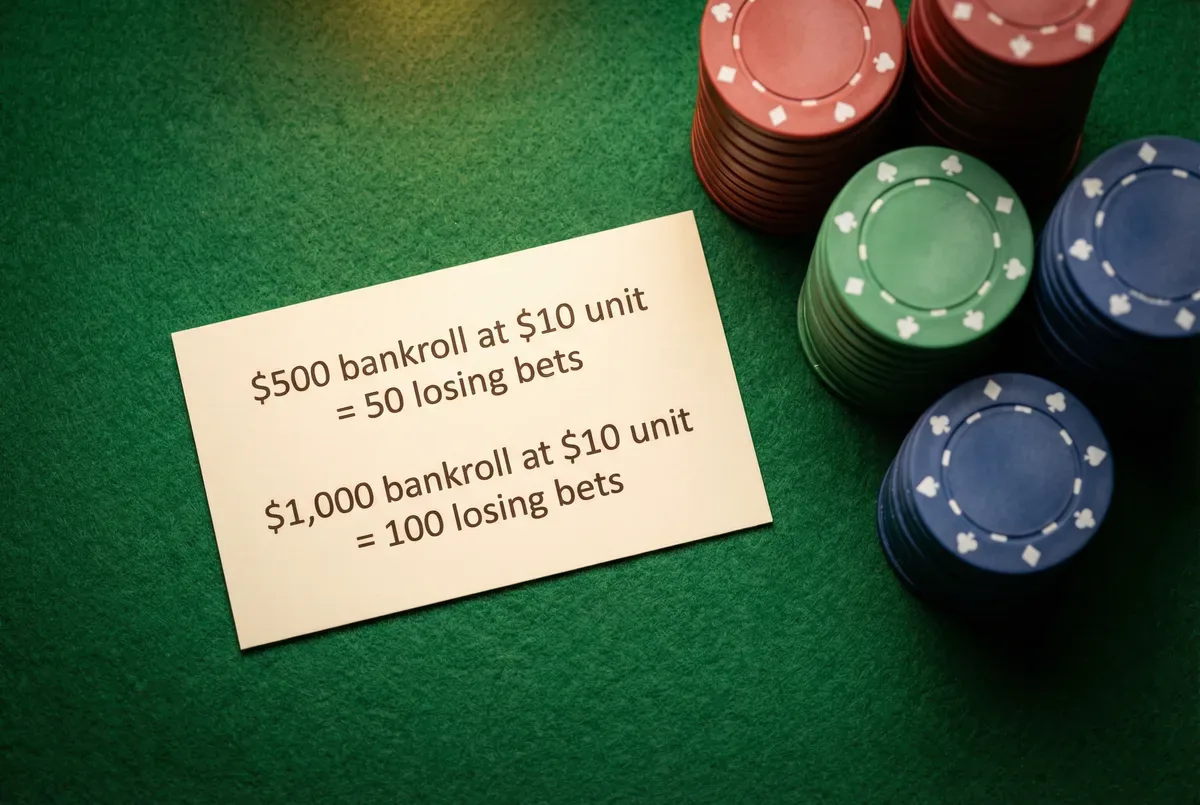
How Long Your Blackjack Bankroll Will Last with Worked Calculations
Bankroll duration in blackjack is calculable from first principles. The formula is: expected session count = bankroll ÷ (blackjack house edge × average bet × hands per session). For hourly duration: expected hours = bankroll ÷ (blackjack house edge × average bet × hands per hour). With blackjack basic strategy, the blackjack house edge is approximately 0.5%. At a full live table you play roughly 50–80 hands per hour; at a one-on-one or online table, 80–120 hands per hour. These numbers produce the expected cost per hour of play and dividing your bankroll by that cost tells you, on average, how many hours it will fund before depletion.
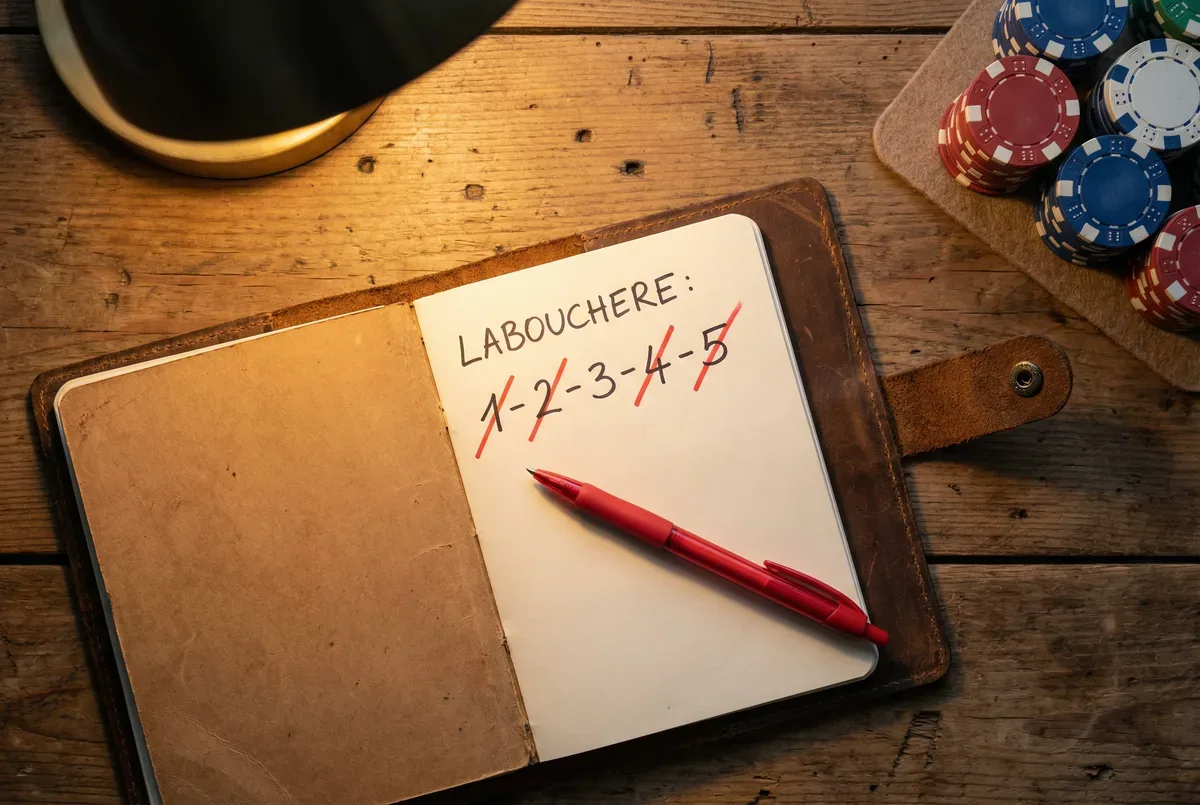
The Formula for Bankroll Duration
| Base Bet | Hands/Hour | Expected Cost/Hour |
|---|---|---|
| $10 base | ||
| 80 hands | ||
| $4.00/hr;$25 base | ||
| 80 hands | ||
| $10.00/hr;$50 base | ||
| 80 hands | ||
| $20.00/hr;$10 base (online) | ||
| 120 hands | ||
| $6.00/hr;$25 base (online) | ||
| 120 hands | ||
| $15.00/hr |
What Are the Worked Examples at Three Bet Sizes?
Consider a $500 bankroll. At $10 base, 80 hands per hour, and 0.5% blackjack house edge: expected hourly cost = 0.005 × $10 × 80 = $4. Expected bankroll duration: $500 ÷ $4 = 125 hours of expected play. That is a meaningful amount of entertainment value for a $500 investment. The same $500 bankroll at $25 base: expected cost = 0.005 × $25 × 80 = $10 per hour. Duration: 50 hours. At $50 base: $20 per hour, 25 hours. The relationship is linear doubling your base bet halves your expected playing time from the same bankroll.
These are expected values, not guarantees. Variance means you might exhaust the $500 bankroll in 30 hours at $10 base if the distribution runs against you or you might still have money after 200 hours if variance runs positive. The calculation gives you the central tendency. It tells you what to expect on average, which is exactly the information you need to decide whether your bankroll is sized appropriately for the experience you want. If you want a weekend of play say 10 hours and your bankroll is $100 at $25 base, the expected cost is $100 and the ruin probability for that session count is high. The math is telling you to lower the bet size, not ignore the calculation.
$500 bankroll at $10 base
expected at 80 hands/hr
$500 bankroll at $25 base
expected at 80 hands/hr
$500 bankroll at $50 base
expected at 80 hands/hr
How Online Play Changes the Calculation?
Online blackjack especially RNG-based play can run at 100–200 hands per hour because there is no dealer shuffling time, no other players to wait for, and no physical chip handling. At 150 hands per hour, the $10 base expected cost jumps from $4/hr to $7.50/hr. The $500 bankroll that supports 125 hours of live play supports only 67 hours online. This is not an argument against online play it is an argument for sizing bets accordingly. Many players who move from live to online without adjusting their bet size are unknowingly accelerating their expected loss rate by 50–100%.
Live dealer online blackjack sits between these extremes typically 40–60 hands per hour due to the real-time video feed and human dealer pace. The expected cost is lower than RNG online play but still affected by the number of players at the virtual table. A heads-up live dealer game might run at 80 hands per hour. A full six-player table might average 45. Knowing which environment you are entering matters for bankroll duration planning the same $200 session budget goes very different distances in each scenario.
Dealer Shows
Your Hand
You have $400 left of a $500 bankroll at $25 base, 80 hands into a session. Should you keep the $25 base or move to $15?
At $25 base with $400 remaining, you have 16 units. Expected cost at $25 base is $10/hr at the current rate you have roughly 40 hours of expected play. Moving to $15 base reduces expected cost to $6/hr and extends to 67 hours. Preserving session duration protects the entertainment value of your remaining bankroll.
How Do You Use Duration Calculations to Set Base Bet?
The most practical use of this formula is working backwards: decide how many sessions you want from your monthly gambling budget, then calculate the maximum base bet that supports them. If your monthly budget is $200 and you want eight sessions of two hours each (16 total hours) at 80 hands per hour, the calculation is: maximum base bet = $200 ÷ (0.005 × 80 × 16) = $200 ÷ 6.4 = $31.25. Round down to $25 for a clean table minimum. That is the mathematically correct base bet for your budget and desired playing time not the highest table minimum you can technically afford per session.
Check Your Numbers Against Real Sessions
Theoretical duration calculations tell you what to expect on average but the only way to calibrate how your personal session rhythm, decision pace, and betting patterns interact with those numbers is to run actual sessions. Spend time at test this stake level at a live table this week tracking your actual hands per hour and unit swings before committing to a real-money bet size, especially if you plan to play online where the pace is materially faster and the stakes of miscalibration are real.
Frequently Asked Questions
Yes. The 0.5% house edge figure requires correct basic strategy on every hand. Deviations from basic strategy raise the effective house edge common errors can push it to 1.5–2%, which reduces expected bankroll duration by two-thirds or more from the same starting bankroll.
Different rule sets change the house edge input. A game with 6:5 blackjack payouts has a house edge closer to 1.5–2%. Plugging that number into the formula shows that a $500 bankroll at $10 base funds roughly 40 hours instead of 125 a dramatic reduction that makes the table choice a meaningful financial decision.
Use total bankroll for long-run duration planning, session buy-in for per-session planning. They serve different purposes: total bankroll tells you how many sessions you can sustain, session buy-in tells you how long a single session should last at your bet size.
Before you test these plays at a real table, run them through our free blackjack simulator practice unlimited hands at zero cost until every move becomes automatic.
Mathematical Risk Warning
Bankroll duration calculations represent expected averages based on the house edge. Variance means actual results will differ some bankrolls will last longer, some shorter. No calculation eliminates the negative expected value of blackjack. The house edge applies to every hand regardless of bankroll size.
Blackjack Academy is an educational resource. All strategy is based on mathematical expectation. Always play within your means.
Learn More
Continue your education with these related lessons.

How Table Speed Increases or Decreases Your Variance
Table speed measured in hands per hour directly controls how quickly variance resolves and how quickly house edge accumulates. Knowing…
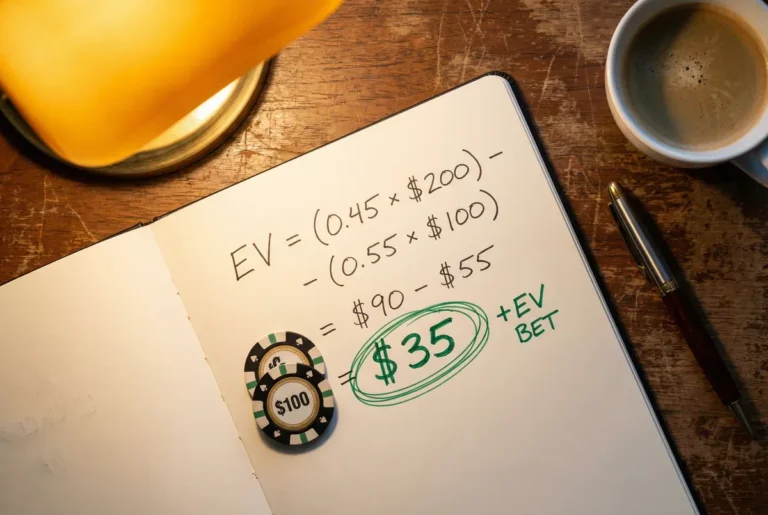
The Proven Rule of Only Betting When You Have Positive Expected Value
The discipline of only placing bets when mathematical expected value favors you is what separates professional play from recreational gambling.…
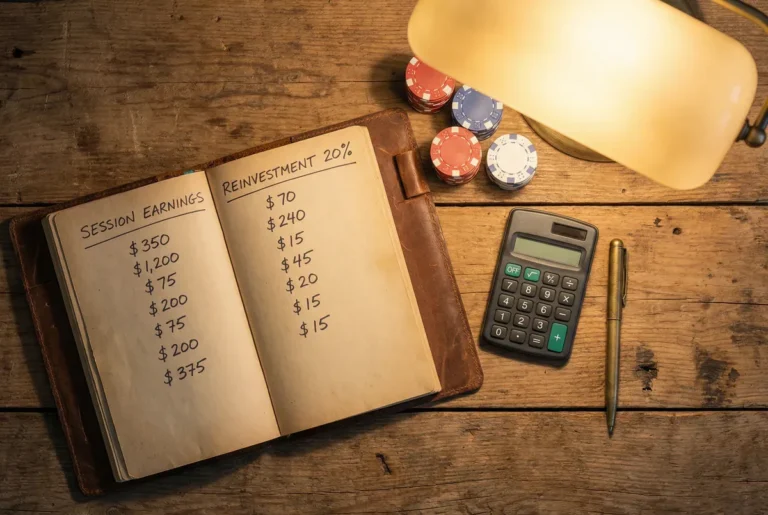
Proven Methods for Managing Professional Blackjack Earnings and Reinvesting
Professional blackjack earnings require the same financial management discipline as any self-employment income. How you allocate winnings between personal spending…