
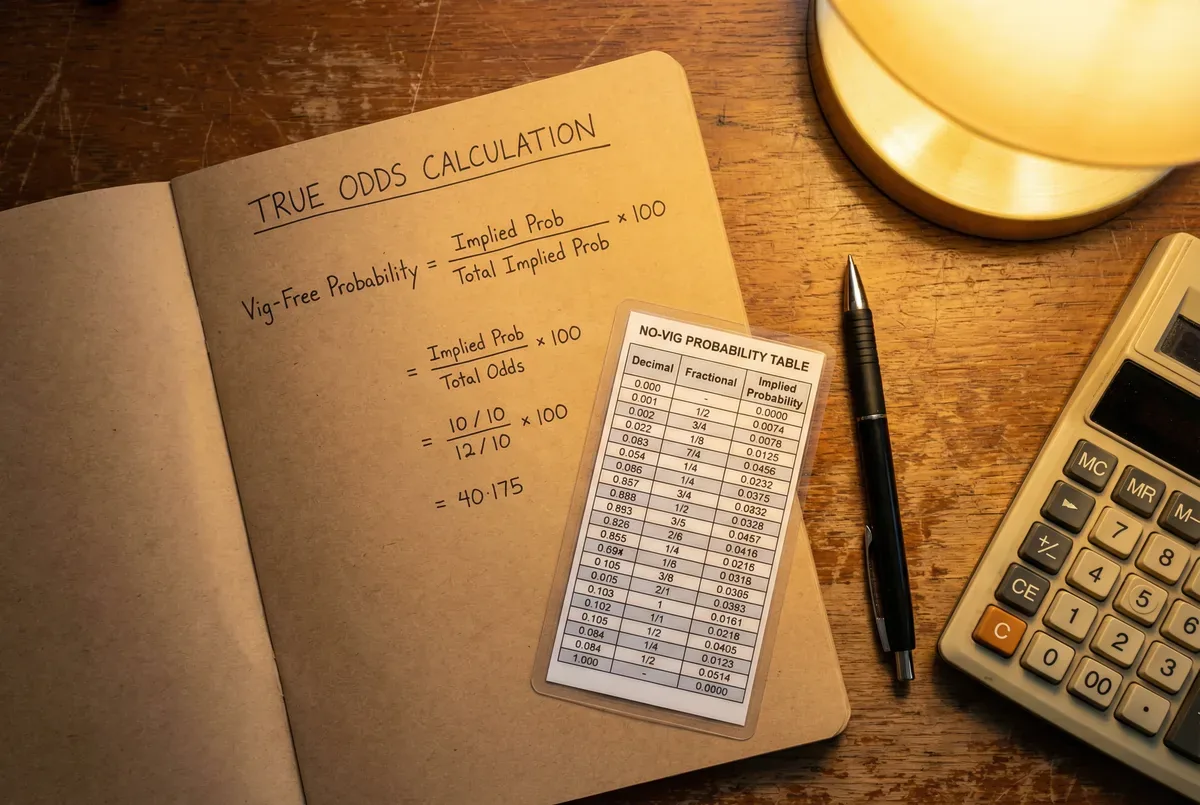
Finding the True Odds of Every Wager with No Vig Math
Every casino bet is priced below its true mathematical odds. The difference between what a bet should pay based on probability and what it actually pays is the vig vigorish which is the casino’s margin. In blackjack, the vig manifests primarily through the dealer-acts-last rule: the player busts before the dealer reveals their hand, creating an asymmetric bust risk that accounts for the majority of the blackjack house edge. In side bets and proposition wagers, the vig is embedded in payout tables that simply pay less than probability demands. Understanding how to find true odds the mathematically fair payout and compare it to the casino payout gives you a complete picture of every bet’s actual value before you commit a dollar.
The Vig Is the Casino’s Revenue Model
Approximate house edge on main blackjack hand (3:2, S17, 6D)
%
Approximate house edge on Perfect Pairs side bet
%
Approximate house edge on insurance bet
%
How Do You Calculate True Odds From First Principles?
True odds are calculated from probability. If the probability of an event is p, the true odds against it are (1-p)/p to 1, and the fair payout on a winning $1 bet is (1-p)/p dollars. For blackjack naturals occurring with probability approximately 4.83% in a six-deck game, the true odds are 19.7:1 and the fair payout per dollar is $19.70. A 3:2 payout pays $1.50 per dollar much lower than fair, reflecting the house margin on naturals. A 6:5 payout pays only $1.20 per dollar, even further from fair odds. This calculation makes the cost of the 6:5 rule concrete: you are being paid $1.20 where the fair value of your win is $19.70, representing a massive understatement of your actual probability-adjusted earnings.
The no-vig framework applies this calculation to every bet in the game. For insurance a side bet paying 2:1 if the dealer has blackjack the true probability of dealer blackjack is approximately 30.8% when the dealer shows an ace in a six-deck game. True fair odds are 2.25:1, but the casino pays 2:1, creating a 5.8% blackjack house edge on the insurance bet. Stripping the vig makes this explicit: the insurance bet pays $2 where fairness demands $2.25, every time not a one-time anomaly but a structural underpayment on every insurance bet ever placed.
Common Myth
“Insurance is worth it when you have a strong hand”
Players feel protecting a winning hand against dealer blackjack is rational
The Reality
Insurance has a 5.8% house edge and is a losing bet regardless of your hand
Even money on blackjack is insurance in disguise it costs you 4% of EV on your natural
How Do You Apply No-Vig Math to Side Bets?
Side bets are where casino vig is most egregious and most obscured. The Lucky Ladies side bet which pays for two-card totals of 20, especially suited has a blackjack house edge of 17–24% depending on variant. The true probability of two queens of hearts in a six-deck shoe is approximately 1 in 1,328 hands, yet most Lucky Ladies tables cap the jackpot payout at 1,000:1, paying below true odds even on the marquee outcome. Calculating this from first principles requires only the deck composition and combinatorics formula. The result is always the same: the casino captures the gap between true probability and actual payout on every outcome in the side bet distribution.
| Scenario | True Fair Payout | Casino Payout |
|---|---|---|
| Dealer has blackjack (wins) | ||
| 2.25 | 1 | |
| 2 | 1;Dealer no blackjack (loses) | |
| Lose bet;House edge on bet | ||
| 0% (fair) | ||
| 5.8% |
How Does No-Vig Thinking Work as a Universal Bet Filter?
The practical application of no-vig mathematics is a simple filter: before placing any bet beyond the main hand, calculate the true odds using the known probability and compare to the offered payout. If the payout is lower than true odds which it almost always is for side bets you are paying vig for the privilege of placing that bet. The only question is how much vig, and whether any strategic or entertainment value justifies it. For the main blackjack hand with blackjack basic strategy, the vig is minimal (0.5%) and the game itself provides genuine strategic engagement. For most side bets, the vig is 5–20% with no skill component a straightforward negative value proposition.
Before any new bet type, run the no-vig calculation. Probability in, true odds out, compare to offered payout. This twenty-second exercise will tell you everything you need to know about whether that bet belongs in your game.
Apply This Filter Before Every Live Session
The best environment for practising no-vig thinking is a real session where side bet circles are visible and the temptation to place them is genuine. At apply this at a live betting session this week, every bet placed costs real money which means the no-vig calculation is not academic but directly consequential. Before opening any side bet, apply the probability-to-true-odds formula. If the vig exceeds 2%, decline the bet and note what the casino captured from players who did not run the same filter. Over a year of sessions, this discipline represents a material reduction in expected loss.
Frequently Asked Questions
The vig is the casino's margin embedded in every bet through a payout below mathematical fair value. In blackjack it appears as the dealer-acts-last structural advantage (main game), as the insurance payout of 2:1 versus true odds of 2.25:1, and as the high house edges in all side bets.
Determine the probability p of the event using deck composition and combinatorics. True odds against = (1-p)/p. The fair payout per dollar is (1-p)/p. Compare this to the actual payout offered. The gap between them, expressed as a percentage of the bet, is the house edge.
Under most conditions, no. However, when a card counter has an established high count, certain side bets particularly 21+3 and Lucky Ladies can swing to positive EV. For non-counters, no standard side bet carries a positive expected value.
Before you test these plays at a real table, run them through our free blackjack simulator practice unlimited hands at zero cost until every move becomes automatic.
Mathematical Risk Warning
All casino bets are priced below mathematical fair value. Understanding the vig allows informed decisions but does not create profitable play opportunities without a genuine player edge.
Blackjack Academy is an educational resource. All strategy is based on mathematical expectation. Always play within your means.
Learn More
Continue your education with these related lessons.
Why Taking Regular Breaks Keeps You Winning Longer
Regular breaks are not a sign of weakness they are a professional discipline tool. Learn how structured rest periods reduce…
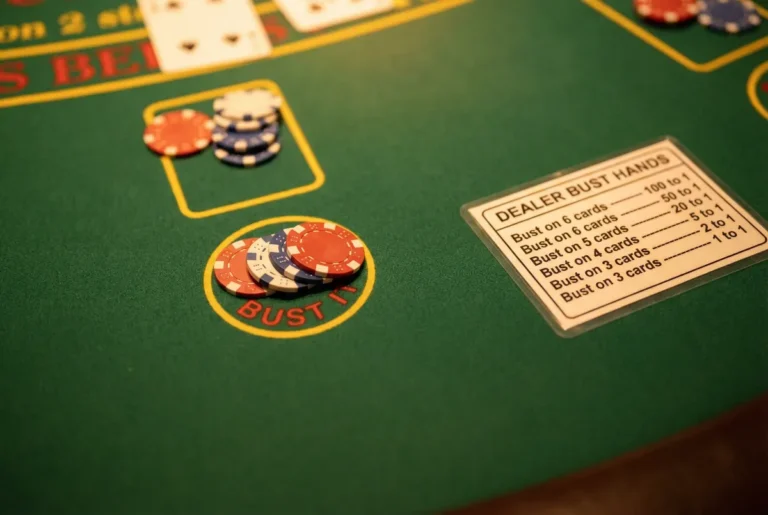
The Real Math Behind the Bust It Side Bet and Why You Should Avoid It
The Bust It side bet pays when the dealer busts with three or more cards. It sounds appealing dealers bust…

How to Set a Win Goal in Blackjack (And Why It Works)
A win goal of 20-25% of your session bankroll gives you a concrete exit point while you're ahead. Here's the…