
Fibonacci Betting System Math, Mechanics, and Its Deadly Real Limits
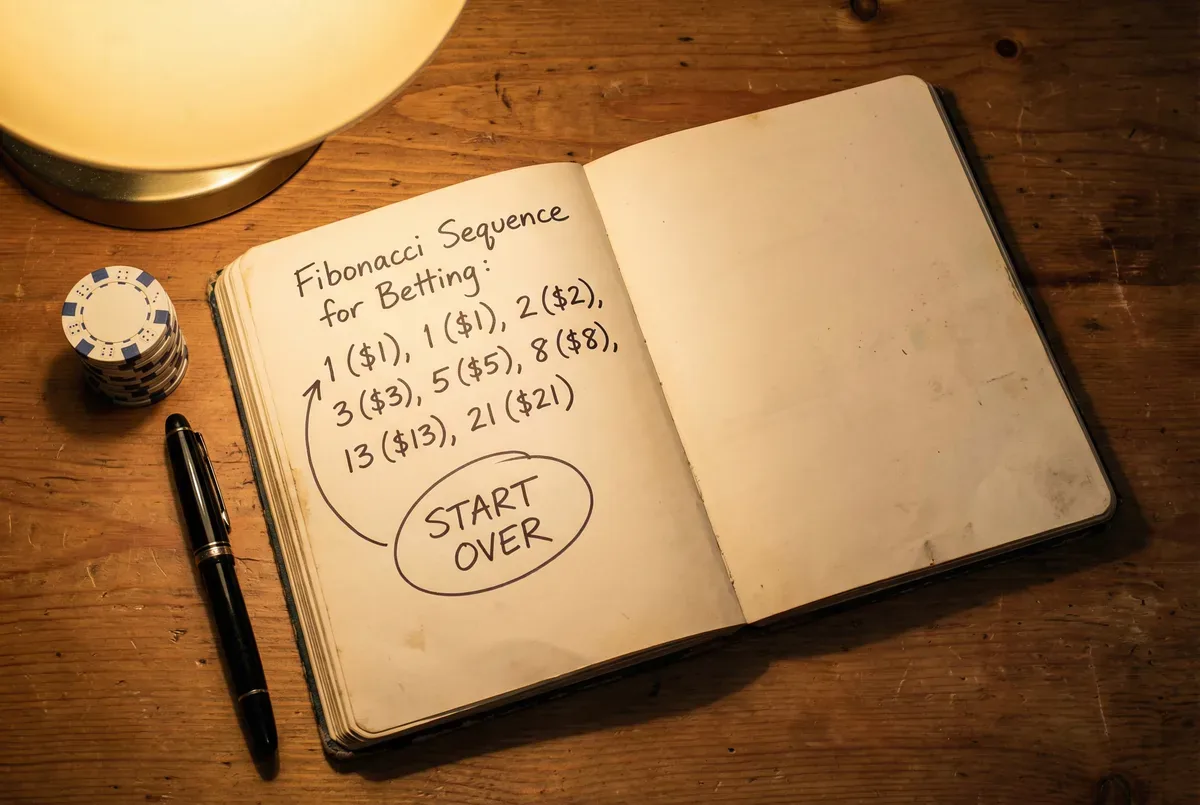
The Fibonacci betting system is a negative progression bets increase after losses built on the sequence 1, 1, 2, 3, 5, 8, 13, 21, 34, 55… where each number is the sum of the two before it. After a loss, you move one step forward in the sequence. After a win, you move two steps back. The appeal over Martingale is that the sequence grows far more slowly after five consecutive losses, Fibonacci requires a 8-unit bet while Martingale demands 32 units. This slower escalation gives the system a more forgiving profile during moderate losing runs, though it does not change the underlying mathematics that makes all negative progressions mathematically neutral at best.
The Fibonacci Sequence Produces a Slower Negative Progression Than Martingale
The system targets recovery of previous losses through larger wins once the sequence reverses. A win at step N in the sequence, followed by a second win at step N-2, recovers the net deficit from the losing run that built to step N. The recovery is not guaranteed it depends on wins arriving before the sequence advances to table-limit territory but the mechanism is mathematically cleaner than systems with arbitrary step-back rules.
Understanding what Fibonacci actually does, and what it cannot, and requires tracking both the bet sequence and the cumulative bankroll position through simulated runs of different lengths.
- Step 1$10
- Step 2$10
- Step 3$20
- Step 4$30
- Step 5$50
- Step 6$80
- Step 7$130
- Step 8$210
- Table limit risk emerges at step 7–8 for most $500 max tables
How Do You Move Through the Sequence Correctly?
Start at step 1 (one unit). After every loss, advance one step. After every win, move back two steps if at step 1 or 2, return to step 1 and consider the sequence reset. The net effect of a win following a losing run is that you recover approximately the losses from two recent losing bets in that run. A full recovery requires multiple wins at elevated positions it is not a single-bet recovery mechanism like Martingale, but a gradual clawback across several winning hands.
The practical implication of the two-steps-back rule is that you need a win rate high enough to step back faster than losing runs push you forward. In blackjack with blackjack basic strategy and roughly 43% wins, 49% losses (the rest are pushes), losing runs of six or more occur roughly once every 50–70 hands. At step 6, the required bet is 8 units an $80 bet on a $10 base. Step 8 requires 21 units ($210). These are meaningful escalations for a system marketed as conservative.
The sequence also has no natural ceiling. Players who start the system without a predetermined exit point a maximum step they will play before resetting will eventually face a bet size that either hits the table limit or exceeds their bankroll. Pre-defining a step ceiling (commonly step 6 or 7) and resetting to step 1 after reaching it is not optional; it is a required parameter for any practical use of the system.
Common Myth
“Fibonacci is safer than Martingale because it grows slowly”
The sequence escalates much less aggressively than Martingale's doubling
The Reality
Fibonacci still reaches dangerous bet sizes during extended losing runs. A 7-step run requires a 13-unit bet and losing runs of 7+ happen regularly in any live session
Both systems are EV-neutral in a fair game and EV-negative against house edge. The Fibonacci risk profile is lower per run, but the house edge compounds identically over all bets regardless of system
What Are the Bankroll Requirements for Fibonacci at Common Stake Levels?
To use Fibonacci through step 7 before resetting, the maximum single bet is 13 units. The cumulative cost of a 7-step losing run is 1+1+2+3+5+8+13 = 33 units. A bankroll that can absorb two complete 7-step losing runs in a session requires at least 66 units plus the normal operating reserve approximately 100 units total for a realistic session. At a $10 base, that is $1,000 as a practical session bankroll. At a $25 base, $2,500 is the equivalent requirement.
These numbers reveal why Fibonacci, despite its slower escalation, still places significant demands on session bankroll compared to flat betting. A flat better can play 200 hands on a 20-unit session stake. A Fibonacci player using through step 7 needs 100 units to handle expected variance. The trade-off is that Fibonacci produces more session-to-session smoothness in outcomes fewer catastrophic single-session losses at the cost of requiring more capital in reserve.
Dealer Shows
Your Hand
You're at Fibonacci step 4 (30-unit bet) on a soft 18 against dealer 6. Do you double down?
The Fibonacci position is irrelevant to individual hand decisions. Basic strategy is always applied independently of the betting system. Soft 18 vs dealer 6 is a double in any situation the +EV of the double exceeds the cost of skipping it.
When Fibonacci Fits and When It Fails?
Fibonacci suits players who want a structured betting system with moderate variance control and a natural mechanical logic that removes ad-hoc bet sizing decisions. The sequence is easy to memorize and execute consistently. For players who struggle with flat betting’s monotony but want something less aggressive than Martingale, it occupies a genuine middle ground.
It fails like all systems when the blackjack house edge is treated as defeatable through sequence optimization. Over thousands of hands, every system produces the same expected loss: total wagered multiplied by blackjack house edge. Fibonacci changes the distribution of wins and losses across sessions; it does not alter the total expected loss across all sessions. Players who use it expecting long-term profit from the sequence mechanics alone will find the mathematical reality unchanged regardless of how elegantly the sequence is executed.
Test the Sequence Before Any Real-Money Session
Before committing to Fibonacci in a live session, run it for 200 hands at bring this betting system to a live session where real money is on the line the emotional response to watching a bet escalate to step 5 or 6 is only learnable under genuine financial stakes, not in free play. Note your actual decision-making at elevated sequence positions: do you stick to the rules or abandon the system when the step-4 bet feels uncomfortably large? That reaction tells you whether your risk tolerance actually supports this system. Real money, real stakes, properly budgeted from entertainment funds only.
Frequently Asked Questions
Not mathematically. Over the long run, both systems produce the same expected loss: total wagered times house edge. Fibonacci changes the distribution of results within and across sessions more session-to-session consistency, but no improvement in long-run expected outcome. The choice between them is about variance preference, not profitability.
You cannot complete the sequence recovery because the next bet in the sequence exceeds the table limit. At that point, you have no mechanism to recover the accumulated losses from the run. This is why pre-defining a step ceiling and resetting before reaching table limits is essential for any serious use of the system.
Oscar's Grind is a positive progression bets increase after wins. Fibonacci is a negative progression bets increase after losses. Oscar's Grind seeks to lock in a one-unit profit per cycle; Fibonacci seeks to recover losses from the previous run. They are structurally opposite systems suited to different psychological profiles.
Before you test these plays at a real table, run them through our free blackjack simulator practice unlimited hands at zero cost until every move becomes automatic.
Mathematical Risk Warning
The Fibonacci system does not overcome house edge. All negative progression systems expose players to increasing bet sizes during losing runs. A long enough losing run will exceed any bankroll or table limit regardless of the sequence used. Define your maximum step and enforce it before sitting down.
Blackjack Academy is an educational resource. All strategy is based on mathematical expectation. Always play within your means.
Learn More
Continue your education with these related lessons.

Proven Bankroll Growth Strategy for Recreational Blackjack Players
When should a recreational player move up to higher stakes? The 300-unit rule, how to manage winnings, and the structural…

Bankroll Management Secrets Every Professional Blackjack Player Needs
Professional blackjack longevity depends entirely on disciplined bankroll management. Learn the exact unit sizing, session limits, and reserve rules that…
The Real Formula for Calculating Your Blackjack Risk of Ruin
Risk of ruin is the probability that a losing streak will eliminate your entire bankroll before you can recover. This…