
Why Even Money is a Sucker Bet You Should Always Decline
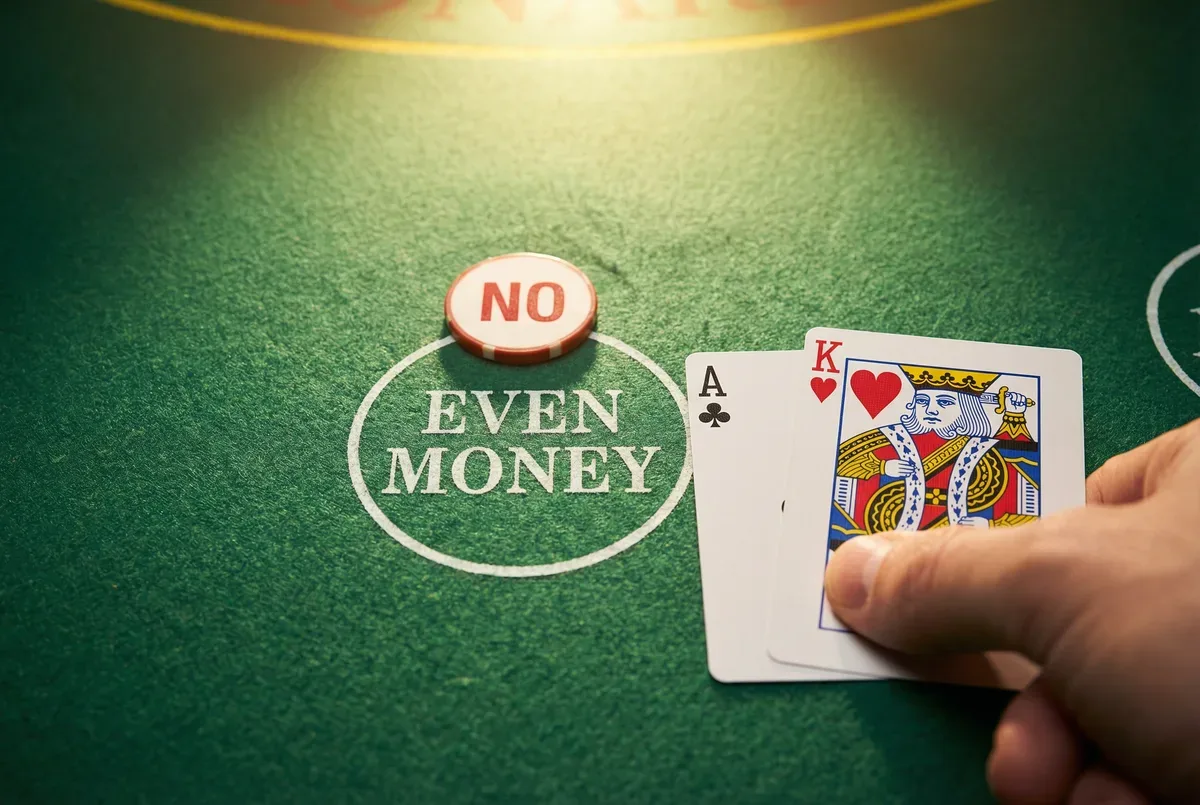
Even money is the offer made by a dealer when you hold a blackjack and the dealer’s upcard is an ace. The dealer offers to pay you 1:1 on your bet immediately, before checking the hole card, in exchange for waiving your right to the standard 3:2 blackjack payout. It is presented as a guarantee you always win, never risk a push. The mathematics reveal that this guarantee costs you approximately 3.7 cents per dollar wagered relative to declining the offer and playing out the hand normally.
Even Money in Blackjack Costs You 3.7 Percent in Expected Value Per Hand
Even money is structurally identical to taking insurance when you hold a blackjack. When you accept even money, the casino is settling the insurance side bet and the main hand simultaneously at a combined 1:1 rate. The name changes, the emotional framing changes, but the underlying bet and the underlying odds are exactly the same as buying insurance a 5.8% blackjack house edge side bet on the dealer’s hole card.
The reason even money feels safe is psychological. Receiving a guaranteed profit when you have a blackjack activates loss aversion the fear that a dealer blackjack will push your premium hand and feel like a theft. But mathematically, a push on blackjack is not a loss; it is a break-even outcome, and the frequency of that outcome does not justify the cost of the insurance premium to avoid it.
| Scenario | Accept Even Money | Decline Even Money |
|---|---|---|
| Dealer has no blackjack (69.1%) | ||
| +1 unit | ||
| +1.5 units;Dealer has blackjack (30.9%) | ||
| +1 unit | ||
| 0 units (push);Expected value per unit bet | ||
| 1.000 | ||
| 1.037;EV difference | ||
| +3.7% better to decline |
Why Does the Exact Math That Make Declining Always Correct?
In a 6-deck game with blackjack basic strategy, the probability that the dealer holds a ten-value card in the hole when showing an ace is approximately 30.9%. The probability that the dealer does not have a ten in the hole is 69.1%. These probabilities determine the expected value of each choice.
When you decline even money: you win 1.5 units 69.1% of the time and win 0 units (push) 30.9% of the time. Expected value = (0.691 × 1.5) + (0.309 × 0) = 1.037 units per unit bet. When you accept even money: you receive 1.0 unit 100% of the time. Expected value = 1.0 units per unit bet. Declining is worth 3.7% more per hand. Over a session with 10 blackjacks a typical rate at roughly one blackjack per 20 hands in 200 hands that difference adds up to a meaningful amount.
The only exception is the blackjack card counting scenario: when the true count is +3 or higher, the proportion of tens remaining in the deck rises above 33.3%, making the insurance component positive EV and even money a correct mathematical choice. For all other players and situations, decline every time.
Common Myth
“Taking even money guarantees a win it is always the smart choice”
A guaranteed profit feels better than a probable profit plus risk of a push
The Reality
Even money pays 1:1. Declining and letting the hand play out produces 1.037 units of expected value per unit bet 3.7% more
Accepting even money is equivalent to leaving 3.7 cents of expected value on the table for every dollar of your bet, every single time
What Are Social Pressure and the Even Money Offer?
The even money offer often comes with social weight. The dealer, pit boss, or other players at the table may react with visible dismay or concern when you decline. Comments like “guaranteed money!” or “never pass up even money!” are common. This social pressure is worth understanding: the casino staff benefit from players accepting even money because it increases the casino’s expected revenue. The advice they give at the table, however well-intentioned it may feel, reflects the casino’s interest rather than yours.
How Do You Handle Social Pressure to Accept Even Money?
Fellow players who advocate for even money are not malicious they simply have not done the math and have been influenced by the same loss aversion bias that makes even money feel safe. Declining quietly and without argument is the correct response. You do not need to explain the probability calculation to the table.
Rehearse your even money decline before your first session. When the dealer says 'even money?', your response should be immediate: 'No thank you.' Speed and calm confidence prevent the social pressure from building. Hesitation invites commentary.
Encountering the Even Money Offer in Live Play
The even money moment arrives without warning and demands an immediate response. Rehearse it before it happens. At apply this at a live betting session tonight, live dealer games offer the even money prompt in real time practice your immediate decline before the scenario arrives in a higher-stakes environment. Real money on the table produces the genuine emotional pull of a guaranteed payout vs. the risk of a push. Only use funds fully budgeted for entertainment, and treat every declined even money offer as a textbook execution of correct mathematical play.
Frequently Asked Questions
Slightly. In a single-deck game, fewer cards have been removed, so the proportion of tens is marginally different. The insurance house edge in single deck is approximately 5.9% slightly worse than 6-deck. Even money remains the wrong choice in single deck for all non-counters.
No. Three consecutive pushes represent a statistically unusual run, not a signal that future dealer blackjacks are more likely. The probability of each new hand is independent of past results. The even money math is the same on the fourth hand as it was on the first.
Even money is only offered when the player holds a natural blackjack and the dealer shows an ace. It is the specific phrasing used for insurance on a blackjack hand. Insurance without a player blackjack is the same bet but cannot be branded as 'even money' since the outcomes differ.
Before you test these plays at a real table, run them through our free blackjack simulator practice unlimited hands at zero cost until every move becomes automatic.
Mathematical Risk Warning
Accepting even money reduces your expected value by 3.7% per blackjack hand relative to declining. Over a full session, this difference is measurable and works consistently against the player. Decline even money on every hand where you are not counting cards at true count +3 or higher.
Blackjack Academy is an educational resource. All strategy is based on mathematical expectation. Always play within your means.
Learn More
Continue your education with these related lessons.
How to Handle a Large Blackjack Win at the Casino Cashier Safely
Winning big at blackjack is great until you handle it poorly. Learn when casinos report winnings, how to color up…
Why the Martingale System is the Fastest Way to Go Broke
The Martingale sounds bulletproof just double after every loss and you must win eventually. But the math behind table limits…
Why Setting a Stop Win is a Critical Professional Skill
A stop-win rule is not pessimism about your ability to keep winning. It is the mathematical recognition that every hand…