
Bankroll Management Secrets Every Professional Blackjack Player Needs
Bankroll management is the discipline of sizing every bet relative to your total available funds, so that inevitable losing streaks cannot wipe you out before variance evens out. In blackjack, where the blackjack house edge is between 0.5 and 1.5 percent depending on rules and your skill level, short-term swings of 20–40 buy-ins are mathematically normal. Without a system that accounts for those swings, even a skilled player can go broke during a run of cold cards that has nothing to do with mistakes.
What Bankroll Management Actually Means in Blackjack
Most recreational players treat their wallet as their bankroll they play until the cash runs out or they feel tired. Professional-level thinking starts with a dedicated blackjack fund kept completely separate from living expenses. This separation is not optional. Mixing gambling funds with rent money creates emotional pressure that distorts every decision at the table.
The foundation is simple: decide your total bankroll, derive your unit size from it, and never deviate. Every rule below flows from that single commitment.
Recommended units in full bankroll
units
Maximum bet per hand
% of bankroll
Typical session buy-in
units
How to Calculate the Right Unit Size for Your Bankroll?
A betting unit is the smallest denomination you wager on a standard hand. The correct unit size is determined by dividing your bankroll by 200 to 300. A $3,000 bankroll produces a $10–$15 unit. A $600 bankroll produces a $2–$3 unit. This range gives your bankroll enough depth to survive a 100-unit downswing which simulations show occurs in roughly 1 in 5 sessions of 500 hands without forcing you to reload or quit the game entirely.
Flat bettors playing blackjack basic strategy at 0.5% blackjack house edge can expect to lose approximately 0.5 units per 100 hands on average, but standard deviation is around 10 units per 100 hands. That means after 400 hands you could realistically be down 25 units through no fault of your own. A 300-unit bankroll absorbs that without alarm.
Card counters using a 1–12 spread need larger bankrolls typically 400–500 units of the base bet because the higher bets during favorable counts amplify variance significantly. Never use counting unit-sizing for flat-bet play, and never try to flat-bet on a counter’s bankroll schedule. The calculations are different for a reason.
Under-bankrolled
Properly bankrolled
- Too large for funds
- High in single session
- Desperate bets likely
- Catastrophic
- 1/200th to 1/300th of total
- Minimal over 5,000 hands
- Calm, rule-based play
- Normal continue playing
How Does Session Rules That Prevent Ruin Between Trips?
Even with the right unit size, session discipline matters. Bring 20–25 units to any single session. This is your buy-in, not your full bankroll. If you lose it, you walk away your full bankroll stays intact at home or in a separate account. This rule alone prevents the most common disaster: reaching into a pocket or ATM for “just one more buy-in” and burning through a month’s worth of sessions in a single bad afternoon.
Set a win target as well. Ending a session at plus 15 units is not cowardice it is variance capture. Continuing to play after a strong run increases your exposure to regression without changing the underlying math. Many players win 20 units, feel invincible, and give all of it back plus their starting stack before standing up. The win limit prevents that pattern.
A properly sized blackjack bankroll holds 200 to 300 units. At $10 per unit, that is $2,000 to $3,000 set aside exclusively for play. A 50-unit losing session which variance produces roughly once in five sessions of 500 hands should trigger zero panic. It is scheduled math, not a crisis. The player who has 250 units absorbs it and continues. The player with 40 units is already out of the game.
How Do You Rebuild a Depleted Bankroll Without Going on Tilt?
Losing streaks happen to every player, including professionals. The recovery protocol is boring by design: drop to a lower unit size, play shorter sessions, and rebuild through accumulated small positives rather than trying to win everything back in one aggressive session. If your bankroll falls below 100 units of your current bet size, cut the unit size in half immediately and do not restore it until you are back above 200 units.
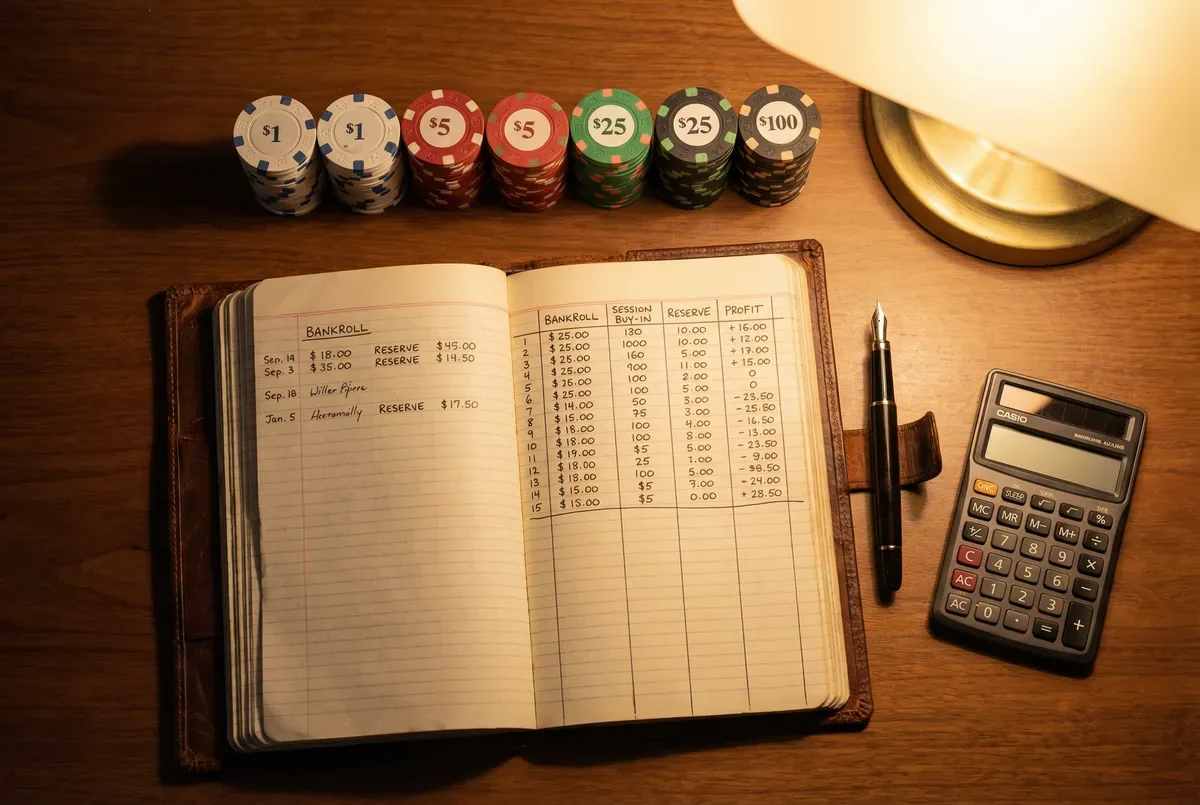
Document every session date, blackjack table rules, hands played, result in units. This log does two things. First, it shows you whether your results are within expected variance or whether something in your strategy needs correction. Second, it turns emotional reactions into data, which reduces tilt. It is much harder to make a desperate bet when you can see that you are statistically right on schedule for a breakeven week.
Applying These Rules Live at the Table
Bankroll principles only work when tested against real decisions. The apply this to a live session with real money environment lets you practice session management buy-in limits, win/loss stops, unit discipline with real stakes and real consequences. Understand that live play involves money you can genuinely lose; only bring funds you have budgeted for entertainment, and treat every session as a controlled experiment in discipline rather than a lottery.
Frequently Asked Questions
Between 200 and 300 betting units at the top-end bet. A counter whose max bet is $100 needs a $20,000 to $30,000 dedicated counting bankroll. Smaller bankrolls at this spread carry a risk of ruin above 10%, which is unsustainable for professional play.
When the bankroll drops below 150 units at the current top bet. At that threshold, the top bet should be scaled down until the 200-unit ratio is restored. Continuing to bet the same size with a depleted bankroll accelerates the risk of total ruin.
Most professionals set aside 25 to 35% of monthly net wins in a separate tax reserve account. This money is never treated as part of the playing bankroll. Failing to reserve for taxes is one of the most common reasons professional careers end prematurely.
Before you test these plays at a real table, run them through our free blackjack simulator practice unlimited hands at zero cost until every move becomes automatic.
Mathematical Risk Warning
Bankroll management reduces the speed of loss but does not eliminate it. All blackjack games carry a house edge. Even with perfect strategy and disciplined unit sizing, extended play will produce a net loss over time unless you are a skilled card counter playing in favorable conditions.
Blackjack Academy is an educational resource. All strategy is based on mathematical expectation. Always play within your means.
Learn More
Continue your education with these related lessons.
Why Setting a Stop Win is a Critical Professional Skill
A stop-win rule is not pessimism about your ability to keep winning. It is the mathematical recognition that every hand…

How to Choose the Right Betting System for Your Personal Risk Tolerance
The best betting system for you is the one that matches your risk tolerance, not the one with the most…
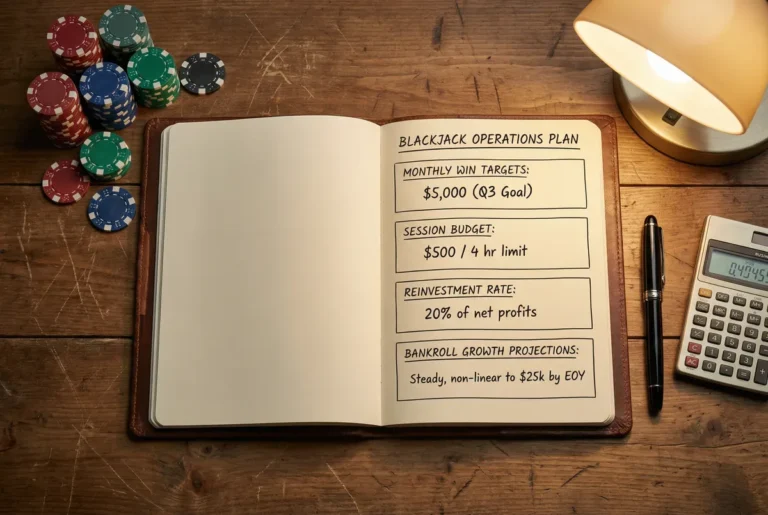
Why Treating Your Blackjack Bankroll Like a Business Beats Pure Gambling
Professional advantage players manage their bankroll with the same discipline as a small business separate accounts, profit-and-loss tracking, quarterly reviews,…