

Avoiding High Risk Betting Systems That Lead to Bankruptcy
The appeal of negative progression betting systems is intuitive: if you double your bet after every loss, one win must eventually recover everything. This logic is seductive because it sounds airtight. In reality it collapses against two hard constraints every casino exploits ruthlessly table maximums and finite bankroll. The Martingale system requires bets to scale exponentially: 1, 2, 4, 8, 16, 32, 64, 128 units after seven consecutive losses. A seven-loss streak at a table with a 500-unit maximum leaves you unable to continue the progression, having already lost 127 units with no recovery path. Streaks of that length occur far more often than intuition predicts, and they are precisely what eventually bankrupts every player who relies on a negative progression system over an extended sample.
Why Betting Systems Feel Logical and Are Mathematically Deadly
Common Myth
“Doubling bets after losses guarantees eventual recovery”
Each win after a streak nets only one unit profit, so the system seems to work in the short run
The Reality
Table limits cap the progression before recovery is possible on long losing streaks
A 7-loss streak at a $10 table requires a $1,280 bet to continue most tables cap at $500
Why Does the Ruin Probabilitie Behind Popular Systems?
Gambler’s ruin theory provides a precise framework for calculating the probability of depleting a bankroll before reaching a target. For the Martingale applied to blackjack at a 0.5% blackjack house edge, starting with 50 units and targeting 10 units profit, the ruin probability exceeds 85% before the goal is reached over a long session. The Labouchere system, which uses a sequence of numbers and cancels them on wins, has a similar trajectory the sequence grows longer on losing streaks and the required bets escalate until bankroll exhaustion forces termination. Neither system changes the underlying expected value. They only redistribute risk across time, concentrating it into catastrophic single-session losses.
The Fibonacci system applies the famous sequence (1, 1, 2, 3, 5, 8, 13…) to bet sizing after losses and moves back two steps after wins. It escalates more slowly than Martingale, which gives players the illusion of safety. But on a sequence of twelve consecutive losses which carries a probability of roughly 0.024% per session, meaning it occurs once every 4,200 sessions the required bet reaches 144 units. At a $10 unit, that is a $1,440 bet to recover a losing streak. The apparent conservatism of Fibonacci is an illusion purchased by elongating the path to the same catastrophic endpoint.
System
Units Needed After 8 Losses
- 256 units
- 34 units
- 22 units
- 8 units (no escalation)
What Flat Betting Actually Delivers?
Flat betting, wagering the same amount every hand, and is mathematically superior to every negative progression system for a player using blackjack basic strategy. It does not promise the exciting short-term recoveries that progressions seem to offer, but it guarantees that each individual hand carries the lowest possible expected loss at the prevailing blackjack house edge. With a 0.5% edge and a $10 flat bet, expected loss per hand is five cents. A Martingale player who reaches the fifth level of a progression is risking $160 to net $10 accepting a $160 downside exposure for a $10 expected gain at the same blackjack house edge. The risk-adjusted math of flat betting is unambiguously better at every point in the distribution.
No betting system changes the mathematical expected value of any individual hand. Systems only change the size of bets placed on hands that carry the same negative expectation.
Fundamental Rule
What Are Positive Progressions and Their Limits?
Positive progression systems increasing bets after wins rather than losses are less destructive because they risk winnings rather than capital. The Paroli system, for example, doubles the bet for up to three consecutive wins then resets. This caps the downside to one base unit at the start of every new cycle. However, positive progressions still do not generate positive expected value from a negative-edge game. They increase variance and create the psychological experience of larger wins, which can be enjoyable, but the long-run expected outcome remains negative at the same house-edge rate. They are a preference tool for managing the shape of variance, not a path to profitability.
The only mathematically legitimate path to positive EV in blackjack is removing the blackjack house edge through blackjack card counting, favorable rule exploitation, or legitimate promotion arbitrage. Any betting system applied on top of a negative-edge game merely redistributes how that negative expectation is experienced across sessions it never eliminates it.
Apply This Knowledge Under Real Conditions
Understanding betting system math theoretically is not enough you need to feel the temptation of a progression mid-session to truly internalize why flat betting holds. Head to apply this progression with real stakes and commit to 100 hands of strict flat betting with real money on the line. Notice how the urge to increase after a losing run surfaces instinctively. Resisting it with a disciplined fixed bet is the most important habit a developing player can build, and real-money stakes make the lesson stick in a way that free practice never replicates.
Frequently Asked Questions
A high-risk system requires bet sizes that can exceed your total session bankroll within a realistic losing streak. The Martingale is the clearest example doubling after every loss means 10 consecutive losses requires a bet 512 times your starting unit, exceeding most bankrolls.
Yes, and this is precisely why they are dangerous. High-risk progressions win frequently in the short term the Martingale wins on over 99% of short sequences. The losses, when they come, are catastrophic and wipe out all prior gains plus the initial bankroll.
Most professional guidelines cap any single bet at 2 to 5% of total session bankroll for basic strategy players, and 1 to 2% of total counting bankroll for advantage players. Any system that requires bets exceeding this threshold in response to losses should be avoided entirely.
Before you test these plays at a real table, run them through our free blackjack simulator practice unlimited hands at zero cost until every move becomes automatic.
Mathematical Risk Warning
All betting systems operate on a negative expected value in standard blackjack. No progression system eliminates house edge. Bankroll ruin is a mathematical certainty for any system applied indefinitely.
Blackjack Academy is an educational resource. All strategy is based on mathematical expectation. Always play within your means.
Learn More
Continue your education with these related lessons.

How to Size Your Blackjack Bets on a Fixed Entertainment Budget
Playing blackjack on a fixed monthly budget requires the 1% per-bet rule, a 100-unit minimum bankroll, and a clear allocation…
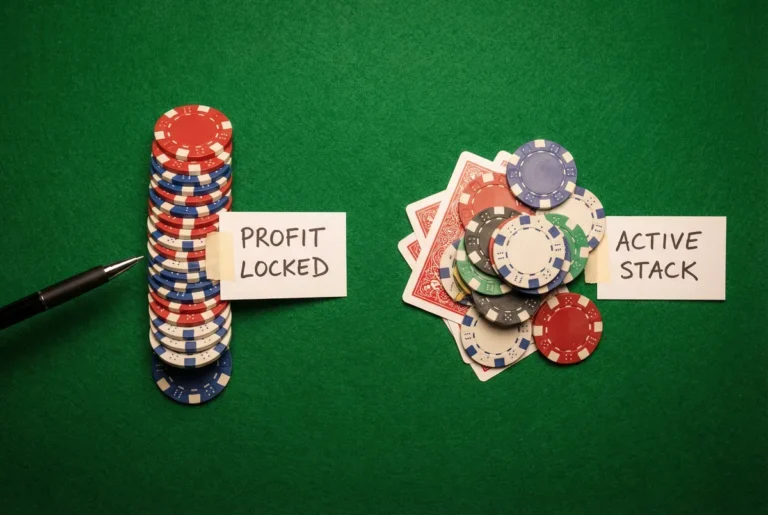
How to Lock in Profits Using Positive Progression Betting
Positive progression betting locks in profits by pressing bets only with winnings, so any loss returns you to your starting…

The Real Difference Between Progressive Betting and Flat Betting
Progressive and flat betting produce the same EV over time. The real difference is variance. Here's who each approach suits,…