
Why Deck Penetration Is the Hidden Factor That Changes Basic Strategy
Deck penetration is the percentage of cards dealt from the shoe before the dealer reshuffles. A 6-deck game with 75% penetration means roughly 4.5 decks are played before the cut card triggers a new shuffle. For blackjack basic strategy players, penetration influences composition-dependent decisions particularly on borderline hands where the remaining deck distribution has shifted. For card counters, penetration is the single most important variable in the game. This guide explains exactly what penetration means, how to measure it, and what conditions to seek or avoid before you sit down at any table.

- 50% penetrationhalf the shoe dealt before reshuffle poor conditions for strategy accuracy
- 60% penetrationslightly below standard marginal conditions, avoid if alternatives exist
- 65% penetrationtypical 6-deck Vegas baseline acceptable for basic strategy play
- 75% penetrationthree-quarters dealt good conditions, composition shifts become meaningful
- 80% penetrationwell above average strong conditions for all skill levels
- 85% penetrationnear-ideal rare in modern casinos, maximum card-tracking value
- 90%+ penetrationexceptional almost never seen in regulated 6-deck games
- CSM (continuous shuffle machine)0% effective penetration cards recycled every hand, avoid
Deck Penetration Explained
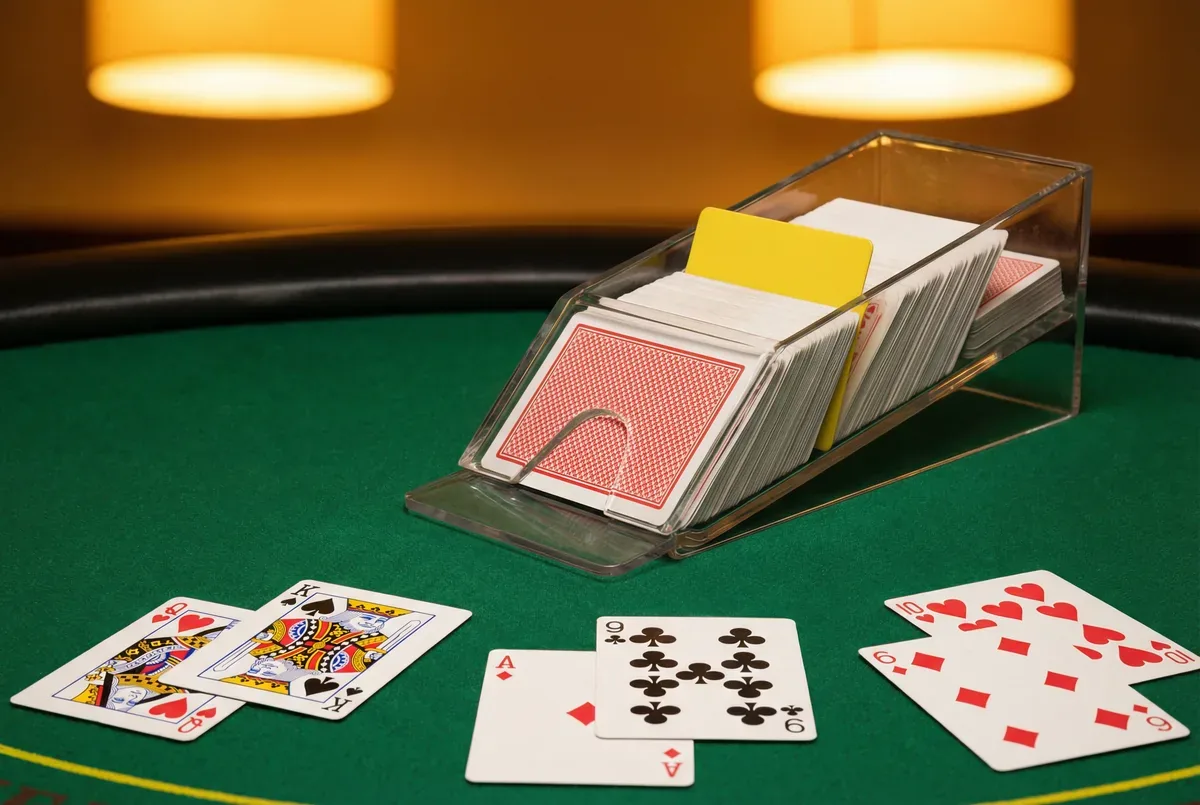
Deck penetration is expressed as the percentage of cards dealt from the shoe before the dealer inserts the cut card and initiates a reshuffle. In a standard 6-deck shoe with the cut card placed at 4.5 decks in, penetration is 75% meaning 75% of the available cards are seen before the deck resets. Casinos set penetration by physically positioning the cut card: push it toward the front of the shoe and penetration falls; push it toward the back and penetration rises.
Measurement is straightforward at the table. Watch for the plastic cut card during the shuffle note approximately where the dealer inserts it into the assembled decks. A cut card placed one deck from the back in a 6-deck shoe means the game runs five decks before reshuffling, which is roughly 83% penetration. In a single-deck game, a cut card placed two-thirds of the way through gives only 67% penetration often a deliberate casino countermeasure against advantage players.
50% Penetration
% of shoe dealt before reshuffle
Standard Vegas 6-Deck
% penetration typical
Good Conditions
% penetration
How Deep Penetration Affects Basic Strategy Decisions?
Basic strategy is calculated assuming a full, freshly shuffled shoe but the deck you’re actually playing against is never perfectly neutral after the first hand. As cards are removed, the remaining composition shifts, and a small subset of blackjack basic strategy decisions, called composition-dependent plays, and can change. The classic example is hard 16 against a dealer 10: the standard play is to hit, but if the remaining deck is unusually rich in small cards, the expected value of standing actually rises. Deep penetration makes these composition shifts larger and more meaningful.
For pure blackjack basic strategy players the impact on blackjack house edge is modest roughly 0.01% to 0.05% depending on the game and how far the shoe runs. That said, consistently playing in low-penetration games compounds into a measurable long-run disadvantage. More significantly, understanding penetration helps you recognise when a table’s conditions are structurally weaker and choose accordingly even if you never count a card in your life.
Why Casinos Control Penetration to Protect Their Edge?
Casinos manage cut card placement as a direct defence against card counters. The deeper the penetration, the more accurately a counter’s running count reflects the true composition of the remaining shoe and the higher their edge when they choose to increase their bet. By restricting penetration to 50–60%, a casino can reduce the correlation between a counter’s bet spread and the actual count, making advantage play substantially harder. Shallow penetration doesn’t harm casual players much; it is specifically aimed at shrinking the window of opportunity for skilled play.
How to Identify Penetration Level Before Sitting Down?
Before committing to a seat, stand behind an active table and watch one or two full shoes play out. Note where the cut card is relative to the total deck thickness when it triggers the reshuffle. A simple visual: in a 6-deck shoe, each deck is about 2 cm thick a cut card appearing with one deck remaining behind it means five decks were played, roughly 83% penetration. If the reshuffle triggers with two or more decks unplayed, you’re looking at 67% or lower acceptable for casual play but suboptimal if game quality matters to you. Also check for continuous shuffle machines (CSMs): a box attached to the shoe that feeds discards back automatically. CSMs eliminate penetration entirely every hand starts from a fully randomised pool making any composition-based edge impossible.
Three things to check before you sit: first, locate the cut card in the assembled shoe during the shuffle the further back it sits, the better the penetration. Second, watch when the reshuffle triggers mid-shoe; count the discards visually against the remaining undealt cards to estimate the percentage dealt. Third, look for a continuous shuffling machine (CSM) bolted to the table if one is present, walk away regardless of any other favourable rule. A CSM recycles discards continuously, resetting effective penetration to zero every hand. No composition-dependent edge, no counting opportunity, no benefit from remaining shoe knowledge. CSM tables exist purely for casino throughput and offer nothing to the informed player.
Using Penetration Knowledge Before Your First Real Bet
Knowing penetration theory is a starting point applying it under live casino pressure with real chips on the table is where the learning becomes genuine. If you want to test your ability to read cut card placement, track deck depth in real time, and execute composition-sensitive adjustments without hesitation, practise in a live-dealer environment before risking real money. Blackjack Academy’s live tables let you experience authentic shoe conditions and observe penetration firsthand bear in mind that live dealer play involves real money and carries real financial risk, so approach it only once your fundamentals are solid and your bankroll expectations are set correctly.
Frequently Asked Questions
It matters less than for counters, but it is not irrelevant. Penetration affects composition-dependent decisions hands like hard 16 against a 10 where a shifted deck composition can technically alter the optimal play. The house edge impact for a pure basic strategy player ranges from about 0.01% to 0.05% depending on penetration depth, which is small but real over large sample sizes. More practically, choosing higher-penetration tables is a free upgrade that costs you nothing.
In a standard 6-deck shoe, 75% penetration (4.5 decks dealt) is the commonly cited benchmark for acceptable conditions. Anything at 80% or above is strong. Most Las Vegas Strip casinos run 6-deck games at 65–75% penetration. If you find a table consistently dealing 80%+, that is an unusually player-favourable condition worth prioritising. Below 65% in a 6-deck game signals that the casino is specifically protecting the shoe, likely in response to skilled players.
A CSM (continuous shuffling machine) feeds each hand's discards back into the shoe immediately, meaning the deck is effectively always full and fully randomised. This eliminates any benefit from tracking deck composition the running count, remaining deck distribution, and composition shifts all become meaningless. Even for basic strategy players, CSMs increase the number of hands dealt per hour, raising your hourly expected loss even if the per-hand house edge is identical. There is no informational or strategic advantage available at a CSM table.
Before you test these plays at a real table, run them through our free blackjack simulator practice unlimited hands at zero cost until every move becomes automatic.
Mathematical Risk Warning
Blackjack carries a built-in house edge that compounds over time regardless of strategy quality. Penetration knowledge, card counting awareness, and composition-dependent adjustments reduce but never eliminate the casino's long-run advantage. Gambling should be treated as entertainment with a defined budget never as a reliable income source.
This article is for educational purposes only. Gambling involves risk of financial loss. Play within your means and in accordance with local laws.
Learn More
Continue your education with these related lessons.
How to Find Casinos That Allow Resplitting Aces
Most casinos quietly prohibit resplitting aces a rule that costs them 0.06% edge. Knowing how to find RSA tables, what…
Most Common Strategic Errors That Make Players Lose Money
Most recreational blackjack players make the same five errors on repeat and each one has a fixed, quantifiable cost. The…
Real Expected Value Numbers for Every Blackjack Hand Type
The expected value of every blackjack hand type hard hands 8 through 20, soft hands, and pairs quantified. Understand which…