
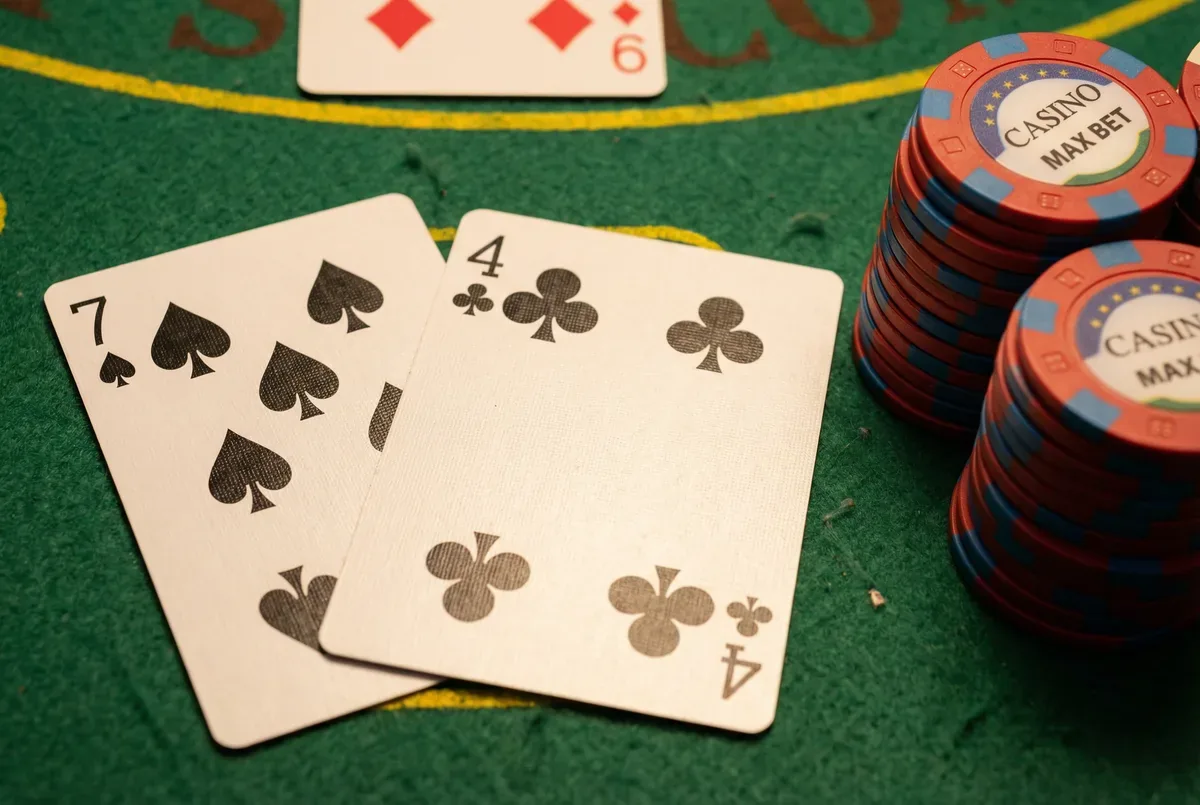
Why 11 Is the Most Powerful Double-Down Hand in Blackjack
- What Makes Hard 11 the Highest-EV Double in Standard Blackjack
- What Are Hard 11 Against Dealer 10 Why Players Hesitate and Why They Shouldn't?
- How Deck Count Changes the Hard 11 Double Against Dealer Ace?
- What Is the EV Cost of Hitting Instead of Doubling Hard 11?
- Committing to the Hard 11 Double Before Real Money Is on the Table
Hard 11 is the most powerful doubling hand in blackjack because it is the only total where three conditions align at once: zero bust risk on a single draw, the highest probability of reaching 21, and a positive expected value against every dealer upcard from 2 through 10 in standard multi-deck games. No other hand in the blackjack strategy chart produces a better return when you commit a second bet. Players who skip this double, particularly against a dealer 10, and are surrendering more expected value per occurrence than almost any other single error in blackjack basic strategy.
| Dealer Upcard | Double EV | Hit EV | Correct Action |
|---|---|---|---|
| Dealer 2 | +0.34 | ||
| Dealer 3 | +0.38 | ||
| Dealer 4 | +0.41 | ||
| Dealer 5 | +0.44 | ||
| Dealer 6 | +0.46 | ||
| Dealer 7 | +0.32 | ||
| Dealer 8 | +0.27 | ||
| Dealer 9 | +0.22 | ||
| Dealer 10 | +0.18 | ||
| Dealer Ace (H17) | +0.08 | ||
| Dealer Ace (S17) | -0.06 |
What Makes Hard 11 the Highest-EV Double in Standard Blackjack
Hard 11 holds the top position in doubling strategy because of its structural advantages over every other two-card total. Approximately 30.8% of all remaining cards in a full shoe are 10-value. A single draw to hard 11 reaches exactly 21 roughly one in three times, producing the highest possible non-blackjack total. That is the primary engine of the hand’s expected value.
The secondary engine is the zero-bust guarantee. No card in the deck can push a hard 11 past 21 on a single draw. The worst outcome is receiving a 2, leaving you at 13. An ace produces a soft 12, which continues to play forward normally. The one-card doubling constraint ordinarily a limiting factor carries no downside risk on this hand. That combination of maximum upside and zero bust risk does not exist on any other doubling total.
What Are Hard 11 Against Dealer 10 Why Players Hesitate and Why They Shouldn’t?
The hesitation on hard 11 vs dealer 10 comes from a specific fear: the dealer has a 10 underneath approximately 30.8% of the time, producing a blackjack or a standing 20 that your doubled hand must beat. Players imagine losing double the bet to a dealer 20 and instinctively reduce their stake. That instinct costs money every time it fires.
Dealer Shows
Your Hand
Dealer shows 10. You have hard 11 (6-5). Double or hit?
Hard 11 against dealer 10: double in all standard multi-deck charts. The dealer has a 10 underneath approximately 31% of the time (producing blackjack). But even when the dealer has a strong total, hard 11 doubled produces 20 or 21 on the draw approximately 31% of the time the most powerful single draw in blackjack. EV of doubling hard 11 vs dealer 10 is approximately +0.18 per original dollar. Hitting is +0.10. The doubled stake captures nearly double the EV. The hesitation on this hand is pure variance fear the chart answer is unambiguous.
How Deck Count Changes the Hard 11 Double Against Dealer Ace?
Against a dealer ace, the correct hard 11 decision splits along two variables: the number of decks and the soft-17 rule. In a six-deck H17 game, doubling hard 11 vs ace produces a marginally positive EV of approximately +0.08, making the double technically correct. In a six-deck S17 game, the dealer standing on soft 17 strengthens the ace enough that hitting becomes the better play, with EV around +0.06 vs the double at approximately -0.06.
Single-deck changes the calculus entirely. The compressed deck amplifies 10-value density for the draw and simultaneously weakens the dealer’s post-ace range. In single-deck with S17 rules, doubling hard 11 against the ace is always correct. In two-deck games the math also favors the double under both H17 and S17. The practical rule: in shoe games, check the soft-17 placard before deciding; in single or double deck, double without hesitation.
What Is the EV Cost of Hitting Instead of Doubling Hard 11?
Against a dealer 6 the weakest upcard in the game doubling hard 11 produces an EV of approximately +0.46 per unit wagered. Hitting the same hand returns approximately +0.24. The gap is 0.22 units. At a $25 base bet that is $5.50 of expected value surrendered on a single hand, every single time a player hits this spot instead of doubling. Hard 11 vs dealer 6 is the widest EV gap in the entire doubling chart.
Even at the tightest point hard 11 vs dealer 10 the gap between doubling and hitting is 0.08 units per original dollar. The doubled stake means that gap compounds: you are committing twice the money to a return that is 80% better per unit than hitting. Over a 200-hand session, hard 11 appears roughly eight times. A player who hits every one of those at a $25 table surrenders approximately $16 in expected value in a single session from this error alone.
Hard 11
Hard 10
- Frequency of 21:30.8% on one card:30.8% same draw rate
- Double vs Ace:Hit EV negative:Double marginal EV
Committing to the Hard 11 Double Before Real Money Is on the Table
The most common place hard 11 strategy breaks down is in live play under pressure dealer shows a 10, pot odds feel scary, and the hand that should be automatic gets second-guessed. The way to eliminate that hesitation is to rehearse the decision before cash is on the line. Knowing the EV numbers intellectually is not the same as having the reflex to push a second stack forward without a pause.
If you want to test whether you execute hard 11 correctly when a dealer 10 is staring back at you, the only environment that replicates the pressure honestly is a live session where the outcome has real financial consequence. Practice at a live dealer table at bring this double-down decision to a real table set a strict table minimum and treat every hard 11 as your benchmark hand for the session. Be clear before you sit down that real money is at risk from the first hand, and keep your session budget fixed in advance.
Frequently Asked Questions
In a standard multi-deck H17 game, double hard 11 against every upcard from 2 through 10, and against the Ace as well the EV is approximately +0.08 per unit. In a six-deck S17 game, the Ace is the one exception where hitting (+0.06) slightly outperforms doubling. For every upcard from 2 through 10 in any multi-deck format, the double is unambiguous and never wrong.
The EV of doubling hard 11 vs dealer 10 is approximately +0.18 per original dollar wagered, versus +0.10 for hitting. The dealer does not always have a 10 in the hole only about 31% of unseen cards are 10-value. Even when the dealer eventually reaches a strong total, hard 11 doubled reaches 20 or 21 approximately 31% of the time on the draw. The math accounts for all outcomes including dealer blackjack. The double wins more money over time.
Yes. In single-deck games, double hard 11 against every upcard including the Ace regardless of the soft-17 rule. The compressed deck amplifies 10-value density and weakens the dealer's post-Ace range enough to make the double correct in all single-deck formats. In a six-deck shoe, the Ace decision depends on the soft-17 rule: double in H17 games, hit in S17 games. Against upcards 2 through 10 the double is correct in both formats.
Before you test these plays at a real table, run them through our free blackjack simulator practice unlimited hands at zero cost until every move becomes automatic.
Hard 11 Is the Highest-EV Double in Basic Strategy
Verify every doubling situation against the correct chart with the Blackjack Calculator before your next session.
Blackjack Academy is an educational resource. All EV figures are based on mathematical expectation under standard multi-deck rules and assume correct basic strategy play. Always set a session budget before wagering real money.
Learn More
Continue your education with these related lessons.
How to Calculate Expected Value for Your Long Term Profit
Expected value in blackjack is the average outcome of a specific decision per dollar wagered, calculated across an infinite number…
Debunking the Myth That 2 Is a Dealer’s Ace Upcard
The 'dealer 2 is a dealer's Ace' myth causes players to play excessively cautiously against one of the weakest dealer…
How to Find Casinos That Allow Resplitting Aces
Most casinos quietly prohibit resplitting aces a rule that costs them 0.06% edge. Knowing how to find RSA tables, what…