
The Complete Guide to Pair Splitting Strategy
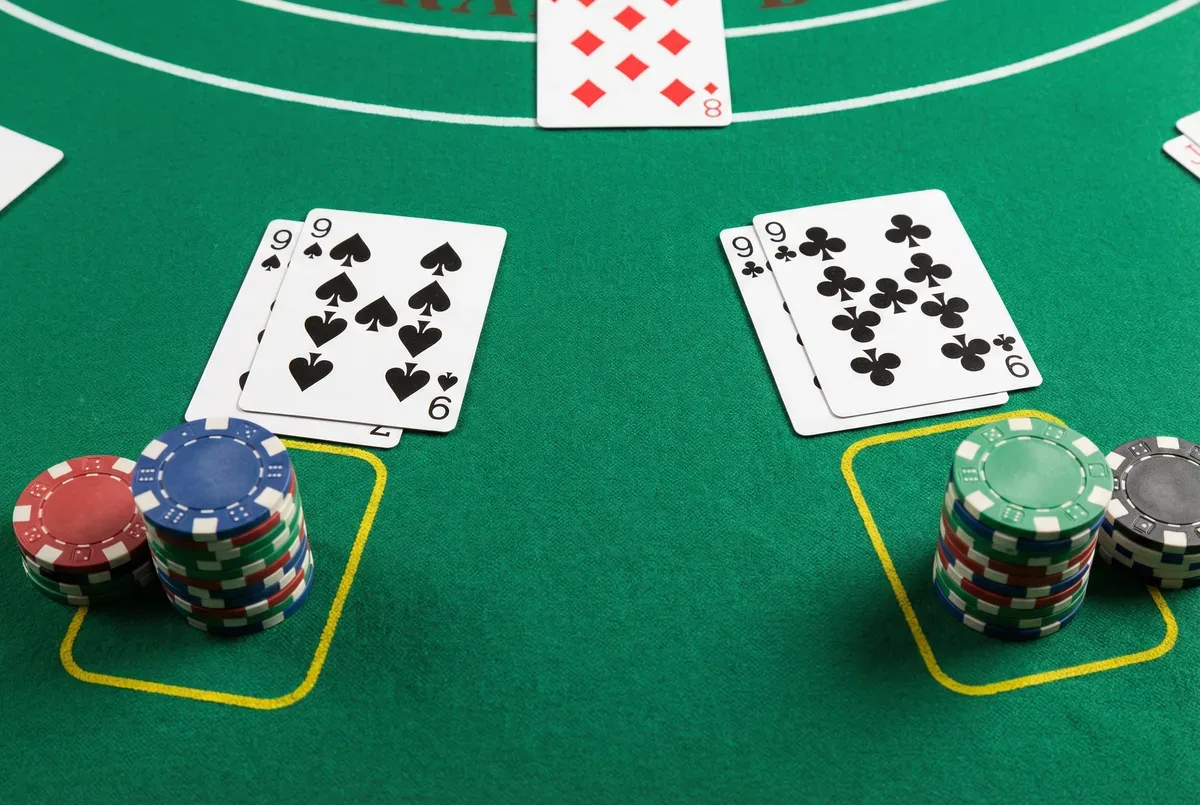
I watched a player at a Strip casino refuse to split 8-8 against a dealer 10 three times in the same hour. Each time he said the same thing: “I don’t want to put more money out there against a strong dealer.” Each time he played hard 16 to its ugly conclusion. Pair splitting strategy is the section of the blackjack basic blackjack strategy chart that costs recreational players the most money, not because the rules are complicated, but because two of the correct moves feel completely wrong. There are 10 possible pairs in blackjack, and the chart gives each a precise answer tied to dealer upcard and blackjack table rules. Learn those answers and you remove the single biggest source of gut-feeling deviation at the table.
- A-AAlways split. Two hands each starting at 11.
- 10-10Never split. A total of 20 is nearly unbeatable.
- 9-9Split vs 2-6 and 8-9. Stand vs 7, 10, Ace.
- 8-8Always split, including vs dealer 10 and Ace.
- 7-7Split vs 2-7. Hit vs 8 through Ace.
- 6-6Split vs 2-6 with DAS, vs 3-6 without DAS.
- 5-5Never split. Treat as hard 10 and double instead.
- 4-4Split vs 5-6 with DAS only. Hit otherwise.
- 3-3Split vs 2-7. Hit vs 8 through Ace.
- 2-2Split vs 2-7. Hit vs 8 through Ace.
Pairs Should Always Be Split
Four pairs have unconditional answers: always split aces and 8s regardless of dealer upcard, and never split tens or 5s regardless of dealer upcard. These four are the bedrock of pair splitting strategy and must be memorized without conditions attached.
Splitting aces converts one hand with limited drawing potential into two hands each beginning at 11, the strongest possible starting value. Splitting 8s converts hard 16, the worst standing hand in the game, into two hands each starting at 8. The conversion itself is the logic: you are not “putting more money out” against a tough dealer; you are replacing a hand that loses at a rate above 70% with two independent hands that each have a realistic path to improvement. Tens and 5s work the other direction. A total of 20 needs no help, and a hard 10 wants to be doubled, not split into two fives.
The 8-8 vs dealer 10 case is where I see the most hesitation. Players feel the dealer strength and want to treat 8-8 as a push or surrender candidate. In games with surrender available, late surrender on 8-8 vs dealer 10 and vs Ace is mathematically correct. Without surrender, the split is still correct. The expected value of splitting 8-8 vs dealer 10 is worse than most split scenarios, but it is still better than standing on hard 16, which loses more than it wins at every dealer upcard from 7 through Ace.
Dealer Shows
Your Hand
Dealer shows 7. You hold a pair of 9s. What is the correct play?
Stand on 9-9 against dealer 7. Your total is 18. The dealer showing 7 most commonly finishes at 17, because a 10-value card underneath gives exactly 17 and the dealer stops. Standing on 18 wins that exchange. Splitting converts a likely winning hand into two independent hands each starting at 9, which is a weaker position against a dealer who will frequently make 17. The 9-9 split rule is: split vs 2-6 and 8-9, where the dealer is weak or where 18 loses often. Against dealer 7, your 18 is ahead. Protect it.
How Do Pairs Change Their Answer Based on Dealer Upcard?
Six pairs, 9-9, 7-7, 6-6, 4-4, 3-3, and 2-2, have answers that change based on dealer upcard. The common thread is dealer bust probability: you split against weak dealer cards because a split hand that reaches a modest total still wins if the dealer busts, and you decline to split against strong dealer cards because the marginal starting values of each split hand are not strong enough to overcome dealer strength.
The 9-9 rule catches the most experienced players off guard. Split 9-9 against dealer 2 through 6 and against dealer 8 and 9. Stand against dealer 7, 10, and Ace. The 7 exception is logical: you have 18, the dealer is most likely to finish at 17, so standing wins. Against dealer 8 and 9, your 18 loses or pushes often, so splitting into two 9-starts gives you better EV than holding an 18 that is already behind or only breaking even. The numbers 7-7 and 6-6 follow simpler patterns: split vs dealer 2 through 7 for 7-7 (both sides), and split vs 2 through 6 for 6-6, with a slight tightening to 3-6 if the table does not allow doubling after split.
What Is the DAS Rule Actually Change Which Pairs You Should Split?
DAS, the rule that allows you to double down on a hand formed after splitting, meaningfully changes the correct play for two pairs: 4-4 and 6-6. Without DAS, a split 4-4 produces two hands starting at 4, which is weak, and you have no way to capitalize if the next card is a 7, making a strong 11. With DAS, that 4 plus a 7 becomes a double opportunity against a weak dealer upcard, flipping the EV of the split from negative to positive.
With DAS: split 4-4 against dealer 5 and 6 only. Without DAS: never split 4-4, hit instead. For 6-6, the threshold shifts from splitting vs dealer 2-6 down to splitting vs dealer 3-6 when DAS is unavailable. The logic is identical: removing the doubling option after split reduces the expected value of the split enough that vs dealer 2, without DAS, hitting 12 is marginally better than splitting into two 6-start hands. Check the table placard for “DAS” or “NDAS” before your first hand. It changes three decisions directly.
What Are the Evidence on the Most Disputed Pair Splits?
The two most contested split decisions are 8-8 vs dealer 10 and 9-9 vs dealer 7, and in both cases the chart is unambiguous once you look at the numbers. Against dealer 10, hard 16 standing loses roughly 77 cents per dollar wagered in expected value terms. Splitting 8-8 against dealer 10 loses roughly 48 cents per dollar wagered. That 29-cent gap is the margin you are defending every time you split rather than stand.
For 9-9 vs dealer 7: standing on 18 has a positive expected value of approximately +10 cents per dollar, because dealer 7 finishes at 17 roughly 37% of the time and busts around 26% of the time. Splitting converts your 18 into two hands each starting at 9, which have a combined EV slightly below the standing figure in this specific match-up. Over 500 hands, the difference between always splitting 9-9 vs dealer 7 and always standing is roughly $40 per $25 bet. Small per hand, but it accumulates.
Pair Split Decision Confidence
SAFEThe 65% reading on the gauge represents the typical intermediate player’s pair-splitting accuracy. They nail the unconditional plays: A-A and 8-8 always split, 10-10 and 5-5 never split. Where their accuracy drops is the conditional group: 9-9 vs dealer 7 (they split when they should stand), 7-7 vs dealer 8 (they split when they should hit), and 4-4 without DAS (they split when they should hit). Drilling the conditional pairs, the six that depend on dealer upcard and DAS availability, is what moves a player from 65% to 92% splitting accuracy.
Practicing Pair Splits Before Putting Real Chips on the Table
The most efficient way to engrain conditional splits is to isolate them as a drilling category. Run through only the six conditional pairs, randomly varying the dealer upcard each rep, until you reach the correct decision without hesitation. The unconditional pairs, aces, eights, tens, fives, should already be automatic from blackjack basic strategy work. Time pressure matters: if you cannot answer a split decision in under two seconds, the casino floor will feel slower than your practice pace, and hesitation invites second-guessing.
When you’re ready to test your pair-splitting reads under real conditions, split every pair correctly at a live real-money table and use the first 20 hands specifically to log every pair you receive and the decision you make. Track whether you hesitated on the conditional splits, and note which dealer upcard triggered the uncertainty. Every chip on that table is real money, so set a firm session limit before you sit down and treat the session as paid practice, not a profit opportunity.
Frequently Asked Questions
Yes. Always split 8-8, including against dealer 10 and Ace. Hard 16 loses approximately 77 cents per dollar wagered when standing against dealer 10. Splitting 8-8 against dealer 10 loses roughly 48 cents per dollar wagered. Splitting is the mathematically correct play, reducing your loss by about 29 cents on the dollar. In games that offer late surrender, surrendering 8-8 vs dealer 10 and vs Ace is also correct, but without surrender, always split.
You stand on 9-9 vs dealer 7 because your total of 18 already beats the dealer's most likely outcome. Dealer 7 finishes at 17 approximately 37% of the time and busts about 26% of the time. Standing on 18 wins against that distribution. Splitting converts a likely winning hand into two independent hands each starting at 9, which carries lower combined expected value against dealer 7 than simply standing on 18.
Yes, DAS changes two specific decisions. With DAS, split 4-4 against dealer 5 and 6, because you can double down if you catch a 7 and make 11. Without DAS, always hit 4-4. For 6-6, the split range narrows from dealer 2-6 down to dealer 3-6 when DAS is unavailable. Always check the table placard for DAS or NDAS before your first hand, as it affects your splitting decisions directly.
Before you test these plays at a real table, run them through our free blackjack simulator practice unlimited hands at zero cost until every move becomes automatic.
Know Your Pair Splitting Edge Before You Bet
The EV calculator shows your exact expected value for any pair and dealer upcard combination before you sit down.
Blackjack Academy is an educational resource. All strategy is based on mathematical expectation. Always play within your means.
Learn More
Continue your education with these related lessons.
How to Calculate Expected Value for Your Long Term Profit
Expected value in blackjack is the average outcome of a specific decision per dollar wagered, calculated across an infinite number…
Composition-Dependent Basic Strategy and When It Gives You Real Edge
Composition-dependent basic strategy goes beyond your hand total the specific cards you hold can change the correct play. The multi-card…

Best Basic Strategy to Reduce the House Edge Under 1 Percent
Basic strategy is a mathematically derived set of correct decisions for every possible blackjack hand. Applied consistently, it cuts the…