
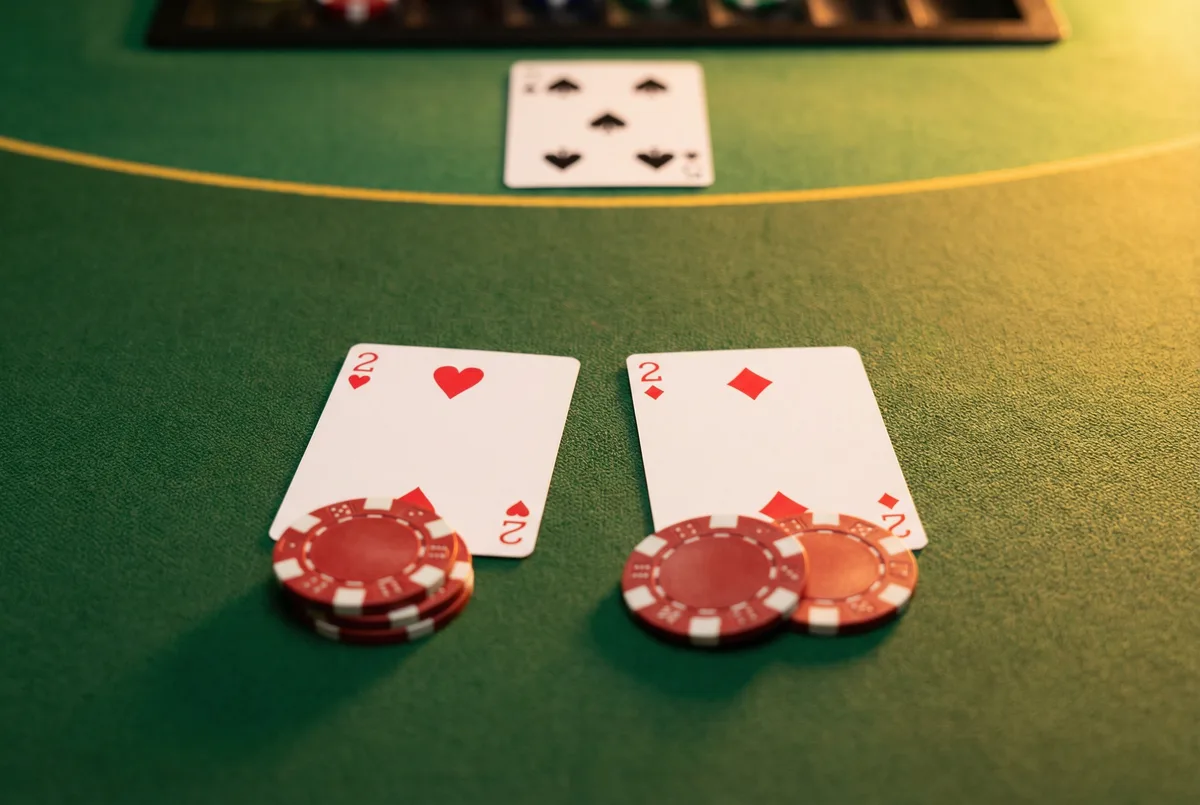
Splitting 2s and 3s Strategy Against Weak Dealer Upcards
Two 2s totaling hard 4, or two 3s adding up to hard 6, but both are losing positions at the table.
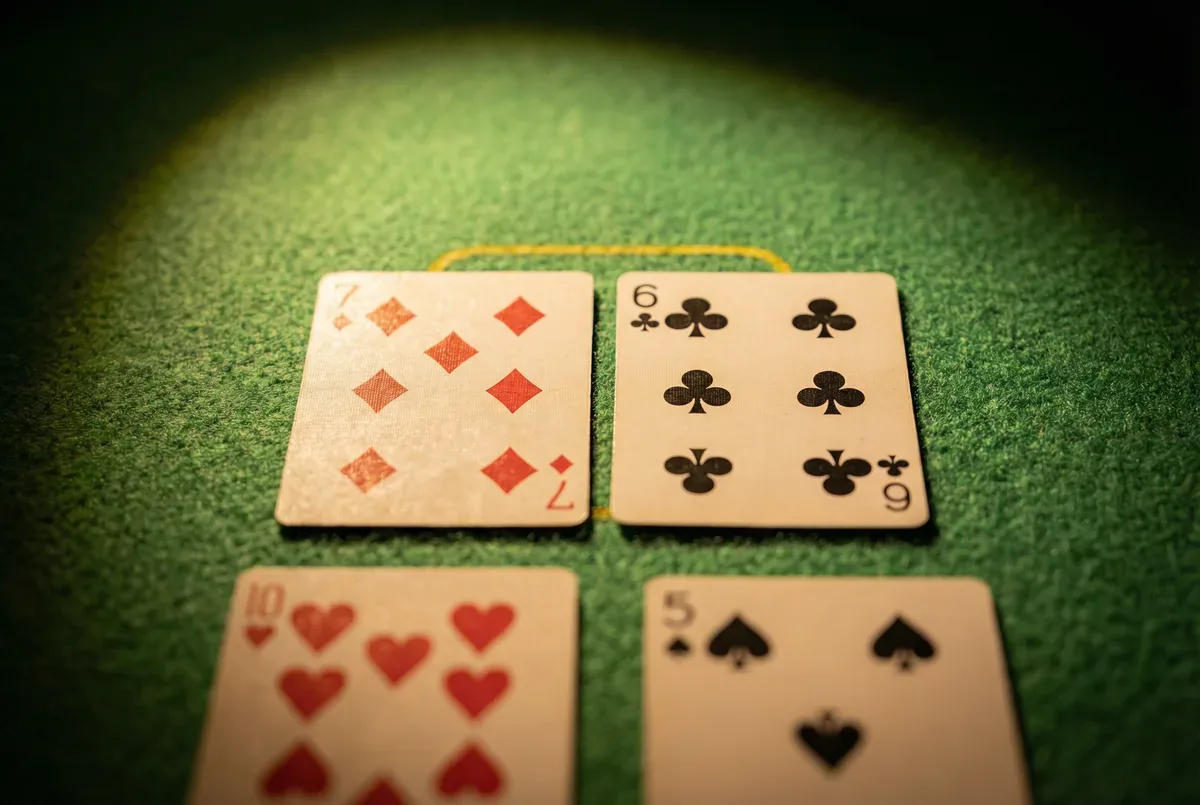
Playing them as hard totals puts you in one of the worst starting positions in the game. There is almost no path to a competitive hand without drawing multiple favorable cards in sequence.
Splitting changes the question entirely. Instead of asking how to rescue a 4 or 6, you ask whether two independent hands starting at 2 or 3 can outlast a dealer who may not survive to compare. Against the right upcards, the answer is clearly yes.
Why Hard 4 and Hard 6 Among the Worst Starting Hands in Blackjack Matter
Hard 4 and hard 6 share a specific problem: they are far from 21 and require multiple favorable draws to reach a competitive total. To reach 17 from hard 4, you need a 10-value card or a specific run of smaller draws. The odds of that sequence are not in your favor.
The situation compounds because the dealer does not need to bust for you to lose. A dealer showing 9 or 10 has a high probability of reaching 19 or 20 through normal drawing. A hard 6 that hits to 16 is still in losing territory against most dealer totals.
Splitting 2s and 3s does not guarantee strong hands on either branch. A 2 still needs a 9 to reach 11, still needs a 10 to reach 12.
But you now have two separate opportunities instead of one trapped total. You have removed the drag of a combined low count that stacks both cards against you at once.
The key insight is that hard 4 and hard 6 are not just bad hands, they are hands with no recovery path except running the table perfectly. Splitting trades that dead end for two live problems, each of which can be resolved independently.
- Hard 4 (2+2) path to 17+needs 13 more in draws
- Hard 6 (3+3) path to 17+needs 11 more in draws
- Split 2starts at 2, any 10-card reaches 12
- Split 3starts at 3, any 8-card reaches 11
- Dealer bust rate vs 5 or 6 upcardabove 42%
What Are the DAS?
DAS stands for Double After Split. When a casino allows it, you can double down on any hand you receive after splitting a pair. This single rule expands the profitable split range for 2s and 3s significantly.
With DAS available, splitting 2s or 3s against a dealer 2 becomes correct. You split, receive a strong second card like an 8 or 9, and double the new 10 or 11 against a weak upcard. That sequence converts a marginal pair into a high-value double opportunity.
Without DAS, the split is only profitable when the dealer’s vulnerability is high enough to justify two hands that may simply hit to modest totals. The split range narrows to dealer 3 through 7 when DAS is not permitted.
The rule adjustment is not trivial. Against a dealer 2 with DAS, the split has positive expected value because of the doubling potential on the resulting hands.
Without DAS, that same split against a dealer 2 is a losing move. Basic strategy says hit the hard 4 or 6 instead.
Before you sit down, confirm whether DAS is in play at the specific table. It is usually listed on a placard at the felt. If the casino restricts doubling after splits, adjust your split range immediately.
With DAS
No DAS
- SPLIT
- HIT
What Is the Dealer Bust Rates Justify Splitting Against Upcards 2 Through 7?
When the dealer shows a 5 or 6, the probability of busting exceeds 42 percent. In roughly four out of ten hands, the dealer will draw past 21 and lose to any non-busted player hand regardless of its total.
Your split hands starting at 2 or 3 do not need to be strong in this situation. They need to survive.
The dealer’s bust rate drops as the upcard strengthens. A dealer showing 7 busts about 26 percent of the time. That is still meaningful vulnerability, enough to justify the split when DAS is in play.
Against a dealer 8, the bust rate falls below 24 percent and the math no longer supports splitting 2s or 3s in any rule variation.
Against the dealer’s weakest upcards, 4, 5, and 6, splitting 2s and 3s is straightforward. You are putting two bets into play at the exact moment the dealer is most likely to self-destruct.
The split is not about building monster hands. It is about multiplying your exposure at precisely the right time.
This logic applies across different deck counts and rule sets. Whether you are at a single-deck game or a six-deck shoe, dealer 4, 5, and 6 are always the bust-heavy upcards. The exact probabilities shift slightly, but the strategic conclusion does not change.
Dealer Shows
Your Hand
You hold a pair of 2s and the dealer shows a 5. DAS is available at this table. What is the correct play?
Dealer 5 is one of the most dangerous upcards for the house. Bust probability exceeds 42 percent. Playing the pair as hard 4 gives you one weak hand needing multiple draws to reach a competitive total. Splitting creates two hands starting at 2, each drawing independently. With DAS available, any strong second card like an 8 or 9 can be doubled to compound the value. Against this upcard, split is the only correct choice.
When to Never Split 2s or 3s Regardless of the Rule Set?
Against a dealer showing 8, 9, 10, or Ace, do not split 2s or 3s in any rule variation. The dealer’s bust probability against these upcards drops to a range where two hands starting at 2 or 3 cannot extract positive expected value even with favorable draws on both.
Against a dealer 8, hit the hard 4 or hard 6 and work toward a competitive total. Splitting into two hands starting that low, when the dealer rarely busts, means betting twice on a position where you need both branches to draw favorably. That is not a bet you want to double.
Against a dealer Ace, the dealer has both a low bust probability and a strong probability of landing blackjack or a 17-to-21 total. Hit the hard 4 or 6 and accept the single-hand loss risk. That is the lower-cost option.
The dealer 7 case deserves attention. With DAS, splitting 2s and 3s against a dealer 7 is correct in standard six-deck games.
Without DAS, blackjack basic strategy still calls for a split in most formulations. Check your specific chart for the exact rules of your table. Dealer 7 is generally a split with DAS and borderline without it.
Players often make the mistake of splitting low pairs out of habit regardless of the upcard. That habit costs money. Every split decision needs a dealer upcard check and a DAS check. Both variables must point to split before you push the extra chips forward.
The mistake most intermediate players make with 2s and 3s is treating them like pairs of 8s, splits on principle regardless of conditions. Splitting 2s and 3s is entirely conditional on dealer vulnerability and DAS availability. In a no-DAS game facing a dealer 2, hitting is correct. Knowing the exact DAS boundary is what separates players who use the chart from players who actually understand it.
How to Practice the Split Decision Until It Becomes Automatic
The split decision for 2s and 3s involves a two-variable check: dealer upcard and DAS availability. Memorizing a single rule without both variables leads to errors at the table. Practice with both rule sets active in your training sessions.
When running through a strategy trainer, toggle the DAS flag and drill low pair splits against upcards 2 through 8. The goal is to stop retrieving the rule consciously and start reading the situation directly. That shift happens through repetition, not re-reading.
You will face a pair of 2s or 3s more often than most players expect. Low pairs appear frequently enough across 500 hands that consistent errors on this decision accumulate into a real expected value loss. Know the split boundaries exactly before you sit down.
Track your error rate specifically on low pair splits during practice. If you are getting dealer 2 wrong in no-DAS games, or incorrectly hitting dealer 6, those are separate failure points requiring separate repetition.
Treat each boundary case as its own training target rather than grouping all low-pair splits together.
Once the decision is consistent in practice, test it under live conditions. The live dealer tables at split 2s and 3s correctly at a live dealer table offer real-money games where every split involves actual stakes, only join those tables after your strategy is solid and you have set a session budget you can afford to lose entirely.
Frequently Asked Questions
No. Split 2s and 3s against dealer upcards 2 through 7 when DAS (double after split) is allowed, or against dealer 3 through 7 when DAS is not available. Against dealer 8 through Ace, hit the hard 4 or hard 6 instead. The dealer's bust probability is what determines whether the split has positive expected value.
DAS stands for Double After Split. When the casino allows it, you can double down on any hand received after splitting a pair. For 2s and 3s, DAS expands the profitable split range to include dealer 2, because after splitting you may receive a strong second card and double that new total against the dealer's weak upcard. Without DAS, splitting against a dealer 2 is not profitable and basic strategy says to hit instead.
Hard 4 requires multiple favorable draws to reach a competitive total and has no direct path to 17 or higher without several cards in sequence. Splitting converts two 2s into two independent hands that each draw separately, doubling your opportunities to improve and allowing you to press with a double after split when DAS is available. Against a weak dealer upcard, two chances at improvement outperform one bad starting total.
Before you test these plays at a real table, run them through our free blackjack simulator practice unlimited hands at zero cost until every move becomes automatic.
Mathematical Risk Warning
Splitting pairs correctly reduces expected losses but does not eliminate the house edge. Every blackjack session carries real financial risk. Set a session budget before you play and never split more money than you can afford to lose on both hands.
Blackjack Academy is an educational platform. Strategy recommendations are based on mathematical expected value calculations. Gambling involves real financial risk. Never wager money you cannot afford to lose.
Learn More
Continue your education with these related lessons.

Double After Split Value and How It Helps the Player
Double After Split (DAS) reduces house edge by 0.14% and makes 8-10 pair splits correct that would be wrong without…
How Much the No Double After Split Rule Costs You
Playing without Double After Split costs 0.14% of your expected edge but the real damage comes from not adjusting your…
The Soft 17 Rule: How One Dealer Decision Costs You 0.22%
One rule printed at the felt. One number that silently inflates the house edge by 0.22%. Here's the complete mathematical…