
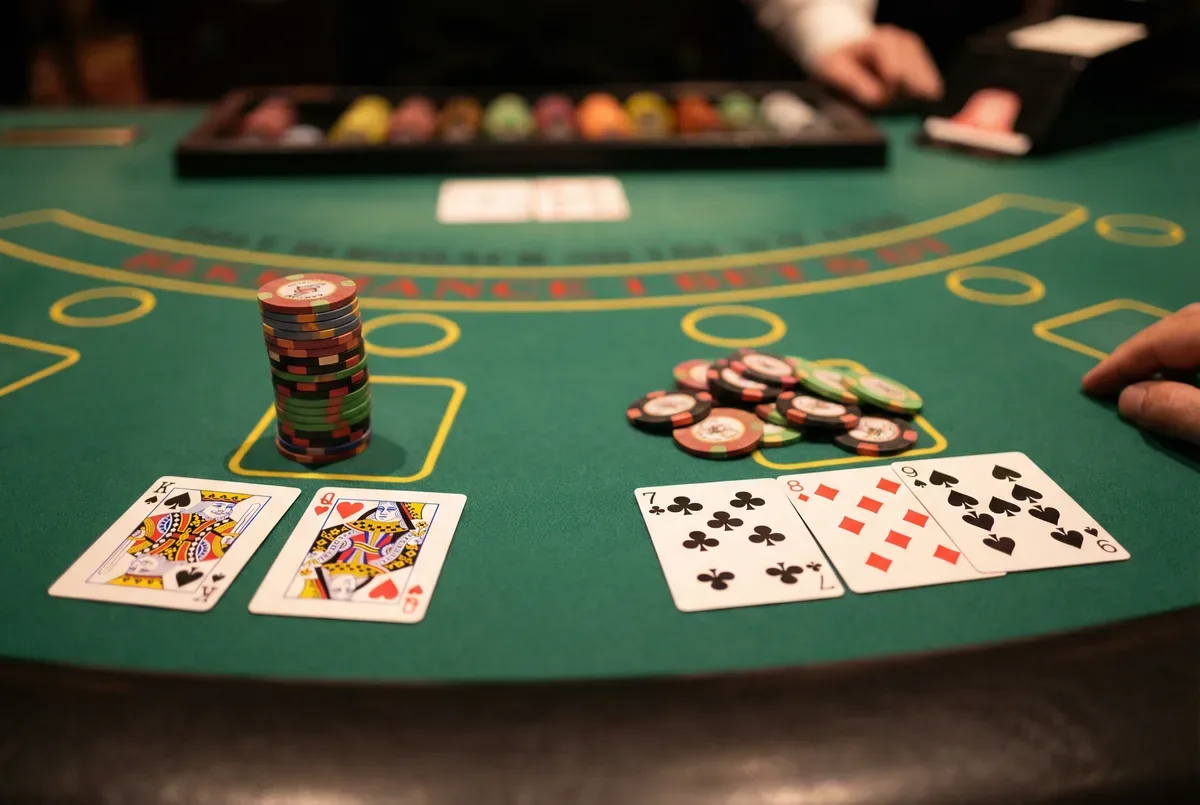
How Variance Affects Short-Term Blackjack Results
Blackjack players who understand expected value often discover something unsettling: perfect strategy does not protect you from losing sessions. Not because the math is wrong, but because variance the statistical noise in every session dwarfs the edge signal in every realistic time frame. A single casino visit of 80 hands carries a standard deviation of roughly $246 at $25 average bet. The expected loss from a 0.5% blackjack house edge over those same 80 hands is approximately $10. The noise is 24 times larger than the signal. In the short run, variance decides everything.
This is not a theoretical curiosity. It is the reason skilled players lose money in the short term, recreational players win without knowing why, and nearly every false conclusion about blackjack strategy gets born. Understanding variance is not optional if you want to evaluate your play honestly.
Variance in Blackjack Explained
Variance in blackjack refers to the spread of outcomes around expected value. Each hand you play has a distribution of possible results: win, lose, push, blackjack, doubled win, split outcome. Expected value collapses that distribution into a single average number. Variance measures how widely the actual results scatter around that average in any given sample.
Standard deviation is the most useful way to quantify this scatter. For a single blackjack hand with standard rules, the standard deviation is approximately 1.1 betting units. That accounts for doubles, splits, blackjack payouts, and pushes. The 1.1 figure comes from the full probability distribution of outcomes, not just the win/loss binary.
Over a session of n hands, standard deviation scales by the square root of n. In an 80-hand session at $25 average bet, standard deviation = 1.1 × $25 × √80 ≈ $246. Expected loss at 0.5% blackjack house edge = 0.005 × $25 × 80 = $10. Variance is 24.6 times the size of the expected loss. The signal is buried beneath an avalanche of noise.
Standard deviation per hand in blackjack is approximately 1.1 units. Over 80 hands at $25, session standard deviation ≈ $246. Expected session loss at 0.5% house edge ≈ $10. The signal (edge) is $10. The noise (variance) is ±$246. In the short run, noise dominates completely. Over 2,000 hands, expected loss ≈ $250 and becomes detectable above noise.
Variance vs Edge
How to Calculate the Standard Deviation of a Blackjack Session?
The formula for session standard deviation is: SD = σ × avg_bet × √hands, where σ ≈ 1.1 for standard blackjack rules. This formula assumes you know your average bet, the number of hands played, and the approximate single-hand standard deviation for the rule set you are playing.
Working examples make the formula concrete. At $10 average bet over 100 hands: SD = 1.1 × $10 × √100 = 1.1 × $10 × 10 = $110. That means one standard deviation from expected encompasses a range of roughly ±$110 around the mean result. Expected loss at those parameters is 0.005 × $10 × 100 = $5. Two standard deviations cover approximately 95% of all sessions a range of ±$220 around a $5 expected loss.
At $50 average bet over 200 hands: SD = 1.1 × $50 × √200 ≈ $778. Expected loss: 0.005 × $50 × 200 = $50. Range at two SDs: -$50 ± $1,556. A player who wins $700 in that session and a player who loses $800 have both landed within normal statistical variation. Neither result tells you anything reliable about strategy quality.
Session SD (80 hands)
at $25 avg bet
Signal (EV) per session
at 0.5% house edge
Hands to detect edge
approximate threshold
Why Variance Produces Winning Sessions Even at Negative House Edge?
Winning a blackjack session while playing against a blackjack house edge is not a contradiction. It is a mathematical certainty that a large fraction of sessions will end in profit, even for a player losing money in the long run. The distribution of session outcomes is not centered at zero it is centered slightly below zero but its width is so large relative to that negative tilt that the right half of the distribution still represents a substantial share of all outcomes.
In an 80-hand session at $25 average bet with a 0.5% blackjack house edge, approximately 35% of sessions end in profit of more than $50. Around 11% of sessions produce wins exceeding $100. These are not flukes. They are the predictable right tail of a wide normal distribution. The blackjack house edge does not prevent winning sessions it only ensures that wins are slightly less frequent than losses over a very large number of sessions.
This explains why players who deviate from blackjack basic strategy frequently report winning. Their wins are variance, not evidence that their system works. It equally explains why players who execute perfect blackjack basic strategy will experience extended losing runs. Those losses are also variance, not evidence that the strategy is wrong. Evaluating strategy by short-term outcomes is the single most common cognitive error in blackjack.
Sessions ending profitable (80 hands, $25 bet)
before the house edge tilt shows
Sessions with loss over $100
within normal one-SD range
Sessions with win over $100
variance-driven right tail
How Many Sessions Before Results Reflect True EV?
The convergence of results toward expected value follows the law of large numbers, but the number of hands required to see the edge reliably emerge is much larger than most players expect. A useful benchmark: variance and edge reach approximate parity when the expected loss equals one standard deviation of the cumulative result. Solving for n hands: 0.005 × bet × n = 1.1 × bet × √n, which simplifies to n ≈ (1.1 / 0.005)² ≈ 48,400 hands at 0.5% blackjack house edge.
That is a more rigorous convergence threshold. A more practical threshold where the expected loss becomes detectable above the noise in most sessions is around 2,000 hands. At 2,000 hands and $25 average bet, expected cumulative loss = $250 and session SD = $1,236. The loss is starting to show, but the variance is still five times the signal. Real convergence requires tens of thousands of hands.
For a recreational player logging 100 hands per casino visit, it would take 484 sessions before the blackjack house edge reliably dominates the outcome distribution. Most recreational players never play that many total hands in their lifetime. This is not a defect in the math it is the structural reality of why gambling feels like it can be beaten in the short term. The sample sizes available to casual players are simply too small to distinguish skill from luck.
The practical implication is discipline rather than pessimism. Knowing that your last 10 sessions mean nothing statistically removes both false confidence and false despair from your game. The session result is information about variance. The long-run cumulative result over thousands of hands is information about strategy and edge.
Using Variance Knowledge Before Playing With Real Money
Understanding variance changes how you approach session planning. A player who knows the standard deviation formula can calculate the bankroll required to survive a two-SD downswing without being forced to stop. At $25 average bet over 80 hands, a two-SD loss is approximately $502. A session bankroll below that level carries meaningful ruin risk within a single visit, independent of strategy quality.
Variance knowledge also changes how you read winning streaks. A player who wins three consecutive sessions has done something entirely consistent with chance, not with mastery. The correct response is not to increase bet sizes or abandon the strategy that produced the win. The variance-informed response is to maintain consistent bet sizing and continue executing correct decisions, knowing that three sessions represent approximately 240 hands a sample carrying almost no information about long-term edge.
Before committing real money, testing your instincts against a live dealer format lets you observe variance directly. If you want to see how a swing of ±$200 feels over a single session before it costs you anything you haven’t already set aside, a live dealer table puts real money on the line and makes the variance tangible in a way no simulator can set a hard session limit before sitting down and treat every result as data, not as proof of anything.
Frequently Asked Questions
Short-term losses at blackjack are dominated by variance, not strategy quality. With a standard deviation of approximately $246 per 80-hand session at $25 average bet and an expected loss of only $10, the math guarantees that many sessions will end significantly below the expected result. Losing runs of five to ten sessions are well within normal statistical variation. Basic strategy minimizes the house edge but does not eliminate session-to-session variance.
Approximately 2,000 hands is a practical threshold where the expected loss begins to emerge above the noise, but even at that point variance is still five times the size of the cumulative edge signal. Full convergence toward expected value in a statistically meaningful sense requires tens of thousands of hands. For a recreational player logging 100 hands per session, that represents hundreds of casino visits.
Not necessarily. A wide variance distribution means that roughly 46% of 80-hand sessions at $25 average bet will end in profit, even against a house edge. Short-term wins reflect the right tail of a normal distribution, not strategy quality. Evaluating your play requires looking at decisions hand by hand whether you doubled, split, hit, and stood correctly not at session profit and loss totals.
Before you test these plays at a real table, run them through our free blackjack simulator practice unlimited hands at zero cost until every move becomes automatic.
Variance Is Not the Enemy Misunderstanding It Is
Use the Blackjack Calculator to model your session standard deviation before your next casino trip.
Blackjack Academy is an educational resource. All strategy figures are based on mathematical expectation. Even with correct basic strategy, house edge and variance mean long-term losses are expected for non-counting players. Always set a firm session budget before wagering real money.
Learn More
Continue your education with these related lessons.
How to Calculate Expected Value for Your Long Term Profit
Expected value in blackjack is the average outcome of a specific decision per dollar wagered, calculated across an infinite number…
When Doubling Down Is Wrong
The five hands beginners over-double soft 19, hard 12, pair of 5s as 10, hard 10 vs Ace, hard 9…
The Complete Guide to Pair Splitting Strategy
Pair splitting decisions separate disciplined players from the rest of the table. Master the always-split rules, the never-split traps, and…