
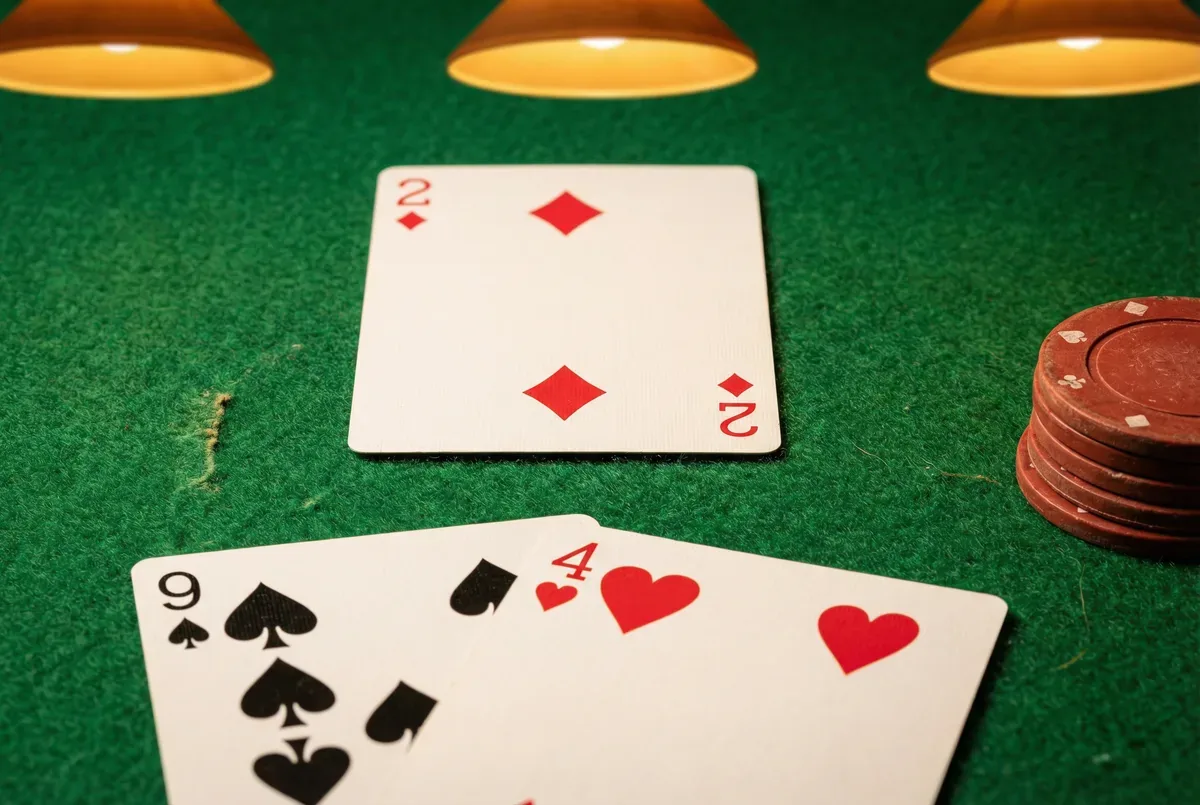
Debunking the Myth That 2 Is a Dealer’s Ace Upcard
The dealer 2 is the most over-feared upcard in blackjack basic strategy. The myth is widespread: dealer showing a 2 is dangerous, like a dealer Ace, because the dealer can draw to almost anything. This belief systematically leads players to stand too conservatively, skip doubles they should take, and refuse splits against an upcard that is mathematically one of the weakest cards a dealer can hold. The dealer busts approximately 35 percent of the time when showing a 2 versus 17 percent when showing an Ace. These are not equivalent. Playing them as equivalent costs EV on every hand where the myth overrides the chart.

Common Myth
“Dealer 2 is like a dealer Ace you should be careful and not double into it”
This belief causes players to stand on stiff hands, skip doubles on 9 and 10, and avoid splits against dealer 2. It treats one of the weakest dealer upcards as one of the strongest.
The Reality
Dealer 2 is a weak upcard. It busts approximately 35% of the time. The correct strategy against dealer 2 is aggressive: double hard 9 and 10, split 2s, 3s, and 7s, and take every EV-positive double available.
Dealer 2 bust rate: 35% vs dealer Ace bust rate: 17% dealer 2 is twice as likely to bust as dealer Ace
Dealer 2 Myth Explained
The myth originates from a partial truth about the dealer 2 upcard: it has a higher completion rate than dealer 4, 5, or 6. Against dealer 4, 5, or 6, the dealer busts 38 to 42 percent of the time. Against dealer 2, the bust rate is 35 percent slightly lower. Players who have heard that the 2 is tricky are observing this real but modest difference and overgeneralizing it to “treat the 2 like a strong card.” The 2 is not a strong card. It is a weak card. The correct strategy against dealer 2 is aggressive not as aggressive as against dealer 5 or 6, but substantially more aggressive than against dealer 7 through Ace.
A secondary source of the myth is the visual appearance of the dealer 2: it can combine with many draws to reach strong totals. A dealer 2 plus a 10 is 12 the dealer must hit. But this same sequence produces dealer busts at high rates when the dealer draws into the stiff zone (12-16) on a subsequent card. The dealer 2’s apparent flexibility is what makes recreational players nervous but the probabilities show it as a bust candidate 35 percent of the time, firmly in the weak-upcard category alongside dealer 3, 4, 5, and 6.
How Does Actual Probabilities When the Dealer Shows a 2?
Against a dealer 2, the probability distribution of dealer outcomes in a 6-deck game is approximately: dealer busts 35.3 percent; dealer makes 17 at 13.9 percent; dealer makes 18 at 13.3 percent; dealer makes 19 at 12.7 percent; dealer makes 20 at 12.0 percent; dealer makes 21 at 11.3 percent. The bust rate is the largest single outcome cluster. A player standing on 17 against dealer 2 loses only when the dealer makes 18 through 21 approximately 49 percent of the time and wins when the dealer busts at 35 percent, plus pushes at 14 percent. This is a substantially favorable standing distribution compared to dealer 7 (bust rate 26 percent) or dealer 10 (bust rate 23 percent).
The correct doubling strategy against dealer 2 reflects this bust probability. Double hard 9 against dealer 2 in some chart variants; double hard 10 against dealer 2 in all standard charts; double hard 11 against dealer 2 in all standard charts. All three doubles collect the dealer’s 35 percent bust rate on a doubled stake. A player who skips these doubles against dealer 2 because it “feels like an Ace” is leaving the doubled wager’s bust-equity on the table on every occurrence.
Dealer Shows
Your Hand
Dealer shows 2. You have hard 10 (6-4). Double or hit?
Hard 10 against dealer 2: double. The dealer busts 35% of the time. Drawing a 10-value card to hard 10 produces 20 the second-best hand in blackjack. The doubled stake collects the full dealer bust equity. EV of doubling hard 10 against dealer 2 is approximately +0.36 per original dollar. Hitting collects only half that equity on the same hand. Players who treat dealer 2 like an Ace and hit instead of doubling are leaving significant EV behind.
How Does Correct Dealer-2 Strategy Differ from Myth-Based Play?
Myth-based play against dealer 2 manifests in three specific patterns: standing on stiff hands (12-16) that should be hit, skipping doubles that the chart calls for, and not splitting pairs that should be split. Correct chart play against dealer 2 on stiff hands: stand on hard 13 through 16 (the dealer’s bust rate makes standing correct); hit hard 12 (the only stiff hand that should be hit against dealer 2 in most charts, because hard 12 busts only on a 10-value draw and there is insufficient stand equity against a 35 percent bust dealer). Players who misidentify dealer 2 as dangerous often hit 15 and 16 when they should stand the exact opposite of the chart.
Pair splitting against dealer 2 follows the weak-upcard logic: split 2-2, 3-3, and 7-7 against dealer 2. These splits convert weak pairs into independent hands that collect the dealer’s bust equity twice. The myth player who hits 3-3 against dealer 2 instead of splitting is choosing one losing hard 6 hand over two independent hands starting at 3 with a dealer who busts 35 percent of the time, the split is clearly better. The chart confirms this; the myth overrides it.
Dealer upcard strength ranking by bust probability: Dealer 6 busts 42%. Dealer 5 busts 42%. Dealer 4 busts 40%. Dealer 3 busts 37%. Dealer 2 busts 35%. Dealer 7 busts 26%. Dealer 8 busts 24%. Dealer 9 busts 23%. Dealer 10 busts 23%. Dealer Ace busts 17%.
The 2 is the weakest strong-dealer card and the weakest card overall is the 6. The gap between dealer 2 (35%) and dealer Ace (17%) is 18 percentage points the 2 is nearly twice as likely to bust. These numbers are the foundation of the aggressive-against-weak-upcards strategy logic.
How Much Treating Dealer 2 Like an Ace Costs in EV: By the Numbers?
The EV cost of myth-based play against dealer 2 accumulates across multiple hand types. Not doubling hard 10 against dealer 2 costs approximately 0.36 EV versus 0.20 (hit) a gap of 0.16 per dollar. Not doubling hard 11 against dealer 2 costs a similar gap. Not splitting 7-7 against dealer 2 costs approximately 0.09 EV per hand (split EV -0.19 versus hit EV -0.28). Not splitting 3-3 against dealer 2 when DAS is available adds a similar margin. These errors appear infrequently on dealer-2 hands individually dealer 2 appears roughly once per 10 hands but across a 80-hand session and over multiple sessions, the myth tax is measurable.
How to Apply Correct Dealer-2 Strategy at a Live Table
The dealer 2 strategy requires one mental shift: classify it as a weak dealer upcard, not a moderate one. The doubles and splits that apply against dealer 4, 5, and 6 mostly apply against dealer 2 as well with the double range slightly narrowed (hard 9 double applies against 3-6 but not 2 in many charts; hard 10 and 11 double against all upcards 2-10). Open the live lobby right now and pick a game before placing real money, commit to treating dealer 2 as a weak card and executing every double and split the chart specifies against it. Set your session budget before the first hand.
Frequently Asked Questions
Weak. Dealer 2 busts approximately 35% of the time nearly twice the bust rate of dealer Ace (17%) and higher than dealer 7 (26%) or dealer 10 (23%). The correct strategy against dealer 2 is aggressive: double hard 10 and 11, split 2s, 3s, and 7s, and stand on stiff hard totals (13-16). Treating dealer 2 like a strong upcard is a widespread myth that costs EV on doubles and splits.
Yes, on hard 10 and hard 11. Double hard 10 against dealer 2 has EV of approximately +0.36 per original dollar. Hard 11 against dealer 2 is also a double in all standard charts. Hard 9 against dealer 2 depends on the chart variant some list it as double, others as hit. The dealer's 35% bust rate makes the doubled stake EV-positive on strong doubling hands.
Partial truth and overgeneralization. Dealer 2 has a slightly lower bust rate than dealer 4-6 (35% vs 38-42%), and it can combine with draws to reach many different totals which looks flexible. Players observe the difference and generalize it to "be careful against 2." The actual bust rate difference between dealer 2 and dealer Ace is 18 percentage points enough to make aggressive strategy correct against the 2 and conservative strategy correct against the Ace.
Before you test these plays at a real table, run them through our free blackjack simulator practice unlimited hands at zero cost until every move becomes automatic.
See Dealer Bust Probabilities for Every Upcard
The EV calculator shows complete dealer outcome distributions for every upcard under your specific rule set. See exactly why aggressive strategy is correct against weak upcards.
Blackjack Academy is an educational resource. All strategy is based on mathematical expectation. Always play within your means.
Learn More
Continue your education with these related lessons.
Table Rules Checklist for Finding the Best Blackjack Games
Not every blackjack table is equal. A six-point rules checklist payout ratio, dealer soft 17, deck count, DAS, surrender, and…

When and Why Blackjack Strategy Deviations Boost Your Long-Term Profit
Rule conditions liberal doubling, restricted splits, H17 vs S17, surrender availability modify basic strategy decisions. Which deviations matter most for…
Why the Martingale System in Blackjack Always Fails Mathematically
The Martingale system promises to recover losses by doubling bets after each hand you lose. It does not change the…