
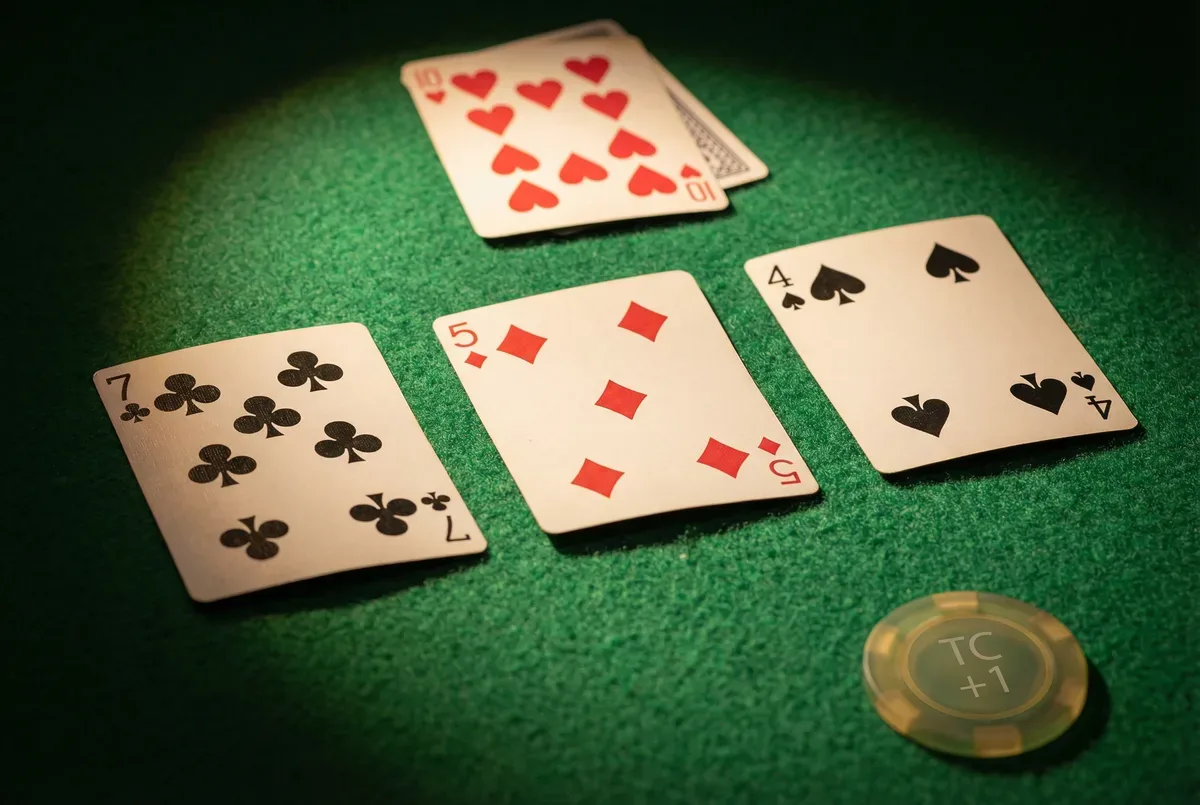
Composition-Dependent Basic Strategy and When It Gives You Real Edge
Composition-dependent blackjack basic strategy is the set of decisions that depend not only on your hand total but on the specific cards making up that total. Standard blackjack basic strategy the version printed on laminated charts and memorized by most players is total-dependent: it tells you what to do with hard 16 against a dealer 10, without distinguishing between a 10-6, a 9-7, or a 7-5-4. Composition-dependent strategy goes one level deeper. When the exact cards in your hand shift the remaining deck composition enough to change probabilities, a different action becomes optimal. In single-deck games this matters frequently. In multi-deck games it matters in a handful of high-stakes situations most notably the multi-card 16 versus dealer 10.
What Composition-Dependent Strategy Actually Means
- Total-dependentdecides based on hand total only.
- Composition-dependentaccounts for exact cards held.
- Multi-deckCD deviations are few but measurable.
- Single-deckCD deviations are more frequent.
- Most valuable CD rule3+ card 16 vs dealer 10 = Stand.
- Standard rule2-card hard 16 vs dealer 10 = Hit.
What Is the Removal Effect?
Every card removed from a deck shifts the probability distribution of all future draws. This is called the removal effect. In a single-deck game with 52 cards, pulling one 10-value card removes it from 16 possible 10s a 6.25% reduction in 10-density. In an 8-deck game with 416 cards, removing one 10 drops 10-density by only 0.78%. The smaller the deck, the larger each card’s removal effect, which is why composition-dependent decisions are most relevant in single and double-deck games and mostly irrelevant in 6- or 8-deck shoes.
Running these hands through a blackjack simulator confirms the expected-value difference across millions of trials.
The logic flows directly from bust probability. When you hold a hard 16 and consider hitting, you bust if the next card is a 6 or higher. If your hard 16 is composed of small cards say 5-4-4-3 you have removed four small cards from the available pool, slightly increasing the proportion of 10-value cards remaining. That makes a hit slightly more likely to bust. Conversely, if your hard 16 is a 10-6, you have removed a 10-value card, very slightly reducing the bust risk on a hit. These are small effects, but in specific situations they cross the threshold where a different action has higher expected value than the total-dependent default.
The composition-dependent exceptions that survive rigorous EV analysis are rare in multi-deck play. Most strategy software and simulation tools confirm only a handful of situations where CD strategy diverges from total-dependent strategy at the multi-deck level. The most well-documented is 3-or-more-card 16 versus dealer 10, and it is the one worth internalizing because hard 16 against a 10 is one of the most common difficult decisions at the table.
Common Myth
“Your total is all that matters a 16 is a 16.”
Players assume the strategy chart accounts for all variables already, and that card composition is too granular to matter.
The Reality
The exact cards in your hand affect the remaining deck and change the correct action on specific hands.
Multi-card hard 16 vs dealer 10 is a stand in single-deck and often a stand in 2-deck the total-dependent chart gives you the wrong answer here.
What Is the Multi-Card 16?
Hard 16 versus dealer 10 is a losing hand regardless of what you do the expected value is negative whether you hit or stand. The question is which action loses less. Total-dependent blackjack basic strategy says hit because the dealer is likely to have a 10 in the hole (total 20), and standing on 16 loses most of the time. A hit at least gives you a chance to improve. That logic is correct when your 16 is a two-card hand.
The calculation changes when your 16 is built from three or more small cards. A hand of 5-4-4-3 reaching 16 has removed four low cards from the deck. In a single-deck game, those removals meaningfully increase the proportion of 10-value and high cards remaining raising your probability of busting if you hit. At the same time, if the dealer has a 10 in the hole (making their total 20), you lose whether you hit or stand. The CD rule recognizes that the bust risk of hitting has increased enough that standing, even on 16, and becomes the higher expected-value play. In single-deck, stand with 3+ card 16 versus dealer 10. In 2-deck games, the play is borderline. In 6- and 8-deck games, the removal effect is too diluted to change the action hit remains correct regardless of card count in your hand.
The 8-7 vs. dealer 10 case is a secondary CD example. In single-deck, an 8-7 hard 15 stands against dealer 10 under some analyses, while total-dependent strategy hits hard 15 against a 10. Again, in multi-deck play this deviation disappears always hit hard 15 against a dealer 10 in 6- or 8-deck games. Composition-dependent rules are not a separate chart to memorize for standard multi-deck games. They are precise refinements for single-deck and 2-deck specialists who have already mastered total-dependent strategy completely.
Dealer Shows
Your Hand
3-card hard 16 vs dealer 10, single-deck game. Total-dependent chart says hit. What does composition-dependent strategy say?
Single-deck composition-dependent rule: stand on 3+ card hard 16 vs dealer 10. The removal of three small cards raises 10-density in the remaining deck enough to make hitting statistically worse than standing. This deviation only applies in single-deck games. In 6- or 8-deck games, the removal effect is negligible hit is still correct for any hard 16 vs dealer 10 regardless of how many cards compose the hand.
Where Composition-Dependent Strategy Matters Most by Deck Count?
Deck count is the primary determinant of how much weight to give composition-dependent decisions. Single-deck games are where CD strategy has the most practical impact. Researchers like Peter Griffin and Don Schlesinger have documented that applying composition-dependent rules in single-deck can reduce blackjack house edge by 0.02–0.03% compared to total-dependent play. That sounds small, but for a disciplined player who is already operating near breakeven, every fraction matters. The specific hands where CD and total-dependent diverge in single-deck include: 7-7 versus dealer 10 (stand vs. hit under different analyses), 8-7 versus dealer 10, multi-card 12 versus dealer 4, and the various 3+ card 16 configurations.
In 2-deck games, the value of CD strategy drops sharply. Only the multi-card 16 vs dealer 10 rule retains any meaningful EV benefit, and even there the margin is thin. For 4-deck, 6-deck, and 8-deck games, composition-dependent deviations provide essentially zero benefit. The correct approach is to master total-dependent blackjack basic strategy completely for the deck count you play, and then if you specialize in single-deck layer in the handful of CD rules that Griffin and computer simulation have validated. Do not attempt CD adjustments in multi-deck games based on intuition. Intuition-based composition adjustments are more likely to introduce errors than improvements.
Putting Composition-Dependent Strategy to Work in Real Play
The practical implementation of CD strategy is simple once you have total-dependent strategy locked in. For most players at most tables, the answer is: play total-dependent strategy perfectly, and add only the multi-card 16 rule if you regularly play single-deck. That one adjustment is the highest-value CD rule in the catalog and the only one that appears with enough frequency to matter practically. The full set of single-deck CD exceptions is worth studying if you are a serious single-deck specialist, but in the real world most of these hands appear infrequently enough that their lifetime impact is measured in fractions of a bet.
Before you can apply composition-dependent strategy, you need total-dependent strategy embedded at an automatic level any hesitation or uncertainty at the table means you are not ready to layer in refinements. Practice with both the single-deck and 6-deck charts until the basic actions are reflexive. If you want to stress-test these decisions in real conditions, the live tables at bring this to a live dealer table let you see exactly how multi-card situations play out under genuine stakes keep in mind that real money is on every hand, so enter only when your fundamentals are solid.
Frequently Asked Questions
No. In 6-deck games the removal effect of individual cards is too small to change expected value enough to warrant a different action. Total-dependent basic strategy is the correct and complete approach for 6-deck and 8-deck games. Composition-dependent rules apply meaningfully only in single-deck games, and to a limited extent in 2-deck games.
Stand on 3-or-more-card hard 16 versus dealer 10 in single-deck games. Total-dependent strategy says hit, but when your 16 is composed of three or more small cards in a single-deck game, the concentration of high cards remaining increases enough to make standing the higher expected-value play.
In single-deck games, applying all documented composition-dependent rules reduces house edge by approximately 0.02–0.03% compared to total-dependent strategy. This is a real but small improvement. In 2-deck games the benefit is under 0.01%. In 6- and 8-deck games it is effectively zero.
Mathematical Risk Warning
Composition-dependent strategy reduces the house edge by fractions of a percent in specific conditions. Even with perfect application, the math works against you over enough hands. Every session budget should be money you are prepared to lose entirely.
Blackjack Academy is an educational resource. All strategy is based on mathematical expectation. Always play within your means.
Learn More
Continue your education with these related lessons.

Best Times to Double Down on Hard 10 Against 2 Through 9
Hard 10 is one of the strongest doubling hands in blackjack. Against dealer upcards 2 through 9, the math always…

How the Number of Decks Changes Basic Strategy
The number of decks in a blackjack game changes specific strategy decisions and the house edge itself. Here are the…
Protecting Your Winning Probability by Standing on Hard 17
Hard 17 is the line where hitting becomes categorically worse than standing against every dealer upcard. The bust rate on…