
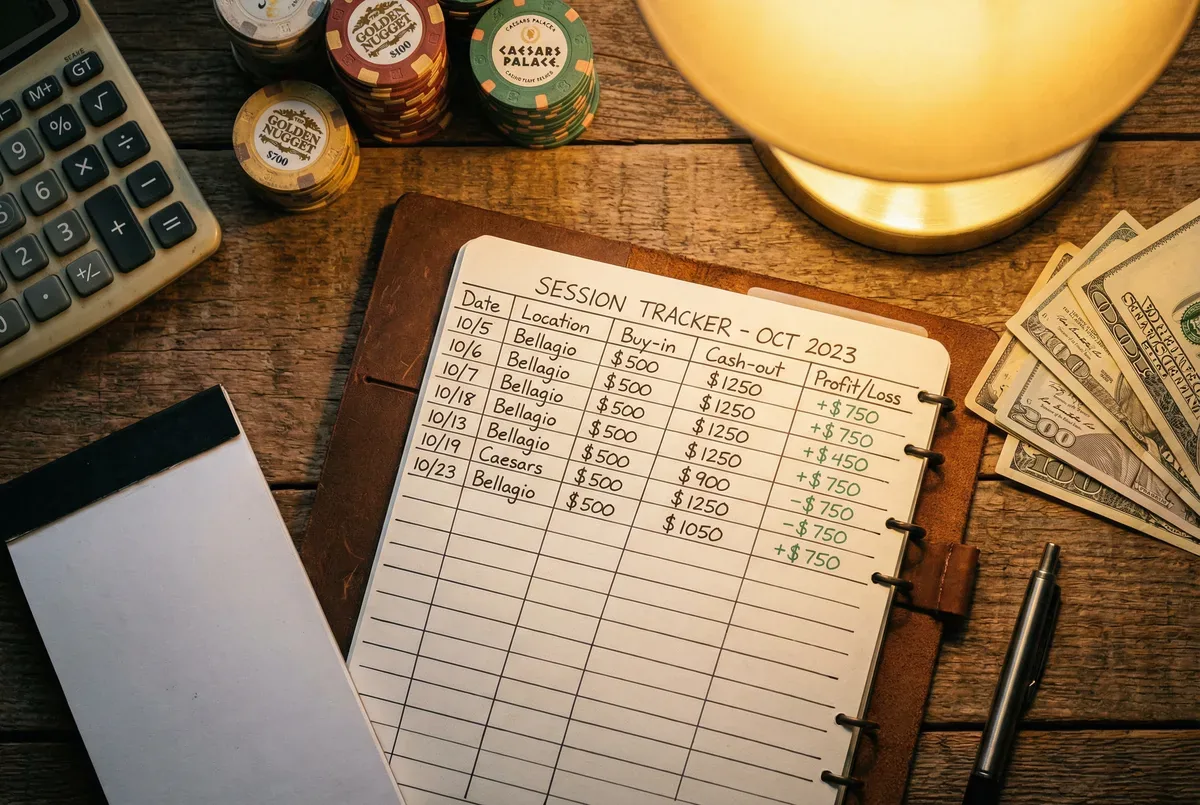
What Professional Blackjack Players Actually Earn
Professional blackjack players earn through a mathematical edge, not skill in the traditional sense. If you run a Hi-Lo system with a 1-to-12 bet spread, you can achieve an edge of roughly 0.5% to 1.5% over the house depending on game conditions. At a $25 minimum table playing 80 hands per hour with an average bet of $75, the theoretical win rate is approximately $30 to $90 per hour. Real-world results, adjusted for table unavailability, casino restrictions, and travel overhead, typically land in the $25 to $50 per hour range for a serious solo counter. The ceiling exists because larger bets trigger scrutiny, and no casino offers unlimited access to favorable conditions.
The Honest Numbers Behind Professional Play
Typical hourly edge for a counter
%
How Does Bankroll Size Determine Your Hourly Rate?
Your hourly rate is inseparable from your bankroll size. The Kelly Criterion dictates that optimal bet sizing is a fraction of your total bankroll, typically 1% to 2% per unit for blackjack, to keep your risk of ruin below 5%. A $10,000 bankroll supports maximum bets in the $50 to $100 range. A $50,000 bankroll supports $250 to $500 maximum bets. Because win rate scales with average bet size, you earn five times as much per hour with $50,000 at risk as with $10,000. Same skill level, same game, different financial output.
This relationship explains why building your bankroll is a prerequisite to professional income, not a parallel activity. You cannot earn professional wages from a recreational-sized bankroll. Many aspiring counters plateau at $20 to $30 per hour simply because their capital base does not support larger spreads. The game rewards capital as much as it rewards skill.
$10K Bankroll
$50K Bankroll
- $100
- $500
How Does Variance Affect Your Monthly Income?
Standard deviation for blackjack runs approximately 1.15 units per hand. If you bet between $25 and $300 with an average bet of $75, your single-session standard deviation over 500 hands is roughly $1,825. That means even with technically perfect play you can realistically lose $3,000 to $5,000 in a bad day’s work without a single error, purely from variance. You understand this intellectually, but managing it emotionally is a separate challenge. Losing sessions are not evidence of failure. They are expected outcomes that you must be capitalized to absorb.
Projected monthly, logging 100 hours at a true $40 per hour edge puts $4,000 in expectation on the table. But the 95% confidence interval around that figure spans roughly negative $2,600 to positive $10,600. In plain terms, roughly one month in twenty will show a significant loss with correct play and zero errors. Over a full year of 1,200 hours the variance smooths considerably and you will converge toward your theoretical rate. In the short term, which can mean several months, the numbers will lie to you in both directions.
The practical consequence is that you must be capitalized for downswings that last longer than feels reasonable. A 50-unit drawdown is not unusual. At a $75 average bet that is $3,750 gone before recovery begins. At a $200 average bet it is $10,000. If you enter professional play undercapitalized you will respond to these swings by reducing your bet spread, which destroys your edge, or by playing scared, which produces errors. The bankroll requirement is not arbitrary. It is the minimum buffer between variance and ruin.
The question is never whether you will have a 50-unit downswing. You will. The question is whether your bankroll can survive it, your psychology can process it, and your discipline can prevent it from triggering bet-size changes that destroy your edge. Build for 300 units before you call yourself a professional.
What Does Professional Play Actually Cost After Expenses?
Beyond your hourly rate, you absorb costs that salaried workers do not. Travel and accommodation to reach favorable games is the largest variable expense. In a mid-sized market you may drive two hours each way to reach a beatable game, logging unpaid time before a single hand is dealt. In major markets, hotel stays and flights add $500 to $2,000 per month depending on your circuit. Self-employment tax in the US runs approximately 15.3% on top of income tax, meaning you gross $60,000 but net closer to $38,000 after federal obligations alone. Health insurance, which no casino provides, adds another $300 to $700 per month.
Run the full numbers at $40 per hour for 1,200 logged hours per year: $48,000 gross. Subtract $7,344 in self-employment tax, $8,000 in federal income tax, $6,000 in travel and accommodation, and $5,400 in health insurance. Net income lands around $21,000. That is below the US median household income for a profession requiring advanced mathematical training, significant capital, emotional discipline, and constant exposure to the risk of being backed off from every casino in your regional market. Most players who sustain professional careers long-term combine blackjack with other advantage play methods, such as sports betting or poker, or transition into consulting and training as primary income within five to eight years.
None of this makes the career impossible. It makes it a business decision rather than a romanticized escape from conventional work. The counters who thrive treat it exactly that way: tracking every hour, every expense, and every basis point of edge with the same discipline they apply to their bet spreads.
Closing the Gap Between Theory and Sustainable Income
The gap between theoretical win rate and real income closes through two factors: game selection and volume discipline. Playing only games with 75%+ deck penetration, S17 rules, and 3:2 payouts adds materially to your long-run results. A game with 60% penetration and H17 rules can cut your practical edge by half compared to a properly dealt 6-deck S17 shoe. Passing on bad games costs you hours but preserves your edge per hour, which is the only metric that matters over a career.
Volume discipline means maintaining consistent bet sizing during both winning and losing sessions. If you fall short of your theoretical rate it will almost always be because you tightened your spread after losses, understandable psychologically but fatal mathematically. Your edge is expressed in expectation over thousands of hands. Changing your bet sizing in response to recent results means gambling on streaks rather than extracting a mathematical advantage. Use the blackjack calculator to model what your specific rule conditions and bet spread actually produce, then hold to those numbers regardless of session outcome.
Frequently Asked Questions
A competent solo counter with a $25,000+ bankroll and access to good games can realistically earn $25 to $50 per hour adjusted for downtime, travel, and variance. Theoretical win rates can be higher, but real-world constraints cap sustainable income significantly below peak theoretical figures.
A minimum of 300 units is the standard professional threshold. At a $25 minimum table with a 1:12 spread, that means $7,500 to $10,000. To earn a living wage, you need a bankroll that supports average bets of $100 to $200+, which requires $30,000 to $60,000 in dedicated gambling capital.
Yes. Even skilled counters playing correct strategy experience downswings of 50 to 100 units purely from statistical variance. Without adequate bankroll, these swings force bet reductions or exits from the game. Managing variance psychologically and financially is what separates professional players from skilled amateurs.
Before you test these plays at a real table, run them through our free blackjack simulator and practice unlimited hands at zero cost until every move is automatic.
Mathematical Risk Warning
Even professional-grade play carries substantial downside risk. A 100-unit downswing is statistically expected over any counter's career. Without a dedicated bankroll of 300+ units and strict Kelly bet sizing, the risk of ruin over a year of play can exceed 40%.
Blackjack Academy is an educational resource. Never use strategy tools at a live casino table.

Written by
Mark AnurakProfessional card counter since 2009 · 500,000+ hands logged · Former Macau advantage player. Studied under Thorp, Griffin & Wong methodology. Full bio →
Learn More
Continue your education with these related lessons.
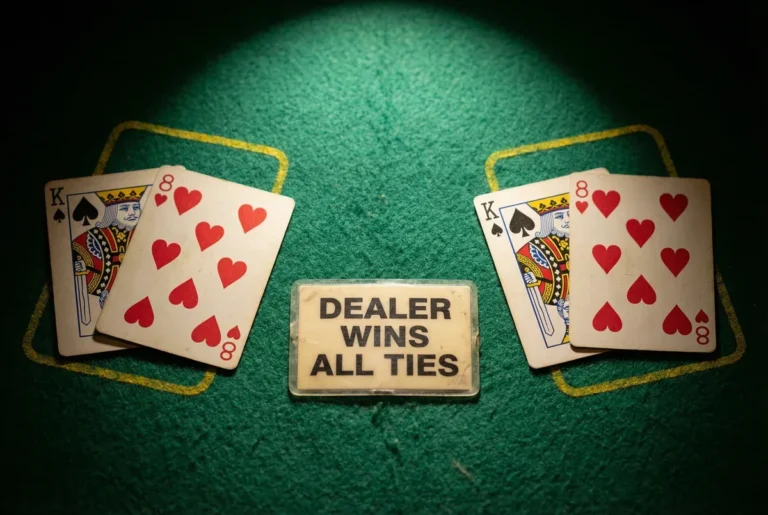
Why Dealer Wins Ties Games are Almost Always Scams
A blackjack game where the dealer wins all ties instead of pushing hands adds roughly 8% to the house edge…

How a Crowded Table Affects Your Mathematical Strategy
A full table plays fewer hands per hour than a head-to-head game. That changes your variance exposure, your expected loss…

Master the Art of Table Selection for Maximum Advantage Play Edge
Table selection as a professional skill: S17 vs H17 value, deck penetration scouting, how to leave a table without drama,…