
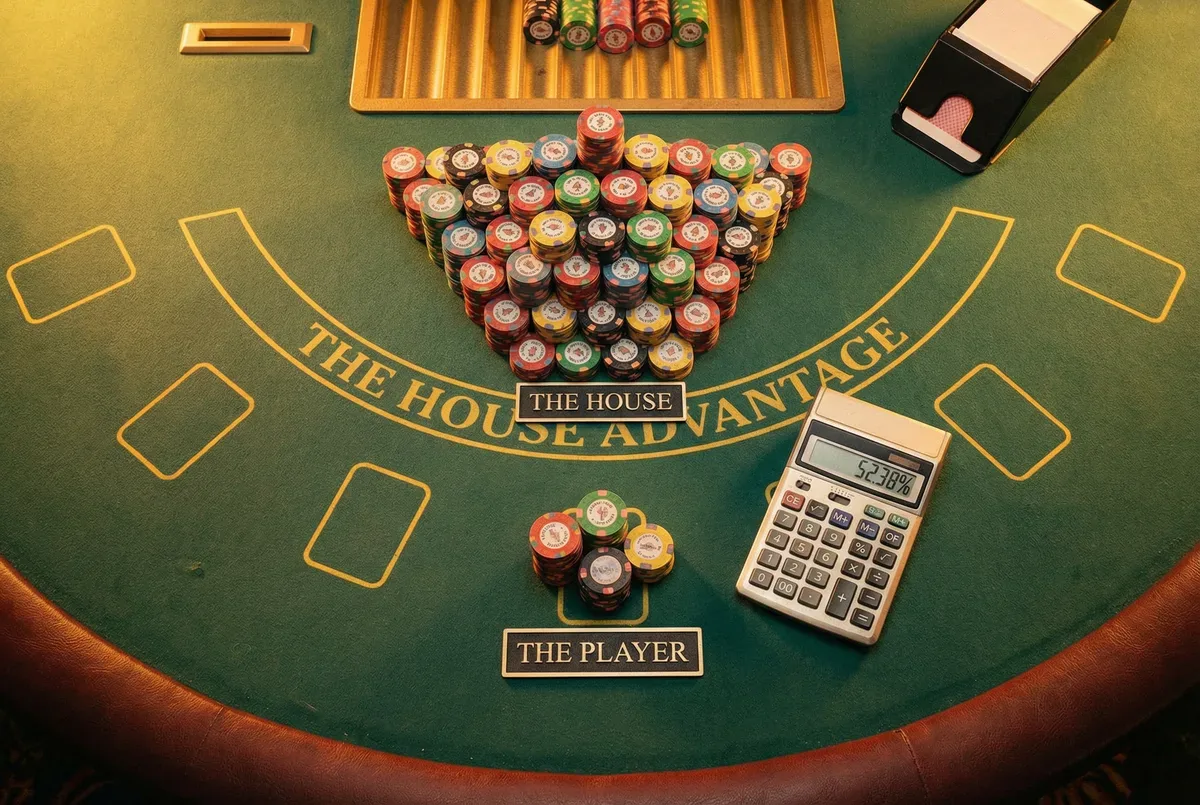
How Casinos Profit From Blackjack Mathematically
The blackjack house edge on blackjack is approximately 0.5% against a perfect blackjack basic strategy player. Yet casino financial reports show blackjack holding between 14% and 20% of all money wagered. That gap is not a rounding error it is the entire business model. Hold percentage measures what the casino actually keeps from each buy-in over a session; blackjack house edge measures the theoretical per-hand disadvantage against flawless play. The distance between these two numbers represents every poor decision, every deviation from strategy, every superstitious bet, and every emotionally driven double-down that players make. Understanding this gap tells you more about casino economics than any other single figure.
The Gap Between House Edge and Hold Percentage
- House edge vs perfect basic strategy~0.5%
- Average player house edge (with errors)2–4%
- Typical blackjack hold percentage14–20%
- Hands per hour at an average table60–80
- Casino advantage on insurance side bet7.69%
Why Player Errors Are the Casino’s Real Product?
A casino offering blackjack at 0.5% against perfect play is essentially offering a near-breakeven game. The product they are actually selling is not the game it is the conditions under which average players make mistakes. Alcohol service, ambient noise, table pressure, and the complexity of edge-case decisions all increase error rates. Studies of player behavior show that recreational players deviate from blackjack basic strategy on roughly one in every five to seven decisions. Each incorrect hit, stand, or missed double-down adds approximately 0.25% to 1.5% to the house advantage on that hand.
The casino does not need you to make large errors. It needs you to make many small ones consistently. Across 80 hands per hour and thousands of tables running simultaneously, the aggregate of minor mistakes compounds into a reliable revenue stream. This is why casinos train dealers to maintain pace: faster hands per hour means more opportunities for the edge to grind.
Common Myth
“The casino profits because blackjack is rigged”
Players see consistent losses and assume the game mechanics are unfair or manipulated
The Reality
Casinos profit from player strategy errors compounded across millions of hands, not from rigged mechanics
Correcting your strategy errors reduces the effective house edge from 3–4% down to 0.5%, saving roughly $2.50 per $100 wagered
How Scale Converts a Small Edge Into Major Revenue?
Consider a mid-sized casino running 30 blackjack tables with an average bet of $25 and 70 hands per hour. That is 30 × $25 × 70 = $52,500 in total bets per hour across the blackjack floor. Against players with a realistic 2% edge (factoring errors), the casino earns $1,050 per hour from blackjack alone. Over a 24-hour day with even modest occupancy variation, that figure climbs above $20,000 daily and $7 million annually from a single property’s blackjack tables. Scale the model to a Strip casino with 100+ tables, and the mathematics of small edges becomes unmistakable.
Average house edge with errors
%
What Side Bets Reveal About Casino Profit Strategy?
Side bets exist purely to accelerate profit extraction from recreational players. Insurance carries a 7.69% blackjack house edge in a six-deck game. Perfect Pairs runs between 4% and 6%. Lucky Ladies reaches 17% to 24% depending on the variant. These bets are positioned exactly where impulsive decisions happen alongside a main hand that already has built-in player error risk. A player who takes insurance once per session on an average bet of $25 donates roughly $0.96 per insurance wager in pure EV. That seems trivial until you model it across every player at every table over a year. The casino’s side-bet revenue is not incidental. It is engineered.
Using Casino Math to Your Advantage at the Table
If you understand the casino’s revenue model, you can position yourself outside most of it. Perfect blackjack basic strategy removes the error-based premium from your disadvantage. Avoiding all side bets eliminates the engineered extraction layer. Choosing S17 games over H17 reduces the blackjack house edge by 0.2%. These decisions compound: a disciplined blackjack basic strategy player at a favorable table faces a true blackjack house edge below 0.5%, meaning the casino earns roughly $0.50 per $100 wagered from them a fraction of what it earns from the average player. If you want to see how these rule differences affect your real per-session cost, apply this camouflage with real money at stake in your next session lets you test real-money conditions with rule variants selected understand the math before any chip touches a real felt with actual cash at risk.
Frequently Asked Questions
The house edge assumes perfect basic strategy. Most players do not play perfectly. The average recreational player operates at 2 to 4% house edge due to strategy errors. Additionally, the hold percentage measures how much of each buy-in the casino keeps over a session, which is amplified by players re-buying and churning chips.
Players must complete their hands before the dealer draws. If a player busts, the casino collects their bet immediately even if the dealer would also have busted. This asymmetry is the structural foundation of the house edge, worth approximately 8% before any favorable rules offset it.
Continuous shuffle machines do not change the per-hand house edge, but they increase hands per hour. More hands per hour means the house edge is applied more frequently, increasing the casino's expected revenue per table per hour without altering the underlying mathematical edge on any individual hand.
Before you test these plays at a real table, run them through our free blackjack simulator practice unlimited hands at zero cost until every move becomes automatic.
Mathematical Risk Warning
Every hand of blackjack carries a quantifiable expected cost. Even at 0.5% house edge, 1,000 hands at $25 produces an expected loss of $125. Understanding the math does not eliminate variance short sessions can end in significant losses regardless of strategy quality.
Blackjack Academy is an educational resource. All strategy is based on mathematical expectation. Always play within your means.

Written by
Mark AnurakProfessional card counter since 2009 · 500,000+ hands logged · Former Macau advantage player. Studied under Thorp, Griffin & Wong methodology. Full bio →
Learn More
Continue your education with these related lessons.
The Critical Psychological Edge Every Professional Blackjack Player Needs
Technical skill gets you to the table. Mental fortitude keeps you profitable. The psychological demands of professional blackjack are harder…

How to Spot Preferential Shuffling and Walk Away Immediately
Preferential shuffling when a casino shuffles early specifically because the count is favorable for players is one of the most…
The Deadliest Casino Blackjack Myths That Keep Costing Players Real Money
The most expensive blackjack myths and their actual EV cost: dealer wins ties, third base controls outcomes, hot and cold…