

The Complete History of Blackjack from Vingt-et-Un to Modern Casinos
- Vingt-et-Un: The French Game That Started Everything
- How Did the Name "Blackjack" Replace Twenty-One in American Casinos?
- How Did Blackjack Rules Evolve Through the 19th and 20th Centuries?
- How Did Card Counting Trigger the Modern Arms Race Between Players and Casinos?
- What Blackjack's History Tells Modern Players About the Game They Are Playing
[bja_toc]
The game we call blackjack traces its clearest documented lineage to Vingt-et-Un — French for “twenty-one” — which was being played in French casinos and aristocratic salons by the early 1700s. The core mechanic was identical to modern blackjack: draw cards without exceeding 21 and beat the banker’s total. Early rules differed significantly from today’s game — only the banker could double, players bet after each card, and rounds could involve multiple draws — but the fundamental goal of reaching 21 without busting was already the architecture of every subsequent version. The game that now generates more table revenue than any other casino card game worldwide grew from that single mechanic over three centuries of gradual rule evolution, American commercial refinement, and one pivotal mathematical breakthrough in 1956 that changed the game’s strategic nature permanently.
Vingt-et-Un: The French Game That Started Everything
The earliest documented references to Vingt-et-Un appear in French literature and court records from the early 18th century. The game was a standard feature of Parisian gambling houses and private salons, played by a rotating banker against multiple players. Unlike modern blackjack, where the dealer position is fixed, Vingt-et-Un rotated the banker role among players after each round or when the banker chose to relinquish it. This created a fundamentally different dynamic — the banker in Vingt-et-Un was both the house and a fellow player, with full discretion over their own drawing decisions.
The game spread through the Spanish colonies and across the Atlantic to North America in the late 18th and early 19th centuries, carried by French colonists and travelling gamblers. It arrived in American frontier gambling halls under various names — “twenty-one,” “vingt-un,” and regional variants — and was a common sight in the saloons and riverboat casinos that characterised American gambling culture before state regulation. The rules varied significantly from region to region, reflecting the informal transmission of the game through card players rather than any standardised rulebook.
Timeline
Early 1700s
Vingt-et-Un documented in French casinos and aristocratic salons
Late 1700s
Game spreads via French colonists to the Americas and Caribbean
1820s–1850s
Twenty-one played in American frontier gambling halls with variable local rules
1910s–1920s
American casinos begin offering the black jack bonus to attract players
1931
Nevada legalizes gambling
6
Las Vegas standardises the modern blackjack ruleset
1956
Baldwin, Cantey, Maisel and McDermott publish the first mathematically derived basic strategy
1962
Edward Thorp publishes Beat the Dealer — card counting becomes public knowledge
1970s–1990s
Casinos respond with multi-deck shoes, continuous shufflers, and rule restrictions
2000s
Online RNG blackjack launches
11
live dealer streaming begins a decade later
2010s–present
Live dealer blackjack reaches global audiences
6
5 payouts spread on popular tables
How Did the Name “Blackjack” Replace Twenty-One in American Casinos?
When twenty-one arrived in American gambling establishments in the early 19th century, it faced competition from poker, faro, and other games that already had established audiences. To attract new players, some casinos introduced a promotional bonus: a hand consisting of the ace of spades and a black jack — either the jack of clubs or the jack of spades — paid out at 10 to 1. This bonus hand was called the “black jack,” and the tables offering it became known as blackjack tables. The name spread faster than the promotion.
The 10-to-1 payout on the specific black jack combination was never mathematically sustainable. As the game grew in popularity and its own audience developed independent of the promotional incentive, the bonus was dropped. But the name remained. By the time Nevada legalised commercial gambling in 1931 and Las Vegas began building its casino infrastructure, “blackjack” had completely displaced “twenty-one” in American casino vocabulary. The modern 3:2 payout on any natural — not just the specific black jack — is the structural descendant of that original promotional mechanism: the idea that an ace-plus-ten-value combination on the initial deal deserves a premium payout remains baked into the game’s architecture.
Common Myth
“The 3:2 payout on naturals was always part of the original game”
Players assume the natural payout was designed into the original French rules — it feels like a fundamental part of the game
The Reality
The original bonus was a 10:1 payment on a specific black jack plus ace combination introduced as a temporary American casino promotion
The modern 3:2 natural payout is a standardised, sustainable version of that early promotional bet. The 6:5 games now appearing on casino floors are reducing that premium further — moving backward from the game's natural evolution toward the player.
How Did Blackjack Rules Evolve Through the 19th and 20th Centuries?
Through the 19th and early 20th centuries, American casinos ran blackjack with widely varying local rules. Some allowed players to double on any number of cards. Some offered early surrender as a standard option. Deck counts varied from one to four decks depending on the establishment. Nevada’s legalisation of gambling in 1931 accelerated standardisation as Las Vegas casino operators developed shared competitive incentives: attract players, keep the game understandable, and maintain a reliable house edge. By the 1950s, the modern core ruleset had largely solidified — players act first and carry the bust risk, the dealer follows fixed rules, naturals pay 3:2, and insurance is offered when the dealer shows an ace.
The pivotal year in blackjack’s modern history is 1956. Four US Army mathematicians — Roger Baldwin, Wilbert Cantey, Herbert Maisel, and James McDermott — published a paper in the Journal of the American Statistical Association titled “The Optimum Strategy in Blackjack.” Using mechanical calculators and months of computation, they demonstrated for the first time that blackjack played with mathematically optimal decisions was nearly a break-even game for the player. Their paper was the first rigorous derivation of basic strategy — the set of correct decisions for every combination of player hand and dealer upcard. It proved that blackjack was not purely a game of chance but a game with a mathematically determinable optimal response at every decision point.
Six years later, Edward Thorp extended that work in Beat the Dealer (1962), demonstrating that a player who tracked the ratio of high to low cards remaining in the deck could gain a positive mathematical edge over the casino. The book spent months on the New York Times bestseller list and triggered a public blackjack obsession that transformed the game’s cultural position from a casual casino diversion to a mathematically serious pursuit. Casinos, for the first time, faced a casino card game that informed players could approach on near-equal mathematical terms.
The 1956 Baldwin paper is one of the most consequential documents in gambling history. Before it, no one had proved with mathematics that any casino game could be played at near-breakeven. Thorp built on it to show it could actually be beaten. Everything that happened in blackjack after 1956 — the multi-deck shift, the rule changes, the surveillance technology, the card counter countermeasures — is a reaction to those two works. If you understand that context, you understand why modern blackjack rules are designed the way they are.
How Did Card Counting Trigger the Modern Arms Race Between Players and Casinos?
Thorp’s publication triggered an immediate casino response. Rule changes were introduced almost overnight — some Las Vegas casinos briefly banned doubling down on anything other than 11, restricted pair splitting, and moved to double-deck games. Player boycotts following those restrictions caused the casinos to reverse course within weeks. The longer-term response was structural: more decks, more frequent shuffles, and eventually continuous shuffling machines (CSMs) that eliminated penetration entirely. The modern standard of six to eight decks, with the cut card placed at approximately 65% to 80% penetration, is the direct legacy of that arms race.
The 1970s and 1980s saw the development of increasingly sophisticated counting systems — Hi-Lo, Omega II, Halves, Zen — as advantage players refined their techniques in response to casino countermeasures. Team play emerged as a way to scale advantage across multiple sessions while individual team members maintained cover as recreational players. The MIT Blackjack Team, operating from the late 1970s through the 1990s, became the most publicly documented example of team card counting, extracting millions from casinos across the United States before detailed surveillance and Griffin Investigations made continued operations impractical.
The 2000s brought online RNG blackjack and, a decade later, live dealer streaming technology that extended the game globally without geographic constraints. The rules players encounter at live dealer tables today — six or eight decks, S17 or H17, DAS, late surrender where available, 3:2 on naturals at better providers — are the direct product of three centuries of game evolution and sixty years of player-versus-casino rule negotiation. Understanding that history gives context to why each rule element exists and why deviations from the player-friendly standard are worth walking away from.
What Blackjack’s History Tells Modern Players About the Game They Are Playing
The historical arc of blackjack is a story of mathematical discovery meeting commercial incentive. The game’s current form — its payout structures, its rule variations, its shuffle procedures — is not arbitrary. Every element reflects either a player-favourable feature preserved because it attracts table volume, or a casino-protective rule introduced in response to demonstrated advantage play. The 3:2 natural payout survived because removing it drives players away. The six-deck shoe survived because it reduces counting effectiveness. The H17 rule is present on roughly half of all tables because it adds 0.22% to the house edge with a modest effect on game pace.
For a player who understands this history, checking the table rules before sitting down is not a formality — it is the application of 300 years of accumulated strategic knowledge to a 90-second decision. The felt placard tells you where the current casino stands in the ongoing negotiation between player and house. A 3:2 S17 DAS game with late surrender available represents the most player-favourable terms most commercial casinos offer. A 6:5 H17 game with restricted splitting represents a casino that has shifted the historical balance significantly toward the house. Knowing the difference is the legacy of everyone who played, studied, and documented this game before you arrived at the table.
The free blackjack simulator lets you put basic strategy into practice across thousands of hands at zero cost — the same strategy first formalised in 1956 and refined for six decades since. When you are ready to sit across from a real human dealer in a game that operates under the rules that emerged from that full history, a live dealer session with real money at stake is the most direct bridge between studying the game and playing it — confirm the table rules match what you have prepared for before placing your first real-money bet.
Frequently Asked Questions
Vingt-et-Un in its original form is largely a historical footnote, but Pontoon — popular in the UK and Australia — preserves several original Vingt-et-Un rules, including both dealer cards face down and the player acting first on all hands. The mechanic survives in modified form across multiple regional variants.
Blackjack overtook baccarat and poker as the dominant casino card game in North America during the 1960s and 1970s, accelerated by the publication of basic strategy and card counting books that created a wave of informed public interest in the game.
The core framework has remained stable, but refinements have been made as computing power allowed more precise simulation across billions of hands. Composition-dependent exceptions, rule-specific adjustments, and optimal surrender indices have been added over the decades — but the fundamental hit, stand, double, and split decisions are largely unchanged from the original Baldwin derivation.
Mathematical Risk Warning
Historical knowledge gives context — strategy knowledge changes outcomes. Understanding the game's origins does not reduce the house edge at any table. Always verify rules, always play with correct basic strategy, and always set a session limit before you sit down.
Blackjack Academy is an educational resource. All strategy recommendations are based on mathematical expectation. Always gamble responsibly and within your means.

Written by
Mark AnurakProfessional card counter since 2009 · 500,000+ hands logged · Former Macau advantage player. Studied under Thorp, Griffin & Wong methodology. Full bio →
Learn More
Continue your education with these related lessons.

Complete Blackjack Table Etiquette Guide Every Serious Player Must Know
Learn the unwritten rules of the blackjack table hand signals, chip buying, tipping, and everything else that separates a smooth…
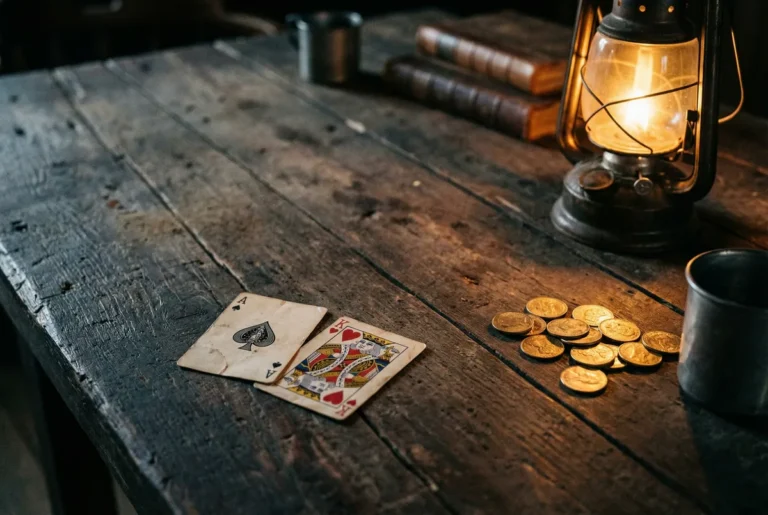
History of the First American Blackjack Rules from 1825
The first written American rules for twenty-one appeared in 1825. They looked nothing like the game you play today. There…
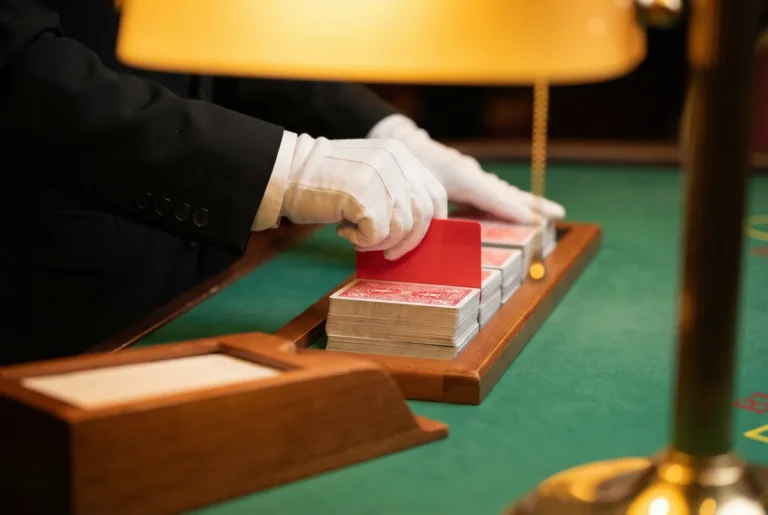
How to Tell When a New Blackjack Shoe is Starting
A new shoe resets everything: the count, the penetration, and your decision-making baseline. Learn the visual signals that tell you…