
How Casino Dealers Are Trained
- The Dealer's Fixed Rulebook: No Strategy, No Discretion
- How Are Dealers Trained Before They Step Onto the Casino Floor?
- Why Does the Dealer Peek Rule Exist and What Does It Mean for Players?
- How Does Knowing Dealer Rules Give Skilled Players a Mathematical Advantage?
- Using Dealer Knowledge at Your Next Real Table
[bja_toc]
The blackjack dealer has no strategic autonomy. Every action they take is governed by a rigid set of house rules — hit on 16 and below, stand on hard 17 and above, peek for blackjack when showing an ace or ten-value card, pay 3:2 on naturals where applicable, and burn one card at the start of each shoe. A dealer cannot choose to stand on 15 to save a struggling table or hit a pat 18 to improve their hand. This total predictability is not a weakness in the game’s design — it is the foundation that makes basic strategy possible. Because the dealer’s every move is scripted by rule, your counter-strategy can be mathematically optimised to exploit that script on every single hand.
The Dealer’s Fixed Rulebook: No Strategy, No Discretion
A blackjack dealer’s job is procedural, not strategic. The moment the cards are in play, the dealer follows a pre-defined decision tree that admits no interpretation. Hard 16 always gets a hit. Hard 17 always gets a stand. Whether the dealer “feels” like the next card is a ten is completely irrelevant — the rules eliminate feeling from the equation entirely. In most games, the dealer also stands on soft 17 (ace + 6), though some casinos require the dealer to hit soft 17, which measurably increases the house edge by approximately 0.2 percentage points. The table placard will specify which rule applies, and knowing the difference changes several of your basic strategy decisions.
This fixed rulebook exists for two reasons: it protects the casino from dealer discretion being used to favour friends or high tippers, and it creates a controlled mathematical environment that lets the casino calculate its precise expected edge. Any deviation — even one the player asks for — is a procedural violation recorded by the overhead cameras and reviewed by the pit supervisor. Dealers found deviating from procedure face immediate disciplinary action regardless of intent. The rule-bound nature of the dealer’s role is not about robotics — it is about protecting the mathematical integrity of every hand dealt.
- Chip handlingcounting chips by touch, without looking down
- Shuffle procedureriffle, box, strip, riffle — in casino-specified sequence
- Hand signal recognitionhit, stand, double, split, surrender
- Payout calculation3:2, 1:1, insurance at 2:1 — counted in chips instantly
- Peek mechanichole card check with zero readable tells
- Burn card and cut card protocols at shoe start and mid-shoe shuffles
How Are Dealers Trained Before They Step Onto the Casino Floor?
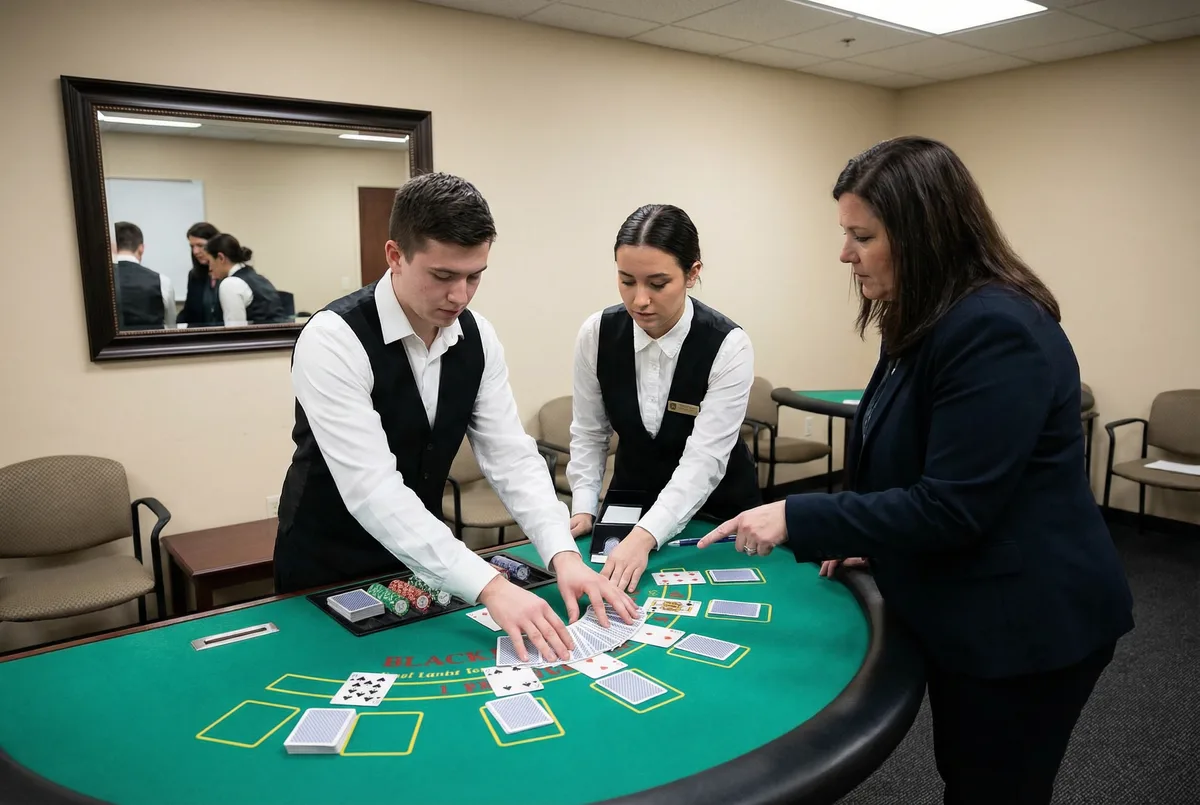
Most casino dealers complete a structured training programme before their first floor assignment — either at a dedicated dealer academy or through an in-house programme run by the casino itself. A standard blackjack dealing course runs four to six weeks. Trainees learn card handling, chip management, shuffle procedures, and the exact sequence of actions required from the moment they approach the table to the moment the pit supervisor approves their shift-end spread. They practise on mock tables with fake chips and dummy cards until their pace, accuracy, and physical movements match the casino’s operational standard.
Speed and precision are evaluated together. A slow dealer who makes no errors is as costly to the casino as a fast dealer who miscounts payouts — fewer hands per hour means lower revenue, and payout errors mean disputes, chargebacks, and camera reviews that stop the table entirely. The training emphasis is on developing muscle memory so that chip counts, card flips, and signal recognition happen below the level of conscious thought. A certified dealer should be able to read a hand signal, announce the action, and respond physically in under a second without looking at the chips they are counting.
After the classroom phase, new dealers typically enter a break-in role on low-stakes tables where supervisors monitor every hand closely. The pit boss watches for miscounts, improper payouts, missed hand signals, incorrect shuffle sequences, and procedural shortcuts. Dealers are also trained to recognise cheating attempts from players — past posting (adding chips after seeing a good result), card switching, and hand mucking — though the primary defence against all of these is the overhead surveillance system, which records every hand at every table continuously.
Common Myth
“Dealers can choose to be lenient with certain players”
Players who tip generously sometimes feel the dealer is 'on their side' and believe this translates into more favourable draws
The Reality
The dealer's actions are fixed by house rules and monitored by overhead cameras on every hand
Any intentional rule deviation — even standing on 16 to avoid busting a friendly table — is a terminable procedural violation. The cameras record the exact sequence of every hand dealt. Tipping improves nothing except goodwill.
Why Does the Dealer Peek Rule Exist and What Does It Mean for Players?
When a dealer shows an ace or a ten-value card, standard North American rules require them to check their hole card before play continues. If the dealer has a natural blackjack, all active player bets lose immediately — except insurance bets, which pay 2:1. The peek prevents players from doubling or splitting into a hand the dealer has already won, which would simply waste additional chips on a guaranteed loss. Without the peek, a player who doubles a soft 13 against an ace and then watches the dealer flip a natural has lost two bets on a hand that was decided before they acted. The peek rule eliminates that situation entirely.
The mechanics of the peek are tightly controlled. Modern casinos use a mirror embedded in the felt surface or a dedicated mechanical peek device that allows only the dealer to see the card angle without lifting it visibly. Dealers are trained to check the hole card with no readable tells — no facial expression, no pause, no micro-reaction to what they see. Any consistent physical tell from a dealer checking a natural versus checking a non-natural becomes an exploitable read for observant players, which is exactly why the training emphasises perfect neutrality at the moment of the peek.
European casinos commonly use a no-hole-card (NHC) rule instead. The dealer receives only one card face up at the start of the hand, and the second card is not dealt until all players have completed their actions. This eliminates the peek entirely but creates a different strategic adjustment: in NHC games, players should not double or split against a dealer ace or ten in situations where a dealer natural would cost them the additional wager. Basic strategy tables for NHC games are slightly different from standard American strategy — specifically around doubling and splitting against ten-value and ace upcards.
The peek mechanic is one of the most misunderstood elements in blackjack. Players often feel cheated when the dealer flips a natural after they doubled — but in a standard game, the peek would have caught that immediately and no additional bet would have been placed. When you play in a no-hole-card game, your strategy must adjust for exactly this scenario: avoid aggressive doubles against ten-value and ace upcards, because a dealer natural costs you the extra wager.
How Does Knowing Dealer Rules Give Skilled Players a Mathematical Advantage?
Because dealers follow fixed rules, your entire strategy can be calibrated precisely to their forced behaviour. You know with certainty that a dealer showing a 6 upcard will bust approximately 42% of the time across all possible hole cards — because you know exactly which totals force them to draw and which draws push them past 21. That predictability is the direct foundation of every doubling, splitting, and standing decision in basic strategy. When you double an 11 against a dealer 6, you are not gambling — you are executing a decision calculated from the dealer’s known bust probability under a rule set you have already read on the table placard before sitting down.
Dealer bust probabilities by upcard are not guesses — they are computed outcomes based on the rule set in play. A dealer showing a 2 busts roughly 35% of the time. A dealer showing a 7 busts around 26%. A dealer showing an ace busts only about 17% — which is why standing on stiff hands against an ace is almost always wrong. The specific percentages shift slightly depending on whether the dealer hits or stands on soft 17, which is why checking the table rules before sitting is not a formality but a strategic necessity. The H17 (dealer hits soft 17) versus S17 (stands on soft 17) rule changes the correct play on at least a dozen hand combinations.
The shuffle procedure is also strategically relevant. Casinos that use continuous shuffling machines (CSMs) eliminate the ability to count cards entirely because the penetration — the percentage of the shoe dealt before reshuffling — drops to effectively zero. Casinos that hand-shuffle or use standard automatic shufflers deal a fixed percentage of the shoe before the cut card triggers a reshuffle, typically 65–80% penetration in a six-deck game. Knowing which shuffle method is in use tells you immediately whether counting is viable and what your effective hand sample size per shoe will be.
Using Dealer Knowledge at Your Next Real Table
Before you sit down at any table, read the placard — specifically for the soft 17 rule, the number of decks, and whether late surrender is offered. These three facts determine which version of basic strategy applies to this game and which of your decisions will differ from the standard chart. A player who memorises a single generic strategy chart and applies it unchanged to every game they encounter is making correctible errors on several hands per session.
At the table, use the dealer’s upcard as your primary decision input — not your gut read of the next card. When the dealer shows a weak upcard (2 through 6), their high bust probability means you should minimise your own bust risk and take every available doubling and splitting opportunity to get more money into play against a dealer who is likely to self-destruct. When the dealer shows a strong upcard (7 through ace), their low bust probability means you cannot afford to stand on stiff hands and hope — you must draw toward a competitive total even at the cost of some bust risk. That is the architecture of basic strategy, and it is built entirely on the dealer’s forced behaviour. For a live feel of how this plays out against a real human dealer bound by the same fixed rules you will encounter in any casino, a live dealer session using real money is the most realistic environment to pressure-test your understanding before a proper casino visit.
Frequently Asked Questions
No. Dealers are required to follow house rules exactly on every hand. Any deviation — intentional or accidental — is a procedural violation recorded by overhead cameras. Dealers cannot legally help players by altering how they hit or stand, regardless of tips, requests, or relationship.
The pit supervisor corrects it using the camera feed. Either the underpaid player is compensated or the overpaid amount is recovered. This is why all chips remain visible throughout the hand and all signals must be made clearly — the camera records the full sequence from bet placement to payout.
This is called the spread or cut-out. It allows the outgoing dealer, incoming dealer, and pit supervisor to verify that all cards are present, none have been substituted, and the deck is complete before a new dealer begins. It is a standard anti-tampering procedure required at every shift change.
Mathematical Risk Warning
Understanding dealer rules clarifies every decision you face at the table — but it does not eliminate the house edge. The dealer's fixed behaviour is a tool for informed strategy, not a guarantee of any outcome.
Blackjack Academy is an educational resource. All strategy recommendations are based on mathematical expectation. Always gamble responsibly and within your means.

Written by
Mark AnurakProfessional card counter since 2009 · 500,000+ hands logged · Former Macau advantage player. Studied under Thorp, Griffin & Wong methodology. Full bio →
Learn More
Continue your education with these related lessons.

Complete Blackjack Table Etiquette Guide Every Serious Player Must Know
Learn the unwritten rules of the blackjack table hand signals, chip buying, tipping, and everything else that separates a smooth…
7 Key Differences Between Online Blackjack and Live Casino Blackjack
RNG online blackjack runs 200+ hands per hour. Live dealer games run 50–60. Here's what changes between formats and which…
How the Dealer Settles and Pays Out Every Blackjack Wager
The dealer follows a fixed settlement sequence after every hand: players who beat the dealer are paid, pushes are returned,…