
Why Blackjack Is a Skill Game, Not Luck
[bja_toc]
Blackjack is the only mainstream casino game where your decisions directly change the house edge. A player using correct basic strategy in a standard six-deck game faces a house edge of approximately 0.5%. A player making intuition-based decisions faces somewhere between 2% and 4%. That gap — up to 3.5 percentage points — represents thousands of dollars over a typical playing lifetime, and every cent of it is explained not by luck, but by the quality of decisions made on individual hands. No other table game in the casino offers an equivalent skill differential. Roulette spins have the same expected outcome regardless of what you think or do. Slots are entirely mechanical. Blackjack is different, and the mathematics proves it precisely.
The House Edge Gap That Proves Skill Matters
The house edge in blackjack is not fixed — it is a function of how well the player makes decisions. Under identical table rules, two players sitting side by side at the same shoe can face dramatically different mathematical expectations purely because of their choices on each hand.
A player using perfect basic strategy in a standard six-deck game with the dealer standing on soft 17, double after split allowed, and late surrender available faces a house edge of approximately 0.44%. That is less than half a percent — meaning for every $100 wagered, the expected long-run loss is under 50 cents. A player hitting on 20, standing on 14 against a dealer 7, and taking insurance routinely faces a house edge closer to 3.5% to 4%. That same $100 wagered costs $3.50 to $4.00 per round in expected value. At 80 hands per hour, the uninformed player is losing over $300 per hour at a $25 table through bad decisions alone — not through bad luck.
Basic strategy house edge
% (six-deck, S17, DAS, LS)
Uninformed player house edge
%
Skill gap
percentage points
This matters because it is measurable and reproducible. Run a simulation of ten million hands with perfect basic strategy. Run the same simulation with random decisions. The difference in outcomes is not noise — it is a precise, stable mathematical gap that confirms skill determines results. The short-term variance of individual hands creates the illusion that cards are random and decisions irrelevant. Over sample sizes large enough to be statistically meaningful, the skill gap is indisputable.
What Is Basic Strategy, and Where Did It Come From?
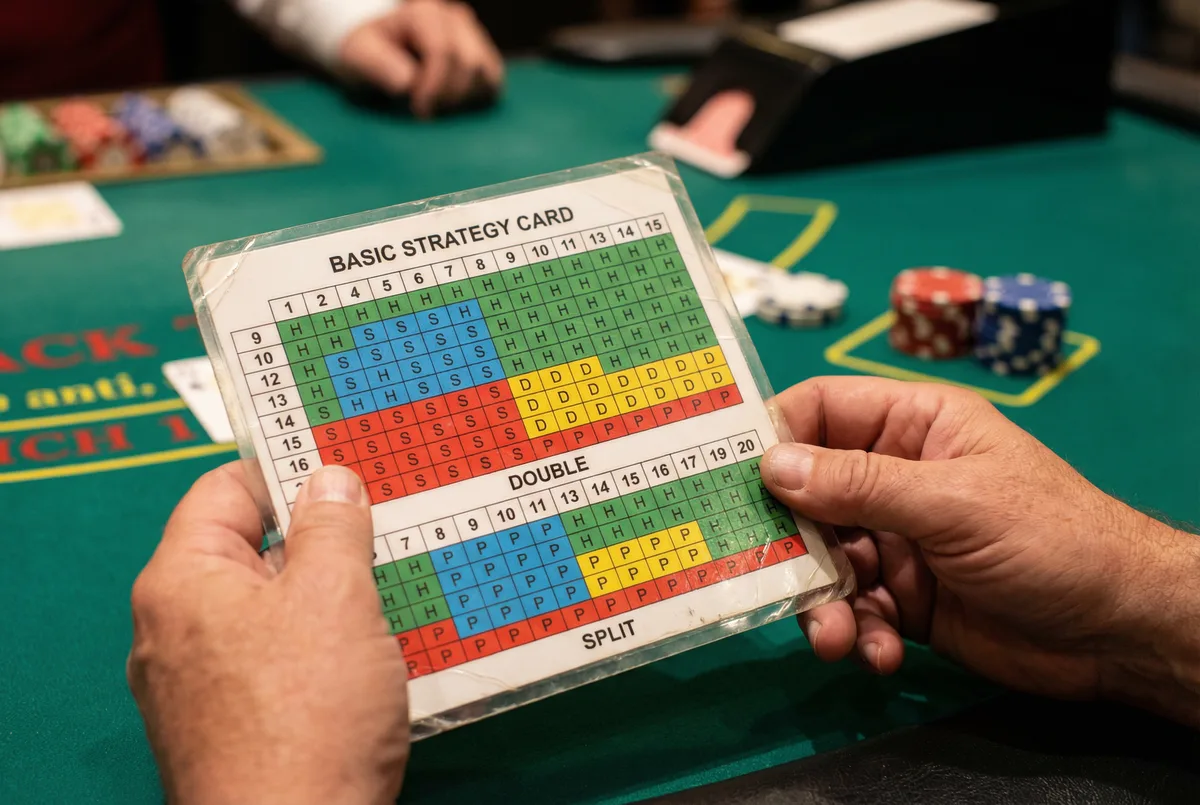
Basic strategy is the mathematically optimal action for every possible combination of player hand and dealer upcard, derived from running hundreds of millions of simulated hands across all possible card distributions. It is not a heuristic or a tradition — it is the provably correct answer to every blackjack decision given complete information about the game rules.
The strategy was first formally published in 1956 by four US Army mathematicians: Roger Baldwin, Wilbert Cantey, Herbert Maisel, and James McDermott. Their paper, published in the Journal of the American Statistical Association, demonstrated for the first time that blackjack played correctly was nearly a break-even game. Edward Thorp extended and popularised that work in 1962 with Beat the Dealer, which remained on the New York Times bestseller list for months and proved that disciplined play could actually give the player a mathematical edge over the house. Every basic strategy table used on this site descends from that original work, refined through decades of computational verification.
Common Myth
“It doesn't matter what you do — the cards are random anyway”
Short-term wins from incorrect plays feel like validation for ignoring strategy, especially hitting on 12 and getting a small card
The Reality
Every decision has a precise mathematical cost or benefit that compounds over thousands of hands
Standing on hard 16 against a dealer 10 costs 0.23% of your bet versus hitting. Hitting hard 20 costs approximately 78% of your bet in lost expected value. The damage is measurable and real regardless of the card you receive on any individual hand
Basic strategy covers approximately 250 unique decision points — every combination of player total and dealer upcard, including pairs and soft hands. Each decision has one mathematically superior answer. The strategy does not change based on hunches, streaks, or what happened on the previous hand. The deck has no memory. The correct play on hard 16 against a dealer 10 is the same on the first hand of a shoe as it is on the last. Deviating from the correct answer always carries an expected value cost, even when the deviation occasionally produces a winning hand.
What Is the Quantifiable Cost of Playing Without Knowledge?
The difference between a 0.44% and a 3.5% house edge is not abstract. It translates directly into dollars across any real session length, and the numbers are large enough to matter to anyone who plays with any regularity.
On a $25 minimum table playing 80 hands per hour, the basic strategy player expects to lose approximately $8.80 per hour in expected value. The uninformed player at 3.5% expects to lose $70 per hour at the same table and same bet size. Over a six-hour session, that is an $52.80 expected loss versus a $420 expected loss — on identical wagers. Over ten similar trips per year, the basic strategy player loses approximately $528 in expected value. The uninformed player loses $4,200. The difference — $3,672 — is not luck. It is the price of not learning the strategy.
The measurable skill gap in blackjack: a player using no strategy faces roughly 4% house edge. A player using perfect basic strategy faces 0.44%. That 3.56% difference, over 500 hands at $25 per hand, is $445 in expected value. Across a year of regular play, the unskilled player loses an amount that would comfortably fund several years of study materials. The skill is not optional — it is the difference between entertainment and financial education.
The specific decisions that create the most damage are not exotic edge cases. They are common situations that uninformed players misplay on every session: standing on soft 18 against a dealer 9 (should hit), not doubling hard 11 against a dealer 6 (a significant missed positive EV opportunity), taking insurance when the dealer shows an ace (a losing bet that adds approximately 7.7% to the house edge when taken), and hitting a pair of 8s against a dealer 10 instead of splitting. Each of these is a textbook situation covered completely by basic strategy. Each costs real money every time it is misplayed.
How Do You Develop Genuine Blackjack Skill Before Risking Real Money?
Skill development in blackjack follows a clear, structured path. The goal is not to eventually guess the right play — it is to make every correct play automatically, without conscious deliberation, under live casino conditions with noise, distractions, and time pressure.
The first stage is memorisation. Download or print the basic strategy chart for the game you plan to play — specifically the number of decks and whether the dealer hits or stands on soft 17, as these change several decisions. Study the chart in sections: hard totals first, then soft totals, then pairs. Drill with a physical deck by dealing two cards to yourself and one card face up for the dealer, then reciting the correct play before checking the chart. Target fewer than three seconds per decision.
The second stage is simulation. The free blackjack simulator on this site allows you to play unlimited hands with real-time feedback on every decision. It flags incorrect plays immediately and tracks your error rate over time. A realistic target before playing in a casino is an error rate below 2% across 500 consecutive hands — that means fewer than 10 wrong decisions in 500 situations, covering all hand types and dealer upcards.
The third stage is live play at the lowest available stakes. Real-money conditions create pressure that simulation cannot fully replicate — the rhythm of the game, the pace of the dealer, the social environment. Start at the minimum table limit and treat the first ten sessions as continued practice, not as profit-seeking. Track your decisions, not just your results. A session where you made every correct play and lost is a better session than one where you made errors and won. The results will converge to expectation over time. The quality of decisions will not improve by accident.
Putting Blackjack Skill to Work at a Real Table
At a live table, skill shows up in consistency under pressure. The dealer is moving quickly. Other players may be making decisions you know are wrong. The pit boss is watching. Your last hand might have been a frustrating loss. None of that changes the mathematically correct action on the hand in front of you.
Two practical commitments separate the skilled blackjack player from the rest: choosing the right game and ignoring the result of the last hand. Game selection means checking the table placard before sitting down — specifically the number of decks, whether the dealer hits soft 17, and whether 3:2 blackjack is paid. A single-deck game paying 6:5 is worse for the player than an eight-deck game paying 3:2. The number of decks printed on the sign matters less than the payout structure. A skilled player who spends two minutes reading the rules before sitting saves more in expected value than a perfect strategy player who overlooks those details.
Ignoring previous results means understanding that the deck has no memory. The correct play on any hand is determined by your cards and the dealer’s upcard — not by whether you won or lost the last three hands, not by what the table has been doing, not by anyone’s superstitions about streaks. Every hand is mathematically independent. Skilled players do not change strategy in response to runs of results. They play each hand in isolation, making the decision with the highest expected value given the information available. That discipline, applied consistently across thousands of hands, is what makes blackjack a skill game. It is also what makes it worth learning.
Frequently Asked Questions
Most players can memorise the complete basic strategy chart in two to four weeks of daily practice. The goal is to reach automatic decision speed — under three seconds per play — before sitting at a casino table. Free simulators accelerate the process significantly compared to studying a chart alone.
No. Basic strategy minimises the house edge but does not eliminate it. The house retains a mathematical advantage of approximately 0.44% even against perfect play. What basic strategy guarantees is that you are making the decision with the highest possible expected value on every hand — which is the most any blackjack player can control.
Casinos allow strategy cards because even a perfect basic strategy player loses to the house edge over time. The cards do not overcome the casino's mathematical advantage — they merely minimise it. From the casino's perspective, players who study strategy still lose money in the long run, just at a slower rate.
Mathematical Risk Warning
Even with perfect basic strategy, the house retains a mathematical edge on every hand. Skill reduces losses — it does not eliminate them. Set a session limit before you sit down and treat it as an absolute ceiling.
Blackjack Academy is an educational resource. All strategy recommendations are based on mathematical expectation. Always gamble responsibly and within your means.

Written by
Mark AnurakProfessional card counter since 2009 · 500,000+ hands logged · Former Macau advantage player. Studied under Thorp, Griffin & Wong methodology. Full bio →
Learn More
Continue your education with these related lessons.
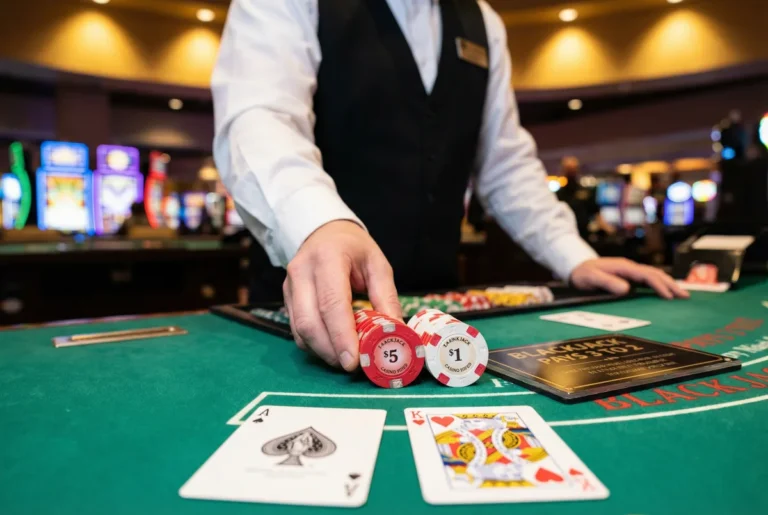
Blackjack Payout Structures Explained from 3 to 2 to Even Money
The payout on a natural blackjack is the single biggest variable in the game. Here is exactly what 3:2, 6:5,…
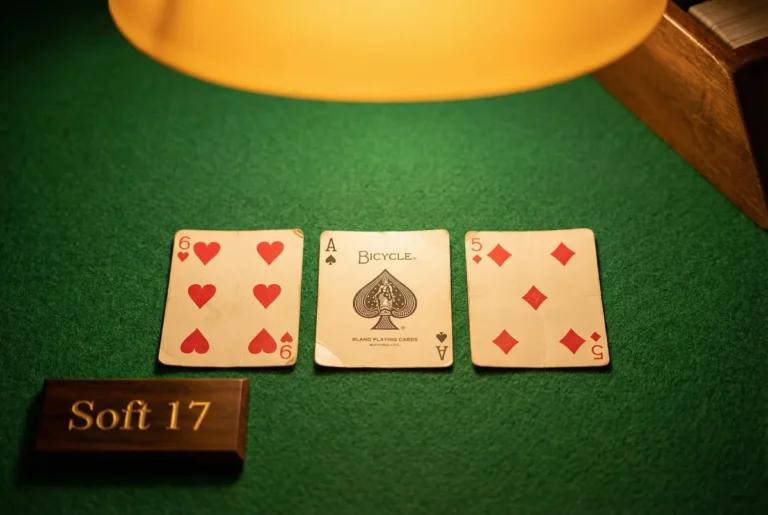
Master Blackjack Card Values Including Every Face Card and Ace Rule
31 of every 52 cards in a standard deck are worth 10 or 11 points. That ratio determines when to…

How the 1956 Baldwin Paper Created the First Winning Strategy
In 1956, four US Army mathematicians published a paper that changed blackjack forever. Roger Baldwin, Wilbert Cantey, Herbert Maisel, and…