
Why Index Numbers Are the Most Critical Tool in Every Counting Strategy
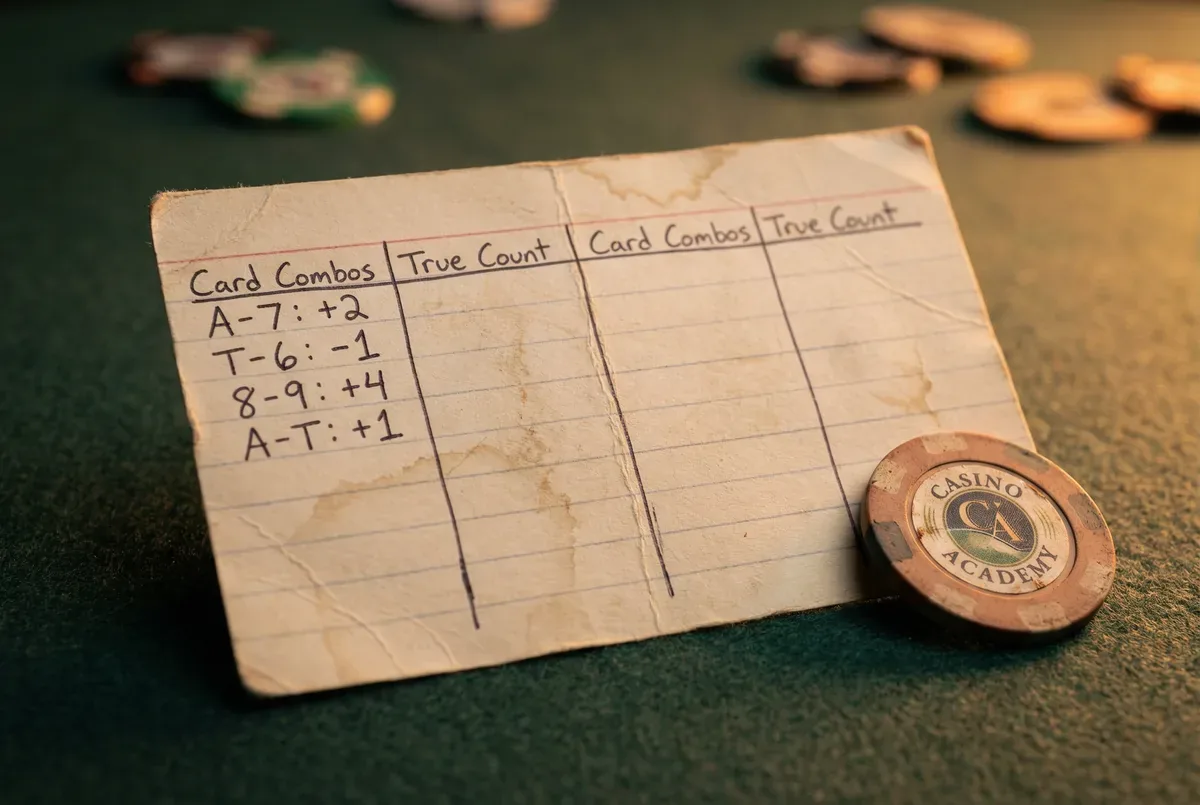
Index numbers are true-count thresholds that signal when the correct playing decision changes from blackjack basic strategy. At a neutral count, blackjack basic strategy is the mathematically optimal play. As the count rises or falls, the composition of remaining cards shifts and at certain thresholds, a different decision becomes correct. For example, the insurance index in Hi-Lo is +3: take insurance only when the true count is +3 or higher, because at that point there are enough 10-value cards remaining that insurance becomes a positive-EV bet. Every deviation from blackjack basic strategy has an index number, and learning them is what separates basic-strategy counters from index-play counters.
What Index Numbers Are and How They Work
| Hand | Dealer | Index (TC) |
|---|---|---|
| Insurance | ||
| Any | ||
| +3 | ||
| 16 vs 10 | ||
| Stand at | ||
| 15 vs 10 | ||
| Stand at | ||
| +4 | ||
| 12 vs 3 | ||
| Stand at | ||
| +2 | ||
| 12 vs 2 | ||
| Stand at | ||
| +3 | ||
| 11 vs A | ||
| Double at | ||
| +1 | ||
| 10 vs A | ||
| Double at | ||
| +4 | ||
| 10 vs 10 | ||
| Double at | ||
| +4 | ||
| 9 vs 2 | ||
| Double at | ||
| +1 | ||
| 9 vs 7 | ||
| Double at | ||
| +3 | ||
| T,T vs 5 | ||
| Split at | ||
| +5 | ||
| T,T vs 6 | ||
| Split at | ||
| +4 | ||
| 12 vs 4 | ||
| Stand at | ||
| 12 vs 5 | ||
| Stand at | ||
| -2 | ||
| 12 vs 6 | ||
| Stand at | ||
| -1 | ||
| 13 vs 2 | ||
| Stand at | ||
| -1 | ||
| 13 vs 3 | ||
| Stand at | ||
| -2 | ||
| A,8 vs 6 | ||
| Double at | ||
| +1 |
Why the Illustrious 18 Capture Most of the Available Gain?
Don Schlesinger’s research in Blackjack Attack quantified the EV contribution of each strategy deviation for Hi-Lo. The Illustrious 18 the 18 highest-value index plays account for approximately 80% of the total gain available from all possible deviations. Index plays 19 through 100+ collectively contribute the remaining 20%, and that 20% is distributed so thinly across so many situations that learning them produces a near-negligible gain in practice. The first index on the list insurance at TC +3 alone contributes roughly 30% of the total index play gain. The next four deviations (standing 16 vs. 10, standing 15 vs. 10, and a few 12-vs-dealer hands) add another 40%.
This distribution means that learning the top 8–10 index plays produces nearly the same gain as learning all 18, and learning beyond 18 produces gains so small they are overwhelmed by the errors introduced by memorizing and applying a larger index table under live conditions. The principle of diminishing marginal return applies sharply to index number study.
Common Myth
“Learning more index numbers always increases your edge.”
More deviations seem like more opportunities to beat the house. Players assume each new index adds proportional value.
The Reality
The top 6 indices contribute over 70% of total index EV. Beyond the Illustrious 18, each additional deviation adds less than 0.002% to edge far less than the error rate introduced by trying to memorize and apply more plays under live pressure.
Schlesinger's data: Illustrious 18 add ~0.15% to Hi-Lo edge. Indices 19-100 add another ~0.03% at best.
How to Apply Index Numbers at the Table?
Applying indices requires simultaneously holding the true count in working memory while evaluating the hand. The process is: convert running count to true count, check the relevant index for your hand and dealer upcard, compare to your current true count, and make the deviation if the threshold is met. Under live conditions, this must happen in two to three seconds while maintaining normal table demeanor. The hands most likely to trigger index plays are 16 vs. 10, 15 vs. 10, insurance, and soft-18 doubles practice these four until the trigger is automatic before adding more.
A critical error pattern is applying indices with the wrong sign. Negative indices mean the deviation applies in negative counts. Standing on 12 vs. 4 at TC 0 is blackjack basic strategy but at TC -3, blackjack basic strategy says hit. If you confuse the sign and stand at a negative count, you are making an incorrect deviation that costs EV. Every index must be memorized with its sign and direction clearly locked in, not just its absolute value.
Master insurance, 16 vs. 10, and 15 vs. 10 before any other index. These three alone account for roughly 45% of total index EV in Hi-Lo. Once those are automatic, add the 12-vs-dealer indices. Only then consider the remaining Illustrious 18. This sequential approach ensures the highest-value deviations are executed most accurately.
What Is Situational Limits?
Not every index-appropriate situation should trigger the deviation in a live casino. Standing on 16 vs. 10 at TC 0 is a correct index play, but it is also noticeably unusual to surveillance. Basic strategy says hit 16 vs. 10. A player who consistently stands on this hand is exhibiting a clear counting tell. Counters at risk of heat often skip the lowest-visibility deviations or apply them less consistently in exchange for longevity at the table. The EV cost of not applying a TC 0 deviation is minimal far less than the cost of a back-off.
Drill Index Plays Against Real Hands
Index plays only become reliable under time pressure and real-money conditions. Rehearsing in silence at home builds knowledge but not the reflexes needed when a dealer is waiting and a pit boss is watching. The use your index numbers at a live dealer game for real money tables offer the live-deal pressure needed to stress-test your index recall real wagering decisions, real timing, real consequences. Play there with only what you can genuinely afford to lose as you build this layer of your counting skill.
Frequently Asked Questions
Index numbers are true-count thresholds at which the correct playing decision changes from basic strategy. For example, the Hi-Lo insurance index is +3 take insurance only when the true count is +3 or higher. Each possible deviation from basic strategy has its own index number.
The Illustrious 18 are the 18 most valuable strategy deviations for Hi-Lo card counters, identified by Don Schlesinger in Blackjack Attack. These 18 index plays account for roughly 80% of the total EV gain available from all possible deviations, making them the priority set for any serious counter.
Applying the full Illustrious 18 correctly adds approximately 0.15% to a Hi-Lo counter's edge in a 6-deck game. The top 6 indices alone contribute over 0.10%. Indices beyond the Illustrious 18 add less than 0.03% collectively and are generally not worth the added complexity.
Before you test these plays at a real table, run them through our free blackjack simulator practice unlimited hands at zero cost until every move becomes automatic.
Mathematical Risk Warning
Applying index plays incorrectly wrong sign, wrong hand, wrong count level produces plays with worse EV than basic strategy. Always verify index mastery with testing before applying deviations at a live table with real stakes.
Blackjack Academy is an educational resource. All strategy is based on mathematical expectation. Always play within your means.

Written by
Mark AnurakProfessional card counter since 2009 · 500,000+ hands logged · Former Macau advantage player. Studied under Thorp, Griffin & Wong methodology. Full bio →
Learn More
Continue your education with these related lessons.

How to Use Shuffle Tracking as an Advanced Counting Extension
Shuffle tracking extends card counting by predicting where clumps of high or low cards land after the shuffle. Learn zone…
How the Casino Calculates the House Edge and Profits from Blackjack
A deep dive into how casino house edge is mathematically calculated, how rules and deck count shift it, and how…

The Zen Count Is a Powerful Balanced Multi-Level System for Experts
The Zen Count is Arnold Snyder's balanced multi-level system that assigns finer card values than Hi-Lo to extract more edge…