The Dangerous Psychology of Big Bets and How It Costs Players Money
Every hand of blackjack has the same mathematically correct play regardless of how much money is on the table. A hard 12 against a dealer 6 is a stand whether the bet is $5 or $500. But research consistently shows that players make different decisions at higher stakes they stand on hands they should hit, refuse doubles that are clearly profitable, and split pairs incorrectly far more often when the bet size triggers a genuine emotional response. The mechanism is loss aversion: the brain weights potential losses roughly twice as heavily as equivalent gains, and when the potential loss is large in dollar terms, that weighting distorts the decision calculus in real time.
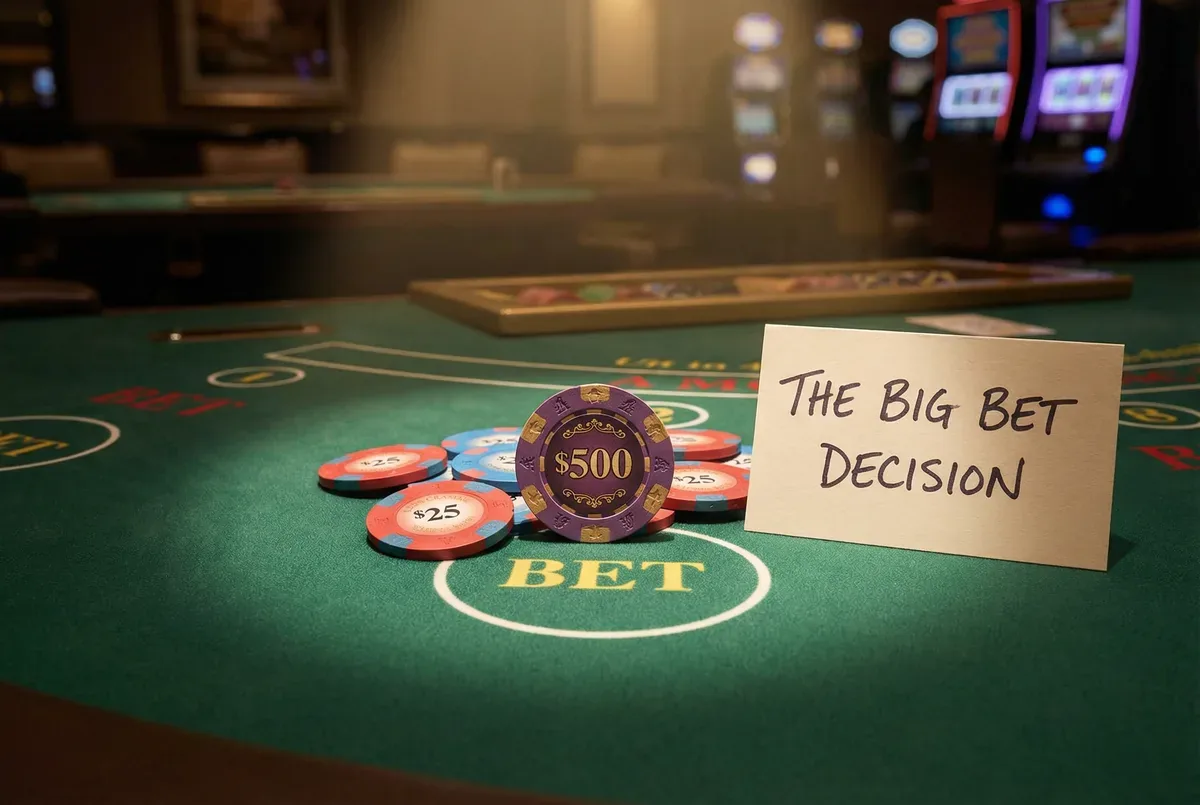
Why Big Bets Feel Different and Why That Matters
Strategy error rate at $5 base
of hands
Strategy error rate at $100+ base
of hands (recreational players)
Correct play probability
regardless of bet size
What Are the Confirmation Bias After a Large Loss?
Confirmation bias operates particularly strongly after a large bet loss. The player who loses $200 on a single hand a doubled 11 against a dealer 10 that failed will selectively remember the outcome. They do not remember all the times the double worked; they remember the most recent painful instance. Over subsequent hands, this memory distorts their willingness to make the same mathematically correct play again. They either hedge (not doubling when they should) or over-correct (doubling recklessly in attempt to prove the play was right). Both responses drift from optimal strategy in proportion to how painful the original loss felt.
The same mechanism applies to split decisions. A player who loses a pair of 8s split both hands failing against a dealer 9 is statistically more likely to refuse the split next time they see it, despite the mathematical correctness of splitting 8s being unchanged. The correct play in that situation is to split regardless of what happened last time, last session, or last month. The outcome of past hands is genuinely irrelevant to the correct decision on the current hand. Confirmation bias makes this intellectually obvious fact emotionally invisible at the moment it matters most.
Common Myth
“After losing a big double or split, you should play more conservatively to protect your remaining stack”
The large loss creates emotional urgency to stop the bleeding conservative play feels safer
The Reality
Basic strategy is already the mathematically optimal play. Deviating after a loss raises the house edge. There is no safer version of blackjack than correct strategy.
Every deviation from basic strategy costs expected value, regardless of recent results
Why Does the Pre-Session Ritual That Create Detachment?
Professional gamblers and elite recreational players use pre-session rituals to create psychological separation between their identity and their bet size. The ritual is not superstition it is cognitive priming. Before sitting down, you explicitly remind yourself of three facts: every bet is a unit, not a dollar amount; every decision follows the blackjack strategy chart, not the size of the current stack; and the outcome of any hand is irrelevant to the correctness of the play. Some players write these statements down. Some say them aloud. The medium does not matter the act of stating them immediately before play primes the prefrontal cortex to override the amygdala’s loss-aversion response at the moment of decision.
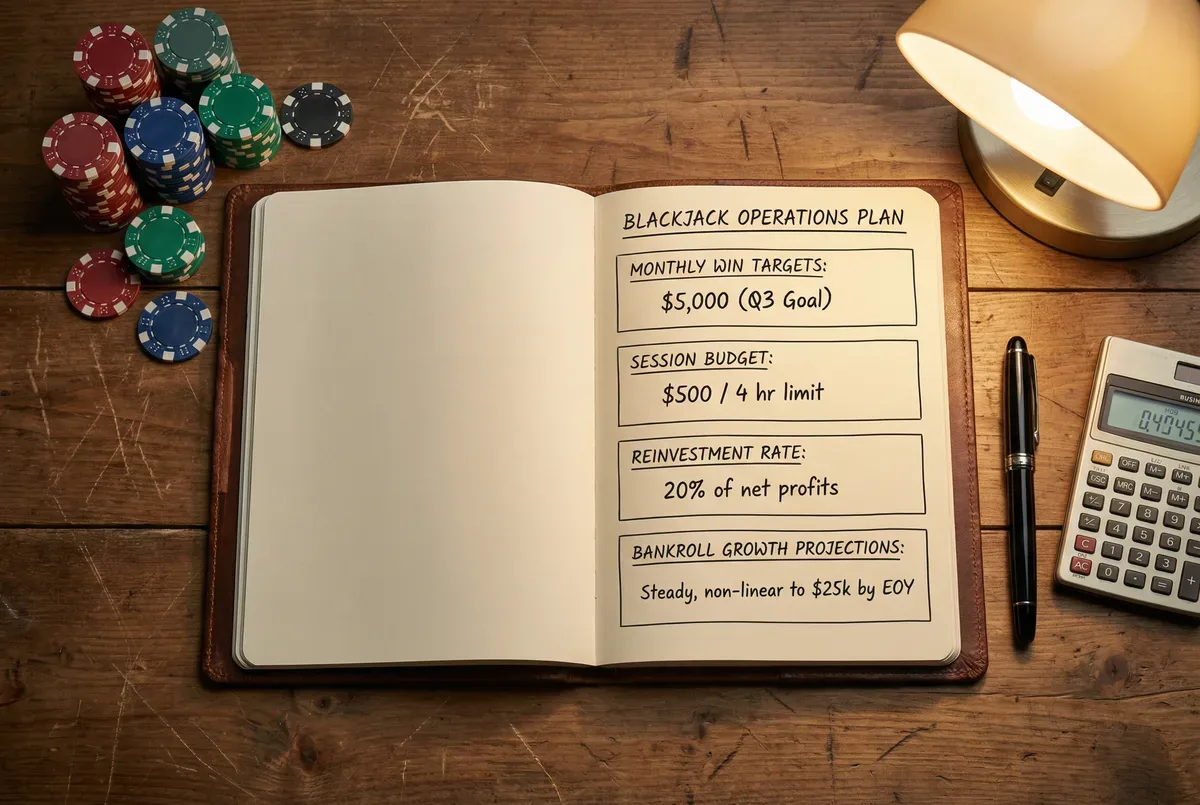
A secondary component of the ritual is denominating all bets in units rather than dollars. Your session cap is 40 units, not $400. Your current bet is 3 units, not $75. This abstraction is not self-deception you know exactly what the dollars are. It is a deliberate cognitive reframing that reduces the emotional weight of each decision to the level at which the strategy was designed to be applied. Players who practice unit-denomination consistently report fewer strategy errors at elevated bet sizes than those who think in dollar terms throughout the session.
The psychological trap of big bets is not the bet size it is the identity shift. Once you see yourself as a big-bet player, the bet size becomes emotionally fixed and you stop making rational sizing decisions. Professional big-bet players size by count and bankroll fraction, not ego.
When to Move Down And Why Most Players Don’t?
The moment a player notices that a particular bet size is triggering emotion hesitation on correct plays, relief at winning routine hands, disproportionate distress at normal losses is the signal to move down in stakes. This is not a sign of weakness; it is calibration. The correct stake level is the one at which you can execute blackjack basic strategy mechanically and without emotional interference on every decision. For most recreational players, that threshold is approximately 0.5–1% of their monthly discretionary income per hand. A player earning $5,000 per month with $500 in discretionary spending can typically handle $5–$10 per hand without emotional distortion. Anything above 1% of monthly discretionary income per hand introduces meaningful psychological interference for most people.
Train Your Decision-Making Under Pressure Before Going Live
The only way to know whether your strategy execution holds up under the emotional pressure of large bets is to test it incrementally. Use make your next big bet at a real-money live table to drill the hands that historically trigger hesitation hard 12 vs. 3, pair of 8s vs. 9, 11 vs. 10 so that the correct play is automatic before you sit at a real table where the chips represent money you can feel leaving your hands.
Frequently Asked Questions
Loss aversion. Your brain processes large potential losses as threats, activating an emotional response that competes with rational decision-making. The strategy chart is not getting harder your emotional state is generating interference. Pre-session rituals and unit-denomination help reduce this interference.
There is no universal threshold it varies by individual financial situation and psychological profile. The practical test is whether you can make every basic strategy decision without hesitation or regret at your current bet size. If you cannot, the bet size is too high.
Separate the outcome from the decision quality. A correct play that loses is still a correct play. A statistically correct decision that fails in one instance is not evidence the decision was wrong it is evidence that variance exists. Review your decision against the strategy chart, not against the outcome.
Before you test these plays at a real table, run them through our free blackjack simulator practice unlimited hands at zero cost until every move becomes automatic.
Mathematical Risk Warning
Basic strategy in blackjack is derived from mathematical expectation, not from emotion or results. Deviating from correct strategy in response to bet size or recent outcomes raises the effective house edge. No psychological reframing changes the underlying mathematics it only improves your ability to execute the strategy correctly.
Blackjack Academy is an educational resource. All strategy is based on mathematical expectation. Always play within your means.

Written by
Mark AnurakProfessional card counter since 2009 · 500,000+ hands logged · Former Macau advantage player. Studied under Thorp, Griffin & Wong methodology. Full bio →
Learn More
Continue your education with these related lessons.
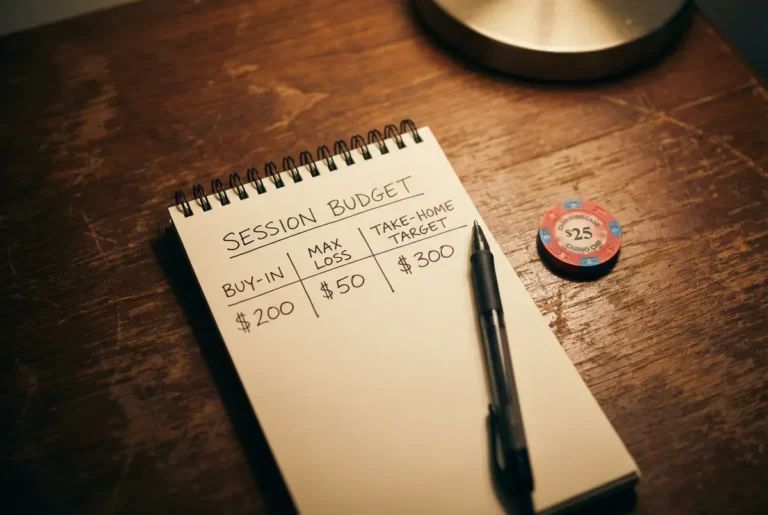
How Much Money You Really Need for a Blackjack Session
The answer to 'how much should I bring?' depends entirely on your bet size, session length, and risk tolerance. This…
Systematic Approach to Steady Profits with Oscar’s Grind
Oscar's Grind is a methodical positive progression designed to earn exactly one unit of profit per cycle, then reset. It…
What the House Advantage Percentage Really Means for Your Bankroll
House advantage is not an abstract casino term it is the exact rate at which your money transfers to the…