
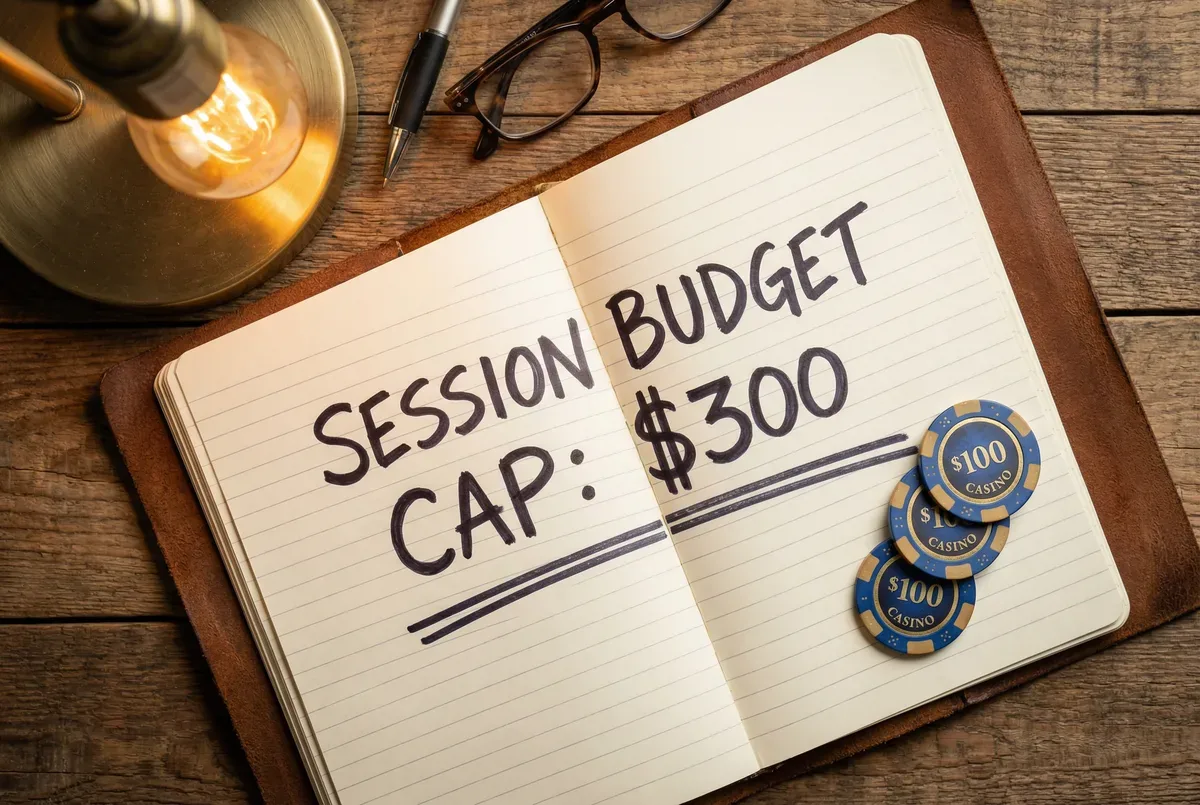
Why Every Blackjack Session Needs a Hard Budget Cap
A session budget cap is a hard dollar amount you decide before sitting down the maximum you are prepared to lose in that session, no exceptions. It is not a suggestion you revisit when you are running bad. It is a pre-committed rule that exists precisely because you will not make good financial decisions in the middle of a losing session. The research on this is consistent: people experiencing loss in a gambling context systematically overestimate their probability of recovery and underestimate how much they have already spent. The cap is the only mechanism that overrides this distortion, because you set it when your judgment is clear.
A Session Budget Cap Is Non-Negotiable
- Monthly entertainment budget × 25% = monthly gambling budget
- Monthly gambling budget ÷ planned sessions = per-session cap
- Per-session cap should be 20–40 buy-ins at your base bet
- Example$200 session cap at $5 base = 40 units maximum risk
- Never bring more cash to the table than your cap
What Is the Psychology of “Just One More Hand”?
“Just one more hand” is not a decision. It is a symptom. When a player reaches their mental threshold of losses and rationalizes continuing, they are experiencing what behavioral economists call the sunk cost effect combined with loss aversion. The money already lost feels recoverable. The cost of the next hand feels small relative to the deficit. Both perceptions are distortions. The money already lost is gone regardless of what happens next. The next hand carries the same expected cost as every hand before it.
The mechanism becomes compounding after the first override. A player who breaks their mental limit once will break it again in the same session, because the psychological barrier has already been breached. This is why the cap must be enforced through a physical mechanism leaving your remaining bankroll at home, using a timed deposit cap at an online casino, or handing cash to a companion before you start. Willpower in the middle of a losing session is the least reliable resource you have. The cap does not require willpower at the moment of temptation because it was already decided hours earlier.
Advantages
- Prevents loss spiral in a single session
- Forces pre-session financial clarity
- Removes in-session decision fatigue
- Protects monthly budget from single-session wipeout
Disadvantages
- Requires setting the cap before emotional investment
- Can feel restrictive during a good run
- Does not prevent losses only limits their size
How to Calculate Your Session Cap?
Start with your total monthly discretionary entertainment budget money genuinely available for leisure after all fixed and variable expenses are covered. Allocate no more than 25% of that to gambling across the month. Divide that figure by the number of sessions you plan to play. The result is your per-session cap. If your monthly entertainment budget is $400 and you plan four blackjack sessions, your cap is $25 per session which means you are playing $1 base bet, not $5. Many players resist this calculation because it produces a smaller number than they expected. That resistance is data: their planned bet size was not calibrated to their actual financial situation.
The cap also determines your base bet. A session cap of $200 at a $5 base bet gives you 40 units of exposure. At a $10 base, you have 20 units tight enough that a modest variance swing ends your session quickly. The standard guideline is 30–50 units per session as a comfortable range that gives the mathematics room to play out without exposing you to ruin on a single bad stretch. If your cap does not support 30 units at your preferred bet size, the answer is to lower the bet size, not raise the cap.
Your base bet is determined by your cap. Your cap is determined by your budget. Neither should be negotiated at the table.
Budget First Rule
What Is Win Caps?
Loss caps get most of the attention but win caps are equally important. A player who is up 50% of their session cap has doubled their entertainment value for that session. Setting a win cap a profit level at which you stop and leave prevents the common pattern of running a profit back to zero or worse. A win cap of 1.5× your buy-in means you cash out when you are up 50%. You will not always reach it. When you do, you leave. The casino does not object to players leaving winners. You should not either.
Test Your Discipline in a No-Stakes Environment
Before you test a budget cap at a live table, practice stopping at your cap limit during sessions at protect your session budget at a real-money live table notice how it feels to walk away at exactly your cap number even when you want to keep going, so that the discipline is already installed before real money is involved and the emotional stakes make it genuinely difficult.
Frequently Asked Questions
It should be consistent within your monthly framework. If you set a $200 cap based on your budget and play four sessions, all four caps should be $200 unless your budget changes. Adjusting the cap based on results playing shorter after a win, longer after a loss introduces the exact distortions a cap is designed to prevent.
Leave. Not in five minutes, not after one more hand. Stand up, rack your chips or close the app, and do something that has nothing to do with blackjack. The cap is binary: you either respect it completely or it provides no protection.
Yes many professionals use 2–3% of total bankroll as a session cap. This automatically scales down if your bankroll shrinks and up if it grows. For recreational players, a flat dollar amount tied to your monthly entertainment budget is simpler to track and equally effective.
Before you test these plays at a real table, run them through our free blackjack simulator practice unlimited hands at zero cost until every move becomes automatic.
Mathematical Risk Warning
A session budget cap limits the maximum loss in any single session but does not change the expected value of hands played. With basic strategy, the house retains approximately 0.5% of all money wagered. Setting a cap is a bankroll management tool, not a strategy for winning.
Blackjack Academy is an educational resource. All strategy is based on mathematical expectation. Always play within your means.

Written by
Mark AnurakProfessional card counter since 2009 · 500,000+ hands logged · Former Macau advantage player. Studied under Thorp, Griffin & Wong methodology. Full bio →
Learn More
Continue your education with these related lessons.
How to Handle a Large Blackjack Win at the Casino Cashier Safely
Winning big at blackjack is great until you handle it poorly. Learn when casinos report winnings, how to color up…
Why Setting a Stop Win is a Critical Professional Skill
A stop-win rule is not pessimism about your ability to keep winning. It is the mathematical recognition that every hand…

How Table Speed Increases or Decreases Your Variance
Table speed measured in hands per hour directly controls how quickly variance resolves and how quickly house edge accumulates. Knowing…