
The 7 Blackjack House Rules That Secretly Change Your Expected Value
Blackjack is one of the few casino games where the blackjack house edge is not fixed it varies depending on the specific rule set the casino has posted for that table. Every rule the casino applies either helps the player or helps the house, and each change is worth a precise number of basis points (hundredths of a percent) in expected value. A player who understands how these rules combine can identify the best game available on any casino floor in under two minutes. A player who ignores them may be paying two or three times the expected blackjack house edge compared to a better game sitting fifty feet away. The rules to examine are: soft 17 policy, doubling after split, resplitting aces, surrender availability, and number of decks.
Why Blackjack Rules Are Not Standardized
- Dealer hits soft 17 (H17)+0.22% vs. S17
- No double after split (NDAS)+0.14%
- No resplitting aces (no RSA)+0.08%
- No late surrender+0.07%
- 8 decks vs. 6 decks+0.02%
What Is S17 vs H17?
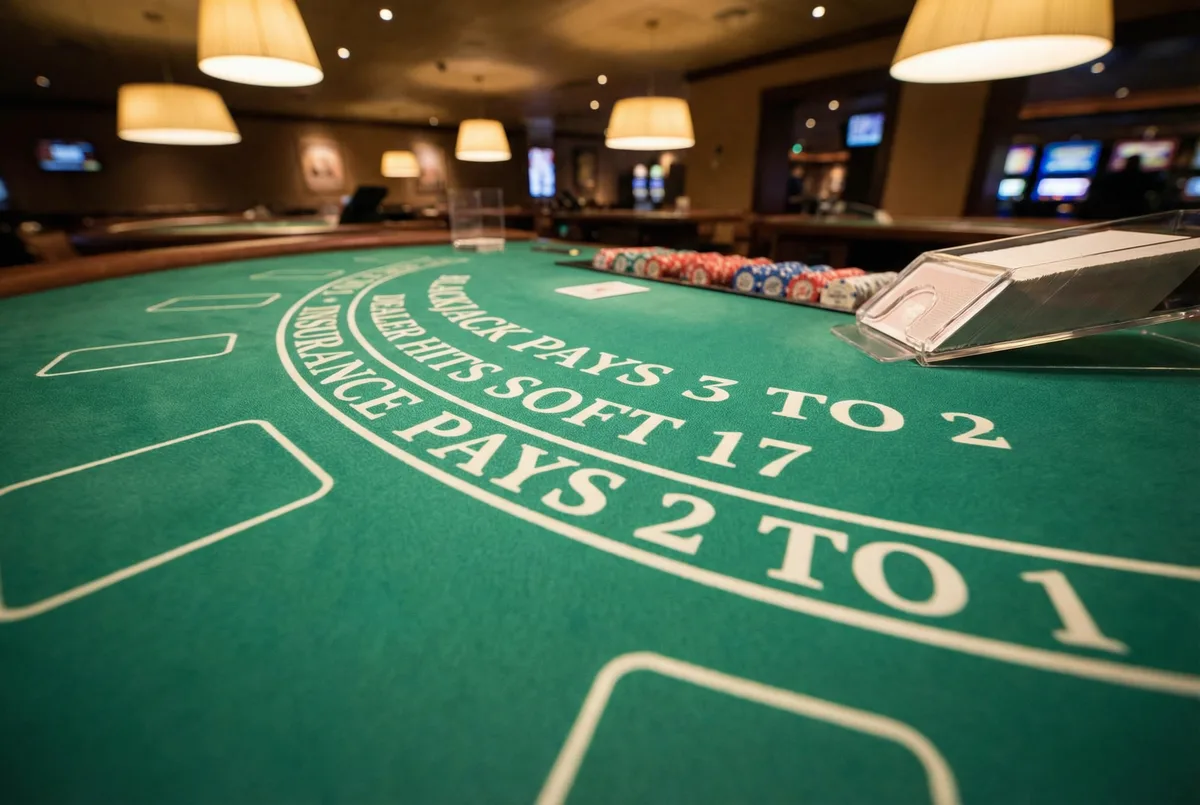
S17 means the dealer stands on all 17s, including soft 17 (ace + 6). H17 means the dealer must hit soft 17. This distinction costs the player approximately 0.22 percentage points of expected value. The reason is mechanical: when a dealer hits soft 17, they have a chance to improve their hand with no risk of busting (an ace adjusts to 1 if needed). A dealer standing on soft 17 locks in a total that players can beat with an 18 or higher. In a six-deck game, switching from S17 to H17 raises the blackjack house edge from roughly 0.44% to 0.66% a 50% relative increase. Every time you see “Dealer Hits Soft 17” printed on the felt, add 0.22% to the blackjack house edge calculation for that table.
The S17 rule also changes blackjack basic strategy in specific situations. Against a dealer ace in an H17 game, players should double soft 18 and soft 19 in certain counts, and the surrender thresholds shift for several stiff hands. The strategy modifications for H17 are documented in the six-deck H17 blackjack strategy chart, but the simpler principle is: always prefer an S17 game when one is available at comparable stakes and payout structure. In practice, most major casino markets now post H17 as the default rule on single-deck and double-deck games, while S17 remains common on six-deck shoe games though this varies by property and city.
Dealer Shows
Your Hand
Dealer shows an ace at an H17 table. You hold 9-9 (18). Do you split?
Standing on 18 is correct against a dealer ace in both S17 and H17 rule sets. The H17 rule slightly increases the dealer's frequency of improving past 17, but not enough to make splitting a pair of 9s against an ace correct. Knowing which rules change strategy versus which do not is a key part of moving beyond rote memorization.
What Is DAS, RSA, and Surrender?
Double After Split (DAS) is the rule that allows a player to double down on a hand formed from a split pair. Without this rule (NDAS), the player loses approximately 0.14% in expected value. DAS matters most when splitting low pairs 2s, 3s, and 4s against weak dealer upcards. In a DAS game, splitting a pair of 2s against a dealer 5 opens the door to doubling a resulting hand of 2+9 = 11 against a weak upcard, which is a high-value action. Without DAS, the split is far less profitable, and blackjack basic strategy adjusts accordingly some splits that are correct in DAS games become incorrect in NDAS games.
Resplitting Aces (RSA) allows a player to split a third or fourth ace if a split ace receives another ace. Without RSA, the player cannot re-split and must play the new ace as a one-card hand to the second pair. RSA is worth approximately 0.08% and is increasingly rare in modern casinos, which commonly restrict splitting to at most two or three total hands. Late surrender allows the player to forfeit half their bet after the dealer has checked for a natural. It is worth approximately 0.07% and is used primarily on hard 15 and hard 16 against a dealer 9, 10, or ace. Surrender is the least commonly offered of these three rules but the most easily verified just ask the dealer before your first hand whether surrender is available.
Advantages
- S17 game: dealer cannot improve soft 17
- DAS available: split pairs become more profitable
- Late surrender: saves half your bet on worst hands
- RSA available: extremely rare but measurably valuable
Disadvantages
- H17: dealer hits soft 17, costs you 0.22%
- NDAS: reduces value of splitting small pairs
- No surrender: forces play on unwinnable stiff hands
- Multiple bad rules can stack to 2%+ house edge
What Are Deck Count and How It Combines With Other Rules?
Fewer decks reduce the blackjack house edge, but the effect is smaller than most players assume and is easily overwhelmed by bad rules. A single-deck game has a theoretical blackjack house edge of about 0.17% under ideal conditions roughly 0.27% better than a six-deck game with the same rules. The catch is that single-deck and double-deck games almost never come with the same rules as shoe games. A single-deck H17 NDAS 6:5 game common in Las Vegas has a total blackjack house edge over 2%, far worse than a six-deck S17 DAS 3:2 game sitting at 0.44%. Deck count is a tiebreaker among otherwise equal games, not a trump card.
Choosing Your Table and Playing It to Full Advantage
A pre-session rule check takes ninety seconds. Read the felt for payout and soft-17 policy. Ask the dealer about surrender and DAS. Calculate your approximate blackjack house edge using the basis-point values above. The best available game in most major casino markets is a six-deck shoe, S17, DAS, 3:2 payout, with late surrender that game runs around 0.37% blackjack house edge. Any table that deviates materially from that standard deserves a conscious decision before you commit your session bankroll to it. The experience this rule variation with real money environment on this site posts rule sets for each available table, which makes for useful pre-play comparison just remember those tables carry real financial stakes, and knowing the rules does not eliminate the house advantage.
Frequently Asked Questions
The blackjack payout ratio. A 6:5 payout instead of 3:2 adds approximately 1.39% to the house edge. No other single rule not H17, not NDAS, not restricted doubling comes close to this magnitude. Payout ratio is always the first rule to check.
Yes. In H17 games, several soft double decisions and surrender decisions change. Soft 18 vs Ace becomes a hit instead of stand. Hard 11 vs Ace becomes a double instead of hit in some configurations. Always verify whether the table is H17 or S17 before your first hand.
Approximately 0.07 to 0.09% depending on the rule set. Surrender is most valuable on hard 15 and 16 against strong dealer upcards. In H17 games, surrender extends to hard 17 vs Ace. The rule is worth seeking out but is a smaller edge than payout, soft 17, and DAS rules.
Before you test these plays at a real table, run them through our free blackjack simulator practice unlimited hands at zero cost until every move becomes automatic.
Mathematical Risk Warning
Even the best-ruled blackjack game maintains a positive house edge. Rule analysis reduces your expected loss rate it does not eliminate risk. Every session carries genuine variance that can produce large short-term losses regardless of the edge percentage.
Blackjack Academy is an educational resource. All strategy is based on mathematical expectation. Always play within your means.

Written by
Mark AnurakProfessional card counter since 2009 · 500,000+ hands logged · Former Macau advantage player. Studied under Thorp, Griffin & Wong methodology. Full bio →
Learn More
Continue your education with these related lessons.

How Online Live Dealer Blackjack Compares to Playing in a Casino
Live dealer blackjack and casino blackjack share real cards and real rules, but they differ in pace, atmosphere, and house…

How Casino Surveillance and the Eye in the Sky Monitor Tables
Casino surveillance operates on two levels: the floor staff you can see and the monitoring room above you. Understanding how…

How the Dealer Settles and Pays Out Every Blackjack Wager
The dealer follows a fixed settlement sequence after every hand: players who beat the dealer are paid, pushes are returned,…