
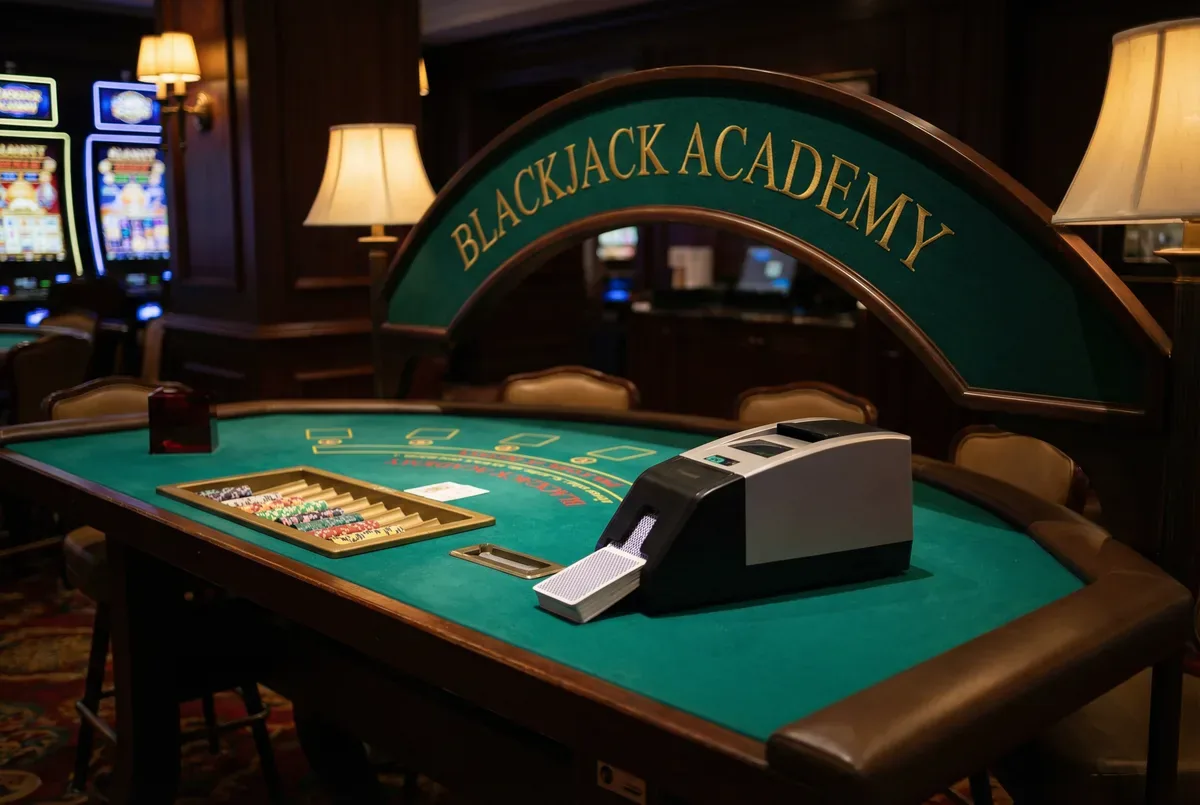
Why Continuous Shuffling Machines Completely Destroy the Counter’s Edge
A continuous shuffling machine (CSM) is a device that shuffles discarded cards back into the shoe after every hand, maintaining a perpetually randomized deck. Card counting relies on tracking the composition of remaining cards specifically, the ratio of high cards (tens and aces) to low cards still in the shoe. A CSM destroys this entirely. When played cards are immediately reinserted into a shuffled pool, the composition of the remaining shoe is always approximately equal to a full reshuffled deck. The running count that a counter has been building becomes meaningless the moment cards return to the machine. At a CSM table, every hand is effectively dealt from a freshly shuffled shoe. There is no count to maintain, no true count to calculate, and no betting edge to exploit.
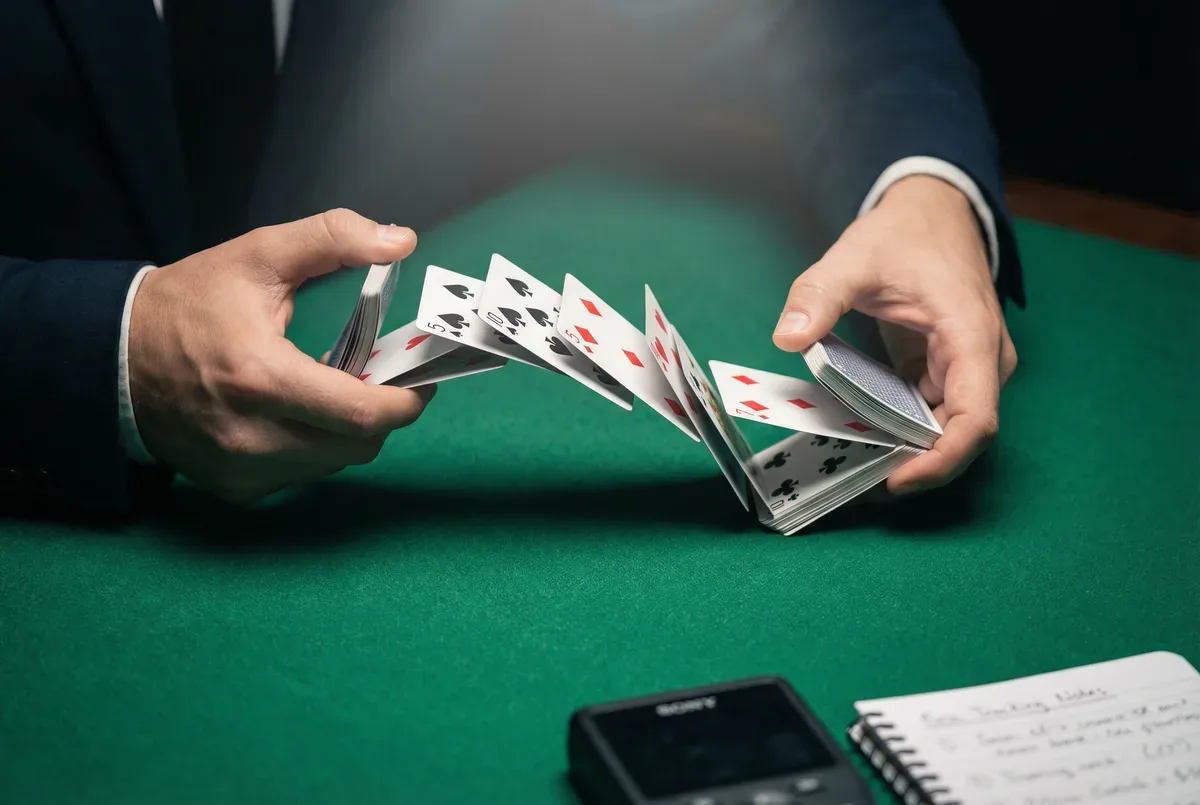
How Continuous Shuffling Machines Eliminate Card Counting
Common Myth
“You can still count cards at a CSM table if you watch carefully”
Counters assume that tracking exposed cards still gives useful information
The Reality
CSMs return cards to a randomly integrated pool any count you maintain has no predictive value for the next hand
The house edge at a CSM table is the same as basic strategy house edge typically 0.4%-0.6%. No counting system recovers any of this.
What Is the Mechanics?
Standard shoe games work on a crucial asymmetry: the composition of the remaining shoe changes as cards are dealt, and the counter exploits that changing composition. After a high-card-rich first round, the remaining shoe is low-card-rich, and vice versa. That variance in composition is the signal a counter reads. In a CSM, the dealer inserts the discards usually 3 to 5 cards at a time directly back into the machine after every hand. The machine’s internal mechanism randomizes the position of those cards among the several hundred cards already inside. By the time the next hand is dealt, the returned cards are indistinguishable from any other card in the shoe. The information you tracked is permanently diluted. The CSM typically holds 4 to 5 decks at a time, and the constant reintegration means the shoe composition never drifts more than a fraction of a percent from neutral. No count system Hi-Lo, Omega II, Wong Halves can extract signal from noise this complete.
There is a secondary effect worth understanding: CSMs also increase hands per hour significantly. Because there is no pause for a dealer to manually shuffle, a CSM table can deal 20%-30% more hands per hour than a standard shoe game. This sounds neutral but is actually bad for blackjack basic strategy players more hands per hour against a blackjack house edge means more expected losses per hour even if the per-hand blackjack house edge is identical. For counters specifically, the situation is worse. Not only is the per-hand edge zero or negative, but the faster pace means negative EV accumulates faster. A CSM table is the worst possible environment for any advantage player.
- Card returnafter every hand vs. after full shoe dealt
- Running count validityzero vs. full tracking
- Hands per hour~20-30% faster pace at CSM
- Counter EVhouse edge only vs. positive at high counts
- Best responseleave immediately vs. stay and count
Which Casinos Use CSMs and Where They Place Them?
CSMs are most common in lower-limit areas of large casino floors, particularly at $5 and $10 minimum tables. The casinos deploying them most aggressively include large volume properties in Atlantic City, many Native American casinos, cruise ship casinos, and mid-tier Las Vegas Strip properties. High-limit rooms almost universally avoid CSMs because high-stakes players even non-counters object to them strongly, and the casino earns more revenue from engaged high rollers playing standard shoes. Premium Las Vegas Strip properties such as Aria, Bellagio, and Wynn tend to use standard shoes or hand-shuffled games at most limit levels, though practices vary by table section. The key tell for a counter walking a casino floor: if the lower-limit pit is all CSMs, the property may still offer countable games at higher stakes in a separate area. Always scout before sitting.
Identify CSM tables the moment you walk a pit. The machine sits to the dealer's right, a box roughly the size of a shoebox with a card-return slot. If you see it, keep walking. No counting system, no camouflage, no advantage play technique gives you any edge at a CSM table. Your only decision is which non-CSM table to find.
How Do You Understand the Distinction?
Many players confuse continuous shuffling machines with automatic shuffling machines (ASMs), which are different devices with completely different implications for counters. An ASM shuffles a second shoe while the first is in play, then swaps the pre-shuffled shoe in when the cut card appears. The ASM speeds up the game slightly but does not affect penetration or running count validity the shoe is still dealt from start to cut card, and counting remains fully viable. A CSM feeds cards back during active play. Visually, the distinction is the slot where the dealer returns discards: an ASM sits inactive during play and cards go to a discard tray, while a CSM has an active insertion slot used every hand. If you see discards going into the tray, you are at an ASM or manual-shuffle game. If discards go directly into the machine, it is a CSM and you should leave.
Identifying and Avoiding CSM Tables Before You Lose Money
If you plan to test your counting mechanics in a live setting, be certain you have confirmed the table type before playing a single hand. validate this count at a real table tonight labels its table types, but any environment involving real money carries genuine financial risk verify the shuffle mechanism before the first bet, not after you have already invested a session bankroll.
Frequently Asked Questions
No counting system works at a CSM. Shuffle tracking and ace sequencing are also impossible because the shuffle randomizes continuously. The only theoretical edge that could apply hole-carding depends on dealer error and is unrelated to the CSM itself. For practical purposes, there is no advantage play technique available at a CSM table.
No. The correct basic strategy decisions are identical whether the game uses a CSM or a standard shoe with the same number of decks and rules. The house edge in a CSM game is slightly higher than a comparable standard shoe game when factoring in the slightly faster pace, but the strategy chart decisions themselves do not change.
Revenue management. Lower-limit tables with CSMs serve recreational players who do not notice or care about the machine the casino earns more per hour due to faster pace. Higher-limit tables use standard shoes to retain serious players who prefer them. The casino optimizes for different player segments simultaneously.
Before you test these plays at a real table, run them through our free blackjack simulator practice unlimited hands at zero cost until every move becomes automatic.
Mathematical Risk Warning
No advantage play technique produces positive expected value at a CSM table. Any gambling at CSM tables is purely recreational with a mathematical house edge. Never attempt to count cards at a CSM game.
Blackjack Academy is an educational resource. All strategy is based on mathematical expectation. Always play within your means.

Written by
Mark AnurakProfessional card counter since 2009 · 500,000+ hands logged · Former Macau advantage player. Studied under Thorp, Griffin & Wong methodology. Full bio →
Learn More
Continue your education with these related lessons.
How Casino Floor Managers Identify and Respond to Card Counters
How casino floor managers detect card counters: bet pattern analysis, surveillance software, escalation chains, and the legal limits of casino…
Why Ace-Reckoned Counting Systems Beat Ace-Neutral for Professional Play
Why do some counting systems assign zero to aces while others count them? The answer determines whether a system is…
The Powerful Big Player Technique for Spreading Bets Without Heat
The Big Player technique lets card counters spread bets dramatically without triggering casino heat by entering tables only at positive…