
Why 75 Percent Deck Penetration Is the True Minimum for Card Counters
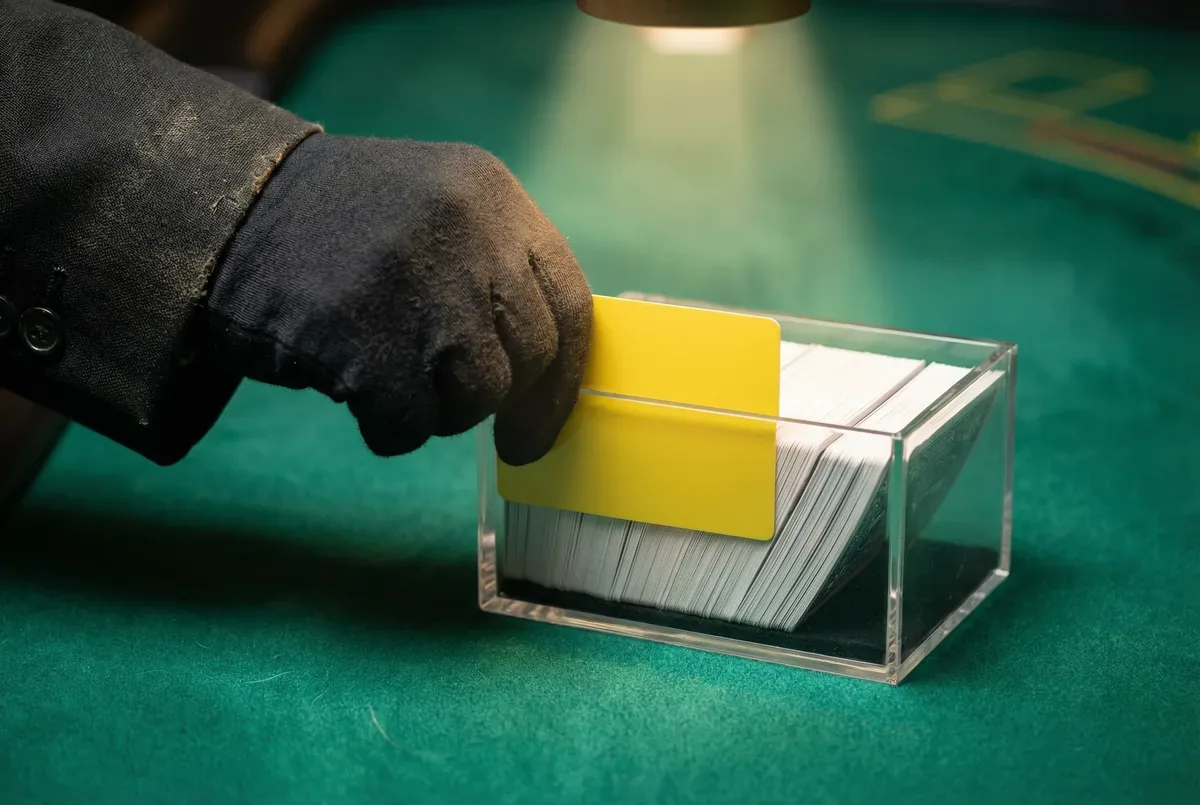
Deck penetration is the percentage of cards dealt before the dealer reshuffles. In a six-deck shoe containing 312 cards, 75% penetration means 234 cards are dealt before the cut card triggers a shuffle. Penetration directly controls how extreme the true count can become and how often. When a dealer cuts off 3 decks from a six-deck shoe (50% penetration), the count rarely reaches true counts above +3 or below -3 because the sample size is too small. At 80% penetration, true counts of +5, +6, or higher occur with regularity, producing betting opportunities that generate real profit. A counter playing a game with poor penetration is like a poker player at a table where most hands are folded before the flop technically the same game, but practically stripped of its edge.

What Deck Penetration Means for Card Counters
50% penetration
low EV
75% penetration
breakeven to positive
80% penetration
strong EV
What Is the Math?
True count is calculated by dividing the running count by the number of decks remaining. At 75% penetration in a six-deck shoe, you are computing the true count against 1.5 remaining decks at the deepest point. At 50% penetration, the minimum remaining decks is 3. The mathematical effect: the same running count produces a true count twice as high at 75% penetration versus 50% penetration. If your running count is +6 with 3 decks left, your true count is +2. That same running count +6 with 1.5 decks remaining becomes a true count of +4 a massive difference in betting terms. True count +2 represents roughly breakeven to slightly positive EV. True count +4 generates an edge of approximately 1.5%-2.0%, justifying large bet ramps. Better penetration does not just give you more high-count hands it makes every high running count worth dramatically more.
Simulation data confirms this relationship precisely. Studies of Hi-Lo counting at various penetration levels show expected value per 100 hands roughly doubles when moving from 67% penetration to 83% penetration, holding bet spread constant at 1-to-12. The counter is not playing more hands per hour they are getting more out of each positive shoe because the count information is richer when fewer decks remain. This is why professional counters will walk past a $25 minimum game with 65% penetration to find a $15 minimum game with 80% penetration. The lower-stakes game generates more profit per hour because the information advantage is real.
Before sitting at any table, count the cards in the discard tray after three or four shoes. Divide by total decks to estimate penetration percentage. If the discard tray holds fewer than 4.5 deck-equivalents when the cut card comes out in a six-deck game, the penetration is below 75% leave immediately.
Why Dealers and Pit Bosses Control Penetration?
Penetration is almost entirely a dealer-controlled variable. The dealer places the cut card into the shoe before dealing begins the deeper it is placed, the better the penetration. Casinos train dealers to cut off at least 1.5 decks in a six-deck game, and pit bosses may instruct dealers to cut off more when a suspected counter is at the table. This is the casino’s primary non-confrontational countermeasure. Shuffling early costs the house money in slower hands-per-hour, but it effectively neutralizes a counter’s edge without requiring a conversation or a backoff. A dealer who consistently delivers 85% penetration is a high-value asset to counters. Counters who identify such dealers visit their tables specifically and give those dealers their best action.
Advantages
- High penetration reveals extreme true counts
- More profitable hands per shoe
- True count calculations are more accurate late in shoe
- Even modest bet spreads generate real EV
Disadvantages
- Good penetration tables are rare and tracked by casinos
- Sitting deep in a shoe increases scrutiny
- High penetration games may have worse rules to compensate
- Finding 80%+ games requires extensive table scouting
How Do You Evaluate Penetration Before You Sit?
The standard evaluation method is to stand near a table for two or three full shoes and watch the discard tray. When the cut card appears, estimate the remaining undealt cards by the thickness of the shoe stub. A six-deck shoe stub that looks like two deck-thicknesses means roughly 33% of cards remain undealt that is 67% penetration, below threshold. A stub that looks like one deck means approximately 83% penetration excellent. With practice, experienced counters estimate penetration to within 5% visually. More precise: count the cards in the discard tray directly. Each deck adds roughly 0.6 inches to the tray. Four decks in the tray on a six-deck shoe equals 67% penetration. Four and a half decks equals 75%. Five decks equals 83%.
Penetration and Live Blackjack: Testing Your Reads
Sharpening your ability to assess penetration quickly and accurately requires observing real shoes under realistic conditions. run this count at a live table with real stakes this week streams real dealer shoes where you can practice estimating discard tray depth but remember, any real-money session carries genuine financial risk, and you should never play live with funds you are not prepared to lose.
Frequently Asked Questions
At 70% penetration in a six-deck shoe, expected value drops to roughly 50%-60% of what you would achieve at 80% penetration with the same bet spread. It is marginally playable with a large spread but most professionals set 75% as their hard floor. Below 70%, the game is essentially unprofitable for a counter regardless of other rules.
Both game types benefit from good penetration, but the sensitivity differs. In double-deck, 75% penetration means only 26 undealt cards a very shallow cut. Double-deck games typically offer 65%-75% penetration as the norm. In six-deck shoes, the variance is larger and 80%+ penetration creates a much more powerful edge because the remaining-decks denominator in the true count calculation drops much lower.
No. Penetration is entirely at the casino's discretion. Some jurisdictions have gaming regulations that specify minimum dealing depths, but most do not. If a casino offers poor penetration, the counter's only options are to find better games elsewhere or accept reduced EV. Trying to pressure dealers for better penetration is counterproductive and draws heat.
Before you test these plays at a real table, run them through our free blackjack simulator practice unlimited hands at zero cost until every move becomes automatic.
Mathematical Risk Warning
Superior penetration improves expected value but does not eliminate variance. Even at 85% penetration, counters experience multi-session losing streaks. No penetration level makes any individual session a guaranteed win.
Blackjack Academy is an educational resource. All strategy is based on mathematical expectation. Always play within your means.

Written by
Mark AnurakProfessional card counter since 2009 · 500,000+ hands logged · Former Macau advantage player. Studied under Thorp, Griffin & Wong methodology. Full bio →
Learn More
Continue your education with these related lessons.

How Your Counting Advantage Changes in Single Deck vs Multi Deck
Single-deck games offer higher count volatility and better counting conditions in theory, but practical challenges often make 6-deck shoes the…

How Casino Floor Managers Identify and Respond to Card Counters
How casino floor managers detect card counters: bet pattern analysis, surveillance software, escalation chains, and the legal limits of casino…

The Full Spectrum from Solid Basic Strategy to Professional Card Counting
There is a complete skill spectrum between playing basic strategy and counting cards professionally. This guide maps every stage with…