
How Casino Surveillance Identifies Card Counters
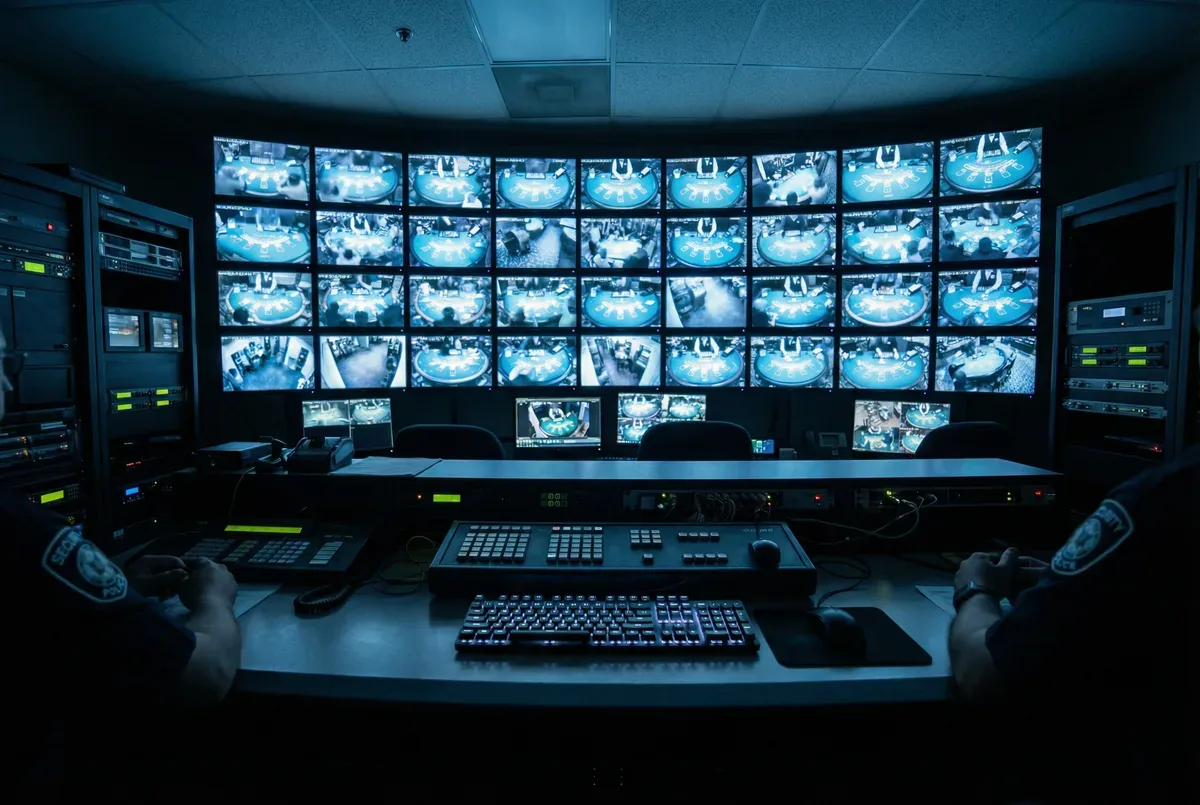
Casino surveillance identifies card counters primarily by detecting the correlation between bet size and shoe composition. A recreational player bets inconsistently, raises and lowers bets based on mood, streaks, and intuition. A card counter does something fundamentally different: they bet maximum when the deck favors them and minimum when it does not. The result is a statistical pattern that surveillance software can identify in as few as 60-80 hands. Modern casino surveillance systems do not require a human to catch this automated betting pattern analysis flags players whose bet correlation to count exceeds a threshold, then routes the alert to a human analyst for confirmation. What surveillance looks for first is not the count itself but the bet spread signature: a player consistently at minimum for most of a shoe who suddenly makes a large bet near the end of a positive shoe, then returns to minimum when the next shoe starts.
What Casino Surveillance Actually Looks for at Blackjack Tables
Timeline
1967
Nevada Gaming Control Board rejects request to ban card counters counting declared legal
1970s
Casinos develop early shuffle-tracking surveillance and begin maintaining handwritten player files
1967-1993
Griffin Investigations Inc. founded builds the first comprehensive counter database (Griffin Book)
1990s
Biometric cameras installed in major Las Vegas casinos real-time face matching begins
2002
RFID chip technology deployed at major casinos bet size tracked chip-by-chip per hand
2010s
AI-powered pattern analysis systems deployed betting correlation flagged automatically
2020s
Cross-property networked surveillance shares counter profiles industry-wide in real time
What Is RFID Chips?
Radio Frequency Identification chips contain embedded microchips that broadcast chip denomination and a unique serial number. When a player places chips in the betting circle, RFID readers embedded in the table surface read the exact bet amount per hand in real time. This data feeds directly into surveillance databases alongside the outcome of each hand and the shoe position. The result: an automatic bet-versus-count correlation calculation running in the background without any human observation required. Prior to RFID, surveillance had to watch video footage and manually estimate bet sizes. With RFID, the system records every wager with complete accuracy. A player making $25 bets for 60 hands and then suddenly placing $500 when the shoe is running hot does not need to be spotted by a sharp-eyed pit boss the algorithm generates an automatic alert. RFID also catches team play: if a Big Player consistently arrives at tables where a Spotter has been sitting, that arrival pattern becomes statistically visible across multiple sessions.
RFID tracking extends beyond bet size. Casinos use chip tracking to calculate each player’s total theoretical loss the amount the house should have won from that player based on hands played, bet sizes, and game blackjack house edge. This theoretical loss figure drives comps. When a counter is receiving large comps based on hours played but actually winning money consistently, the discrepancy between theoretical loss and actual result flags the player for deeper review. A recreational player who wins occasionally is expected by the variance model. A player who consistently wins at rates incompatible with the game’s blackjack house edge triggers investigation regardless of how naturally they are behaving.
- Exact bet amount via table RFID readers
- Hand outcomewin/loss/push
- Shoe position when bet was placed
- Player ID via loyalty card or face match
- Cumulative bet correlation score across session
What Is Facial Recognition?
Modern casino facial recognition systems use biometric geometry the distance between specific facial landmarks to identify individuals regardless of hair color, beard, glasses, or hat. The core measurements that facial recognition relies on (distance between the eyes, nose bridge to chin ratio, cheekbone width) cannot be altered with common disguises. This is why the MIT team’s wigs and colored contacts ultimately failed: they changed surface appearance but not facial geometry. Major casino networks maintain facial recognition databases that include images from surveillance cameras, state ID records in jurisdictions where casinos have access to them, and photographs shared by other casino properties. When a player sits at a table, overhead cameras capture their image and run real-time matching against the database. A known counter registered in the system will typically be identified within minutes of sitting down.
Common Myth
“Good disguises can fool modern casino facial recognition”
Surface changes (hair, makeup, glasses) effectively concealed identity in the 1990s
The Reality
Biometric facial recognition measures fixed bone structure glasses and wigs change nothing about eye spacing or jaw geometry
Facial recognition accuracy at major casino networks exceeds 95% under standard lighting disguises that worked in 1994 are ineffective today
What Are Griffin Investigations and the Player Database Era?
Griffin Investigations Inc. was founded in the 1960s and built the first centralized database of known advantage players the Griffin Book. Casinos across the US and internationally subscribed to the service, receiving regular updates with photographs, descriptions, and behavioral notes on known counters. When a casino identified a new counter, they submitted the player’s details to Griffin, who distributed the information to all subscribers. The network effect made it increasingly difficult for identified counters to find new venues: a player banned at the MGM Grand would be in the Griffin Book within days and recognized at Harrah’s within weeks. Griffin Investigations filed for bankruptcy in 2005 after losing a lawsuit to two professional gamblers who proved the company had included false information in their files. The company’s collapse disrupted the industry network temporarily, but casino-operated databases and the modern surveillance technology infrastructure have replaced Griffin’s function more effectively.
Adapting Your Game in the Modern Surveillance Environment
The surveillance landscape of 2026 is qualitatively different from the environment the MIT team operated in. The primary implication for any counter: longevity requires managing behavioral pattern first, and accepting that any significant win at a major property will generate a review. If you ever play real-money blackjack at a live venue including through blackjack-live which carries genuine financial stakes on every hand understand that your betting pattern is always observable, and no camouflage is perfect. Approach any real-money session only with money you can afford to lose in full.
Every behavioral habit you form now will be the one surveillance sees under pressure. Live dealer tables offer the closest simulation of real casino conditions same pace, same decisions, real money at stake. Practice your cover behavior at a live table before a casino floor tests it for you.
Frequently Asked Questions
In most US jurisdictions, yes. Casino properties within the same corporate network share player data freely. Cross-company sharing also occurs through industry databases and associations. Some states have privacy laws that limit how biometric data can be stored and shared, but these protections vary widely and do not prevent casinos from refusing service to known advantage players.
With modern automated systems, initial flagging can occur in as few as 60-80 hands if the bet spread is aggressive. Human confirmation typically follows within one to two hours of the first flag. For conservative counters with tight bet spreads, the identification process may take several sessions spread over days or weeks. The more aggressive the bet spread, the faster the identification.
The typical sequence: pit boss approaches the player, may change their dealing procedures (shuffle up frequently, flatten the deck), and may eventually ask the player to stop playing blackjack but offer other games. In jurisdictions where exclusion is legal, the player may be formally trespassed. Physical removal and legal action only occur if the player refuses to leave after being asked.
Before you test these plays at a real table, run them through our free blackjack simulator practice unlimited hands at zero cost until every move becomes automatic.
Mathematical Risk Warning
Casino surveillance is a real operational risk for card counters. Being identified and backed off eliminates your access to that venue permanently. Every session carries both financial variance risk and the risk of losing table access.
Blackjack Academy is an educational resource. All strategy is based on mathematical expectation. Always play within your means.

Written by
Mark AnurakProfessional card counter since 2009 · 500,000+ hands logged · Former Macau advantage player. Studied under Thorp, Griffin & Wong methodology. Full bio →
Learn More
Continue your education with these related lessons.

How to Count Cards in a Crowded Casino Without Being Obvious
The real detection risk for card counters is not your behavior at the table it is the pattern of your…
How to Make the Proven Transition from Hobbyist to Advantage Player
The transition from recreational blackjack player to advantage player involves more than learning to count. Discover the mindset shift, the…

5 Advanced Camouflage Techniques Every Card Counter Must Master
Camouflage keeps card counters in games longer. Learn advanced techniques: acting like a tourist, intentional strategy mistakes, cover bets, and…