
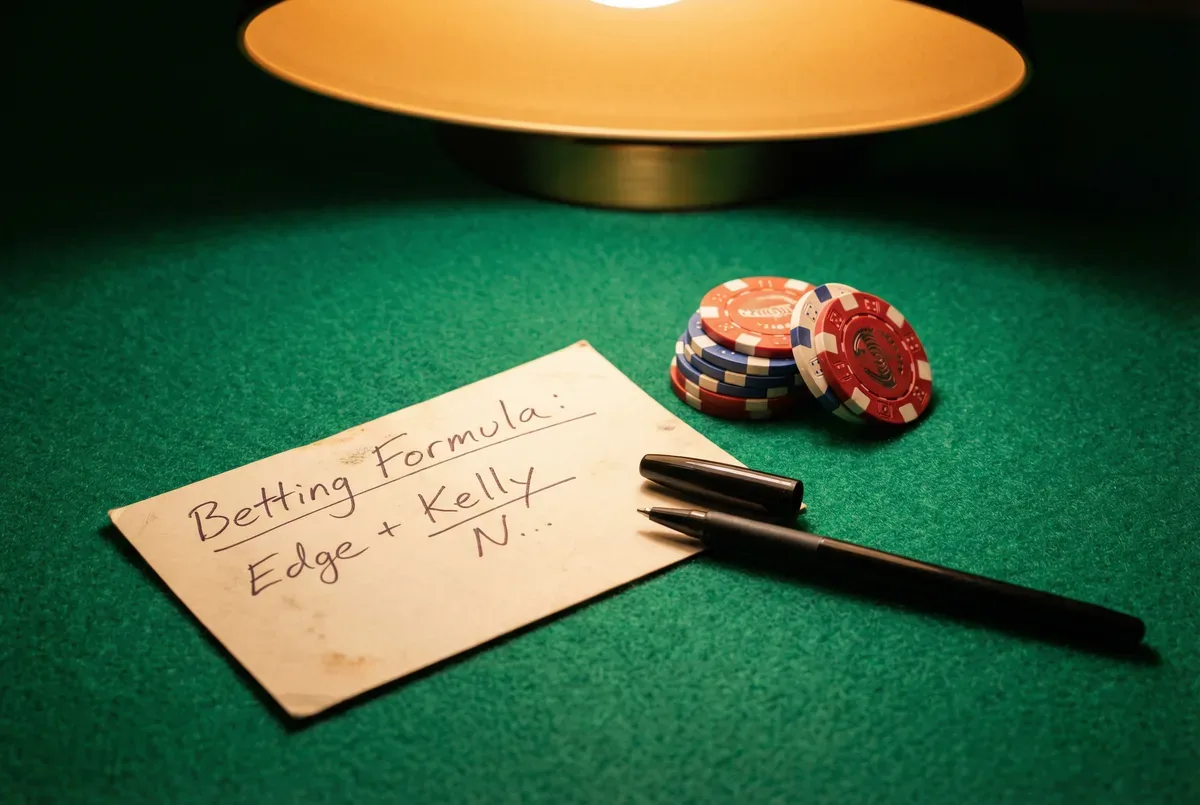
The Powerful Kelly Criterion for Perfect Card Counting Bet Sizing
The Kelly Criterion is a mathematical formula that calculates the exact fraction of your bankroll to wager when you hold a known edge. For card counters, that edge changes with every card dealt the true count determines it. At a true count of +1 in Hi-Lo, a counter holds roughly a 0.5% edge over the house. At +2, that edge climbs to approximately 1.0%. Kelly says: bet a fraction of your bankroll equal to your edge divided by the odds paid. In blackjack paying even money, that fraction equals your edge outright. A 1% edge on a $10,000 bankroll means a $100 Kelly bet. The formula sounds simple. The discipline to follow it is not.
What the Kelly Criterion Actually Tells Card Counters
- True Count +1 → ~0.5% edge → Kelly bet = 0.5% of bankroll
- True Count +2 → ~1.0% edge → Kelly bet = 1.0% of bankroll
- True Count +3 → ~1.5% edge → Kelly bet = 1.5% of bankroll
- True Count +4 → ~2.0% edge → Kelly bet = 2.0% of bankroll
- $10,000 bankroll at TC+2 → $100 Kelly optimal bet
What Are the Full Kelly Formula and Why It’s Too Aggressive?
The Kelly formula is f* = (bp – q) / b, where b is the net odds received, p is the probability of winning, and q is the probability of losing. In blackjack, because you can double, split, and collect 3:2 on blackjack, the effective odds are slightly better than 1:1. But the standard approximation used by most counters is f* = edge / variance. For a game with roughly 1.3 variance (accounting for doubles and splits), a 1% edge produces a Kelly fraction of about 0.77% of bankroll not the full 1%. Full Kelly maximizes long-run geometric growth rate, but the path is brutal. A $10,000 bankroll run at full Kelly will regularly swing $3,000–$4,000 in a single session at moderate stakes. Most professional players cannot psychologically sustain that volatility, and more importantly, they should not need to.
The deeper problem with full Kelly is that edge estimates in blackjack are never perfectly precise. You might believe you have a 1.2% edge at a given true count, but the real number depends on exact rules, number of decks remaining, and your specific bet spread. If your edge estimate is even 20% too high, you are over-betting the true Kelly fraction, which increases risk of ruin significantly. Over-betting Kelly is worse than under-betting it. Over-betting Kelly compresses long-term growth you grow slower than optimal and face steeper drawdowns. This asymmetry is why professional counters treat their edge estimates conservatively.
Common Myth
“Full Kelly is optimal because it maximizes growth”
Kelly derivation does maximize long-run bankroll growth mathematically
The Reality
Full Kelly is only optimal when edge estimates are perfectly accurate and they never are in blackjack
Fractional Kelly (25%-50% of full Kelly) produces 90%+ of the growth with a fraction of the volatility
What Is Fractional Kelly?
Half Kelly betting 50% of the Kelly-optimal fraction is the standard starting point for serious counters. At half Kelly, the bankroll variance drops to one-quarter of full Kelly variance, while expected growth falls only to 75% of full Kelly growth. That trade-off is almost always worth it. Quarter Kelly (25% of the optimal fraction) reduces variance to one-sixteenth of full Kelly, with expected growth at roughly 44% of maximum. Most recreational counters playing part-time use quarter Kelly because the smaller swings are psychologically sustainable over months and years of play. The exact fraction you choose depends on your risk tolerance, your accuracy in estimating edge, and how many hours per month you play. A counter playing 20 hours per month with a conservative edge estimate should not be running full Kelly. A professional team playing hundreds of hours monthly with precisely calibrated edges might approach half Kelly.
Full Kelly
Half Kelly
- 100% of max
- 75% of max
How Do You Apply Kelly in Practice: Real Numbers at the Table?
Take a counter with a $15,000 dedicated bankroll playing a six-deck game with Hi-Lo. At neutral count (TC 0 or below), the house holds a 0.5% edge the counter bets the table minimum, say $15. At TC+1, the edge is approximately zero to slightly positive still minimum. At TC+2, edge is roughly 0.75% after variance adjustment Kelly bet is 0.75% of $15,000 = $112, but at half Kelly that becomes $56, rounded to $50 for camouflage. At TC+3, edge is approximately 1.25% half Kelly bet is $94, rounded to $100. At TC+4 and above, edge reaches 1.5%–2.0% half Kelly bets land between $112 and $150. This produces a bet spread from $15 to $150, a 1-to-10 spread that is aggressive enough to generate meaningful EV while staying below the threshold that triggers immediate heat at most casinos. The key discipline: bet sizing must be mechanical, not emotional. Raising your bet because you feel lucky is not Kelly. Raising your bet because the true count crossed a threshold is Kelly.
Using Kelly at the Real-Money Table
Before applying Kelly betting to live play, every counter must stress-test their count accuracy against the pressure of a real casino environment. If you want to observe Kelly bet sizing in action against a live dealer before committing serious money, blackjack-live exposes your bet spread to real-time dealer pressure and actual monetary stakes approach it with discipline and a pre-set session bankroll you can afford to lose entirely.
Kelly bet sizing only proves itself over a real sample. A live session is where fractional Kelly discipline gets tested against the emotional weight of actual money. Apply your Kelly bet spread at a live dealer table and see whether your sizing holds when a cold shoe runs four shoes deep.
Frequently Asked Questions
Most counters using Hi-Lo start increasing bets at TC+1 or TC+2. At TC+1 the edge is approximately breakeven to slightly positive, so the Kelly-optimal bet is near minimum. At TC+2 you hold roughly 0.75%-1.0% edge and Kelly sizing becomes meaningful. Below TC+1, always bet table minimum.
Technically yes, but the minimum table requirement becomes a binding constraint. If the table minimum is $10 and your bankroll is $1,500, Kelly tells you to bet $7.50 at a 0.5% edge below the minimum. Small bankrollers are forced to overbets Kelly at every positive count. You need at least 200-300x your maximum bet as a bankroll to run proper Kelly sizing.
The formula is the same, but edge-per-true-count is higher in double-deck games. In a double-deck game, each true count point is worth approximately 0.6%-0.7% edge rather than 0.5% in a six-deck shoe. That means Kelly-optimal bets are larger at the same true count in double-deck, and your bankroll requirements can be somewhat lower for the same expected value per hour.
Before you test these plays at a real table, run them through our free blackjack simulator practice unlimited hands at zero cost until every move becomes automatic.
Mathematical Risk Warning
Kelly Criterion optimizes long-run growth but cannot eliminate losing sessions. Even with a verified edge, counters experience extended downswings lasting hundreds of hours. Never play with money you cannot afford to lose entirely.
Blackjack Academy is an educational resource. All strategy is based on mathematical expectation. Always play within your means.

Written by
Mark AnurakProfessional card counter since 2009 · 500,000+ hands logged · Former Macau advantage player. Studied under Thorp, Griffin & Wong methodology. Full bio →
Learn More
Continue your education with these related lessons.

What Research Reveals About Real Card Counting Win Rates and Data
Academic simulations and real-world data from Don Schlesinger's Blackjack Attack put hard numbers on what counters actually earn. The results…

The Difference Between Running Count and True Count in Practice
Running count tells you what happened. True count tells you where you stand. Learn the mental division process, deck estimation,…

Why Card Counting Is Legal but Casinos Hate It
Card counting is a legal mental skill, yet casinos have spent decades developing countermeasures. Here is exactly what the law…