
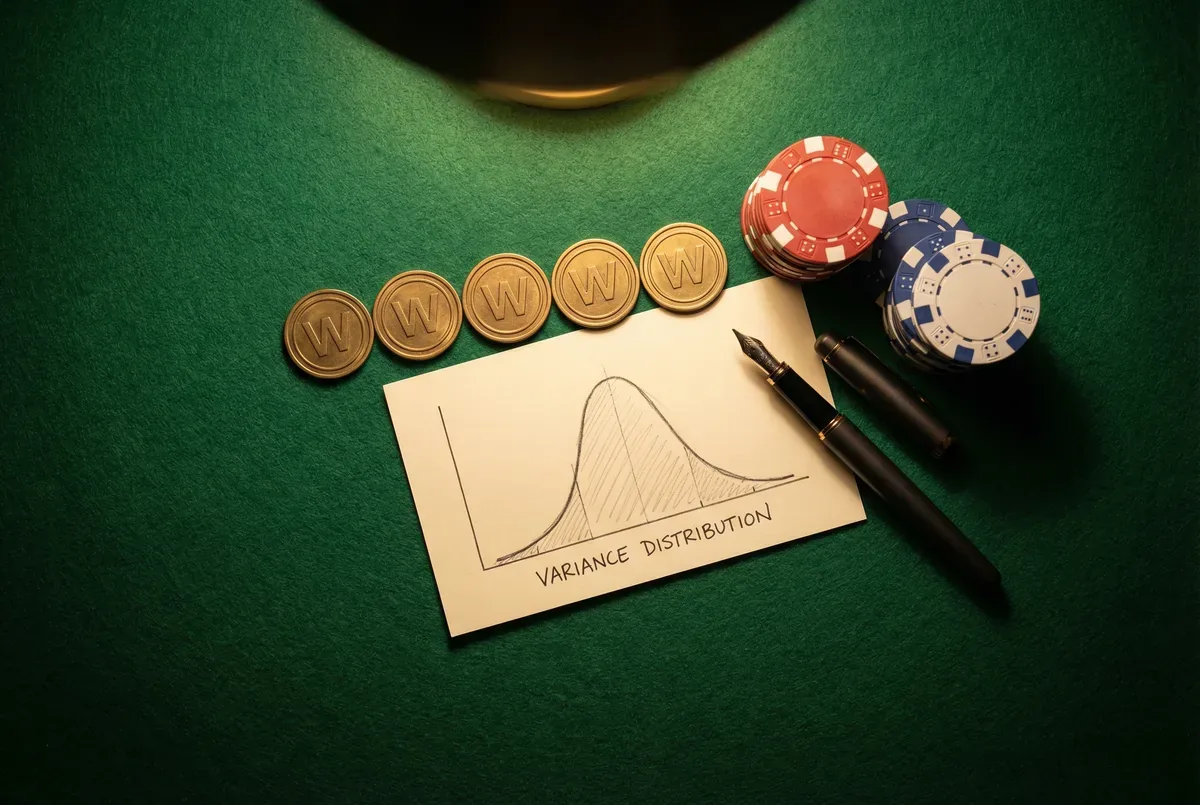
Why Winning Streaks are Just Short Term Statistical Variance
A winning streak is a sequence of consecutive positive outcomes. In blackjack, where each hand has approximately 47% win probability (excluding ties), sequences of 3, 4, 5, or more consecutive wins occur regularly through pure probability. A 4-consecutive-win sequence has a probability of approximately 0.47 to the fourth power about 4.9%, meaning it occurs roughly once in every 20 such sequences. A 6-consecutive-win streak has a probability of about 1.1% rare per attempt, but frequent over hundreds of sequences in a long session.
Winning Streaks in Blackjack are Clusters of Positive Variance, Not Evidence of Momentum
The critical mathematical fact is that the probability of the next win is identical during a winning streak to what it is at any other point. The streak does not create momentum. It does not predict continuation. Each hand is independent, and the 47% win probability is the same on hand 7 of a streak as it was on hand 1. The streak is already complete in hindsight it was going to happen eventually by pure probability, and it has no predictive power over the next hand.
This is the hot hand fallacy applied to blackjack: the belief that current success predicts continued success. In sports (basketball free throws, for example), debate exists about whether hot hands are real. In blackjack with a shuffled deck, the mathematics are unambiguous there is no hot hand effect.
Probability of winning next hand (any point)
%
Probability of 4 consecutive wins
% per attempt
Probability of 6 consecutive wins
% per attempt
Why Streaks Feel More Significant Than They Are?
Human pattern recognition evolved to detect meaningful sequences in noisy environments and it does this too well in gambling contexts. Five consecutive wins feel like information because our brains are designed to extract signal from pattern. In nature, five consecutive indicators of the same thing typically mean something. In a shuffled-deck card game, they mean nothing except that this particular sequence, which was mathematically certain to occur at some point, happened to occur now.
The recency bias compounds this. The last five hands are more emotionally salient than the last 500. A player who has won the last five hands weights those five outcomes heavily in their mental model of the session, despite the fact that they represent 1% of a 500-hand session and are statistically expected to occur multiple times during that session without any strategic implication.
Social reinforcement amplifies both effects. Other players at the table notice and comment on winning streaks. Dealers congratulate continuing wins. The social environment treats streaks as meaningful events, which further embeds the pattern in the player’s mental model as having predictive significance that it mathematically lacks.
Common Myth
“When I am on a hot streak, I should increase my bets to take advantage”
Current wins feel like momentum and the deck feels favorable
The Reality
The probability of the next win is 47% regardless of the previous 5 outcomes. Bet increases during streaks are funded by prior wins but expose those gains to the same negative EV as any other hand
Increasing bets during streaks without counting justification does not improve expected value. It increases the size of future wins and losses at identical probability
What Positive Progressions Actually Do During Streaks?
The legitimate value of positive progression systems (Paroli, 1-3-2-6) during winning streaks is not that they exploit momentum it is that they allow larger bets when you have already won recent hands and those prior wins are funding the increased exposure. If you are pressing from winnings rather than from your original stake, the downside of a loss at the elevated bet is smaller in absolute terms. You are playing with house money.
Name the Variance and Keep Your Bet Flat
This is structurally different from believing streaks have predictive power. A Paroli player is not betting more because they believe the next hand is more likely to win they are betting more because the prior wins mean the current hand’s potential loss is offset by the prior wins’ actual gains. The distinction matters: one is based on false premises about probability, the other is based on sound premises about loss exposure relative to prior gains.
When a streak starts, acknowledge it consciously: 'This is a positive cluster of variance.' That verbal acknowledgment interrupts the narrative-building process that turns a sequence of independent events into a perceived trend. Naming what is happening variance, not momentum makes it easier to maintain flat-bet discipline or execute the reset rule of a positive progression correctly.
Streaks in Action at a Real Table
The temptation to press bets during a hot run is one of the most persistent challenges in blackjack discipline. At see these numbers translate at a live table tonight, real winning streaks produce real excitement and real pressure to press. Test your discipline by winning four consecutive hands and deliberately holding your flat bet before adding any progression rule. The emotional experience of that discipline sitting on a streak without increasing exposure is the skill worth training. Real money makes the test genuine; only use funds completely budgeted for entertainment.
Frequently Asked Questions
Not from the streak itself. The only information that genuinely predicts the probability of future wins in a blackjack shoe is card composition specifically whether the remaining shoe is rich or poor in high cards. This is what card counters track. Streak length provides zero predictive information.
Regression to the mean. After an above-average run, results tend to move back toward the average win rate of approximately 47%. This is not because your bet increase jinxed the streak it is because streaks are finite positive variance clusters and end regardless of your bet size. The increased bet just means the regression costs more.
If you have hit your pre-committed win target, yes leave. That target should have been set before the session and should not be adjusted mid-streak. If you have not hit your target, the streak does not change the math on whether continuing play is rational.
Before you test these plays at a real table, run them through our free blackjack simulator practice unlimited hands at zero cost until every move becomes automatic.
Mathematical Risk Warning
Winning streaks in blackjack are statistical events with no predictive power over future hands. Increasing bets based on streak length rather than count-based evidence has no mathematical justification and increases financial exposure during a period that is statistically likely to regress toward the mean.
Blackjack Academy is an educational resource. All strategy is based on mathematical expectation. Always play within your means.

Written by
Mark AnurakProfessional card counter since 2009 · 500,000+ hands logged · Former Macau advantage player. Studied under Thorp, Griffin & Wong methodology. Full bio →
Learn More
Continue your education with these related lessons.
Why Chasing Losses is the Biggest Mistake in the Casino
Chasing losses is the single most common and most expensive behavior in casino gambling. This post explains the psychology behind…
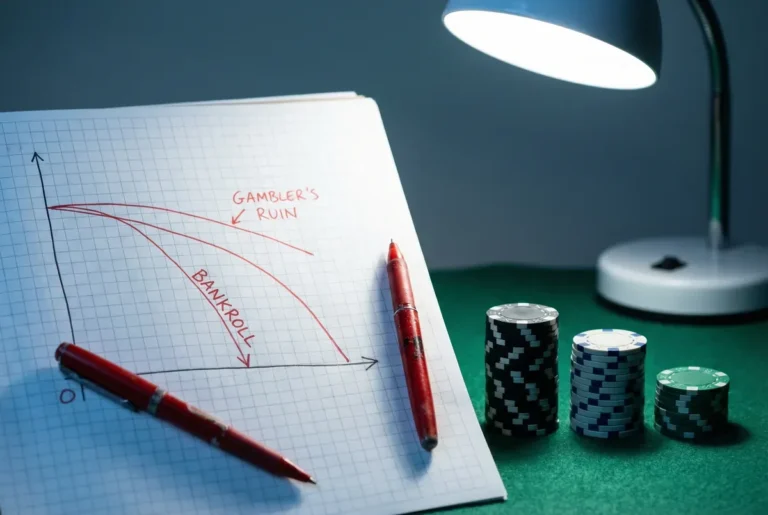
How Gambler’s Ruin Theory Affects Every Blackjack Player
Gambler's ruin is not a metaphor it is a precise mathematical theorem that predicts when any finite bankroll will be…

Why Sticking to Your Tactical Plan and Leaving Early Wins More Money
Walking away early before a session ends naturally is one of the most underrated professional skills in blackjack. A tactical…