
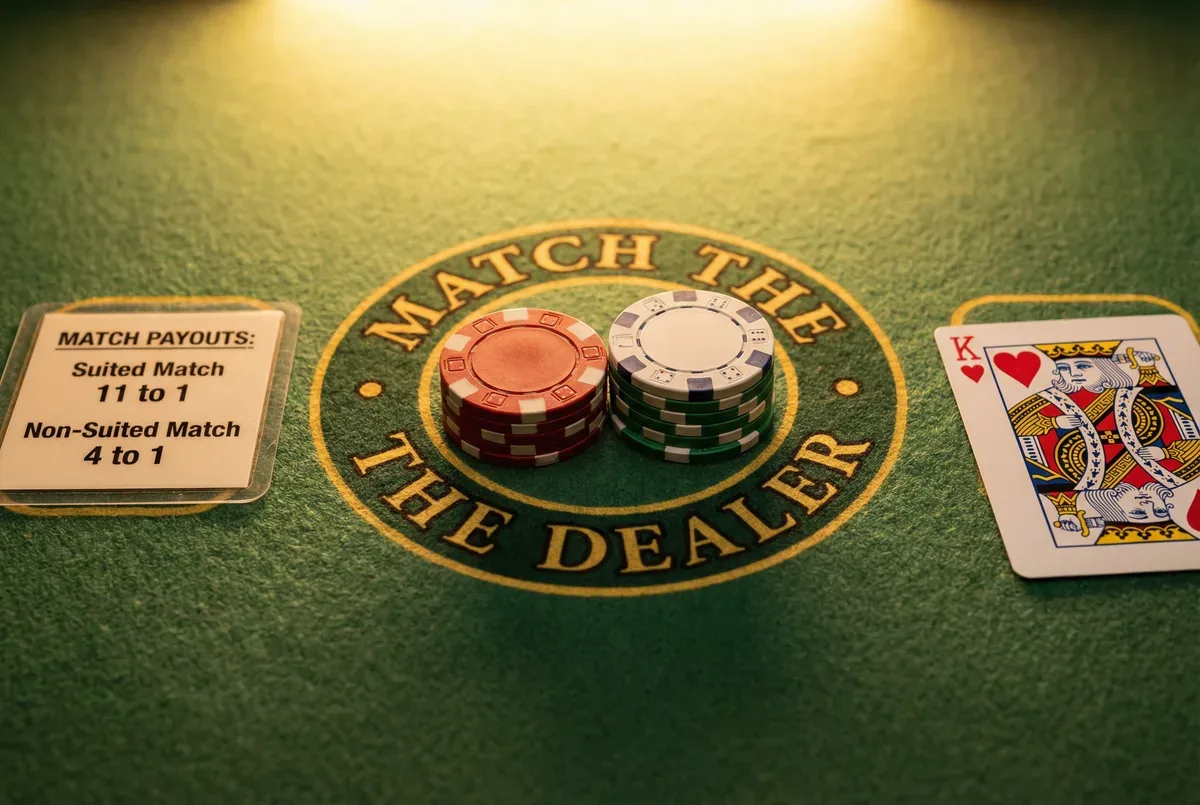
Is the Match the Dealer Side Bet Ever Worth the Financial Risk
Match the Dealer is a blackjack side bet placed before the hand is dealt. It wins when either or both of the player’s initial two cards match the dealer’s upcard by rank with bonus payouts for suited matches. In a standard six-deck game, the payout table typically pays 4:1 for an unsuited match and 9:1 for a suited match on one card, doubling to 8:1 and 18:1 when both cards match. A suited match on both cards produces the top payout of 36:1. The payouts are structured to feel substantial and to reward the events players find most visually satisfying all your cards matching the dealer in rank and suit. The blackjack house edge, however, sits between 3% and 6.5% depending on deck count and the exact payout schedule offered, which places Match the Dealer firmly in the category of entertainment products rather than strategic wagers.
What Match the Dealer Pays and How It Works
| Event | Suited Payout | Unsuited Payout |
|---|---|---|
| One card matches dealer | ||
| 9 | 1 | |
| 4 | 1;Two cards match dealer | |
| 18 | 1 / 36 | |
| 8 | 1 |
What Is the House Edge Calculation in Detail?
In a six-deck game, there are 312 cards total. With the dealer showing one card of a specific rank, 23 matching-rank cards remain in 311 unseen cards, and 5 of those are suited matches. For the player’s first card matching unsuited, probability is approximately 18/311 ≈ 5.79%; for suited match, 5/311 ≈ 1.61%. After the first card is drawn, conditional probabilities adjust for the second card. Running the full expected value calculation across all outcomes one match unsuited, one match suited, two matches in various combinations, no match produces a total expected return of approximately $0.935–$0.968 per dollar wagered depending on the specific payout table. The house captures $0.032 to $0.065 per dollar, translating to a 3.2–6.5% blackjack house edge.
Deck count materially affects this calculation. Single-deck Match the Dealer carries a much higher blackjack house edge sometimes exceeding 11% because the suit-specific match probabilities change dramatically with only 52 cards. Fewer decks mean the suited-match payout is hit less frequently relative to the reduced card population, but the payout table does not typically adjust to compensate. Players who assume single-deck games are more favorable for side bets are making the opposite assumption from what probability supports.
House edge on Match the Dealer (6 deck, standard pays)
%
House edge on Match the Dealer (1 deck)
%
Probability of at least one match (6 deck, both cards)
%
Whether Card Counting Can Unlock Match the Dealer?
Match the Dealer is one of the few side bets where blackjack card counting can theoretically produce positive expected value but the practical requirements are demanding. Since the bet pays based on rank matches, a shoe depleted of the specific rank the dealer is showing becomes unfavorable; conversely, a shoe rich in the dealer’s upcard rank increases match probability. A specific count called the Ace Side Count or a rank-specific surplus count can identify when a particular rank is sufficiently concentrated to create positive EV. However, the required count surplus is large enough that positive-EV opportunities are rare, and managing a rank-specific side count simultaneously with the main running count is a significant cognitive burden.
If you are not actively counting and tracking rank surpluses, Match the Dealer is a 3–6% house edge side bet. The fact that it can theoretically be beaten does not make it a smart play for anyone below the professional preparation threshold.
How Do You Compare the Entertainment Value to the Cost?
If you play Match the Dealer as pure entertainment, the cost-per-event analysis looks like this: at 80 hands per hour with a $5 side bet and 3.6% blackjack house edge, expected loss from Match the Dealer alone is approximately $14.40 per hour in addition to main hand losses. At 4 hours of play, that is $57.60 in expected additional loss purely from the side bet roughly the cost of a decent dinner. Some players consider that a fair trade for the excitement of watching for matches. That is a legitimate personal choice, provided the cost is understood rather than obscured. The risk lies in players who view the side bet as supplementary strategy rather than pure entertainment spend.
The optimal position for any player who cannot execute rank-surplus counting is straightforward: skip Match the Dealer on every hand, redirect the side bet amount to the main hand where the blackjack house edge is ten times lower, and treat any session where a match would have paid as simply variance that did not occur.
See the Side Bet Reality at Live Stakes
Side bet discipline is easy to maintain in theory and genuinely tested under live conditions. At test this side bet decision with real stakes, Match the Dealer will appear on the table layout every hand you play the circle will be there, the suited-match jackpots will be displayed, and the temptation will be real because real money is involved. Commit to 50 hands where you never place the side bet, track what the side bets would have paid versus what you would have lost, and calculate your actual EV savings. That exercise converts the 3.6% blackjack house edge from an abstract number into a concrete session result.
Frequently Asked Questions
Approximately 3.2–6.5% depending on the specific payout table used. The most common six-deck variant runs around 3.6%. This is five to twelve times higher than the main blackjack hand house edge with basic strategy.
Yes significantly. Single-deck Match the Dealer typically carries a house edge above 11% because suited-match probabilities change substantially with a smaller card population, and payout tables rarely adjust to compensate for the deck reduction.
Theoretically yes, using a rank-specific surplus count. Practically, the required surplus is difficult to achieve, and maintaining a rank-specific side count while managing the main running count and strategy decisions is extremely cognitively demanding.
Before you test these plays at a real table, run them through our free blackjack simulator practice unlimited hands at zero cost until every move becomes automatic.
Mathematical Risk Warning
Match the Dealer carries a house edge of 3–6%, substantially higher than the main blackjack hand. Placing this bet on every hand significantly increases expected session losses compared to main-hand-only play.
Blackjack Academy is an educational resource. All strategy is based on mathematical expectation. Always play within your means.

Written by
Mark AnurakProfessional card counter since 2009 · 500,000+ hands logged · Former Macau advantage player. Studied under Thorp, Griffin & Wong methodology. Full bio →
Learn More
Continue your education with these related lessons.
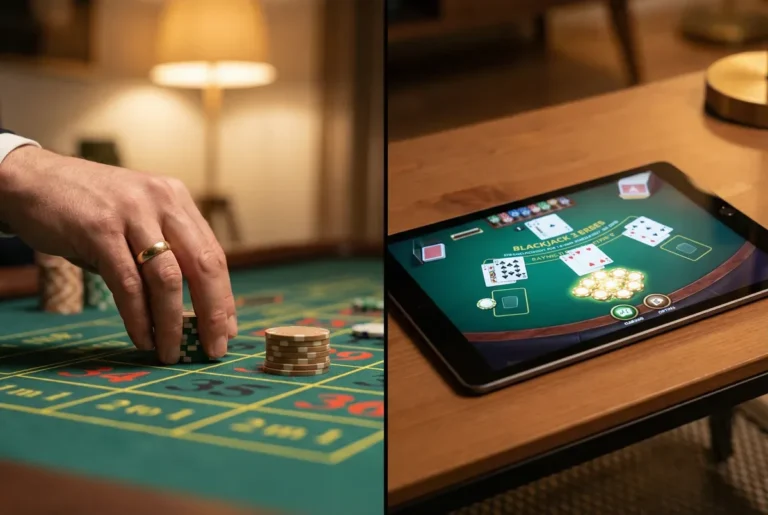
Why Betting Psychology Changes Dangerously with Virtual Chips vs Real Cash
Virtual chips in online blackjack reduce the psychological pain of loss, causing players to bet more recklessly than they would…
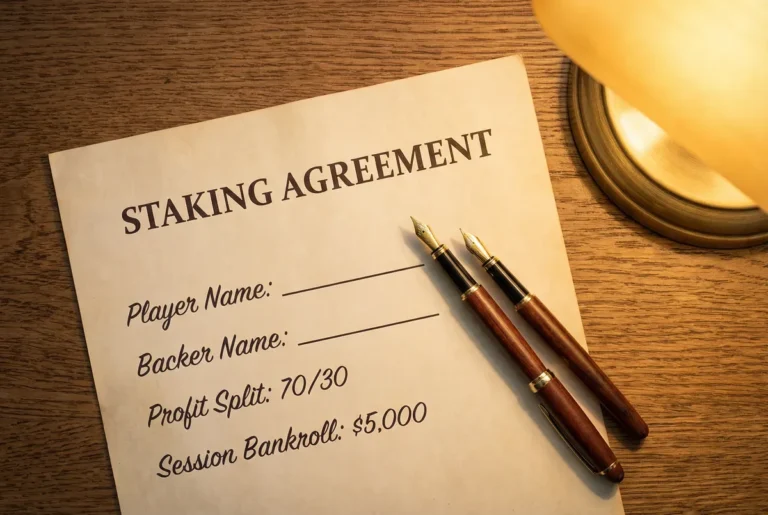
The Complete Guide to Blackjack Staking Agreements for Team Play
Staking agreements let backers fund card counters in exchange for a share of profits. Here's how the typical 50/50 split…
Proven Bankroll Growth Strategy for Recreational Blackjack Players
When should a recreational player move up to higher stakes? The 300-unit rule, how to manage winnings, and the structural…