
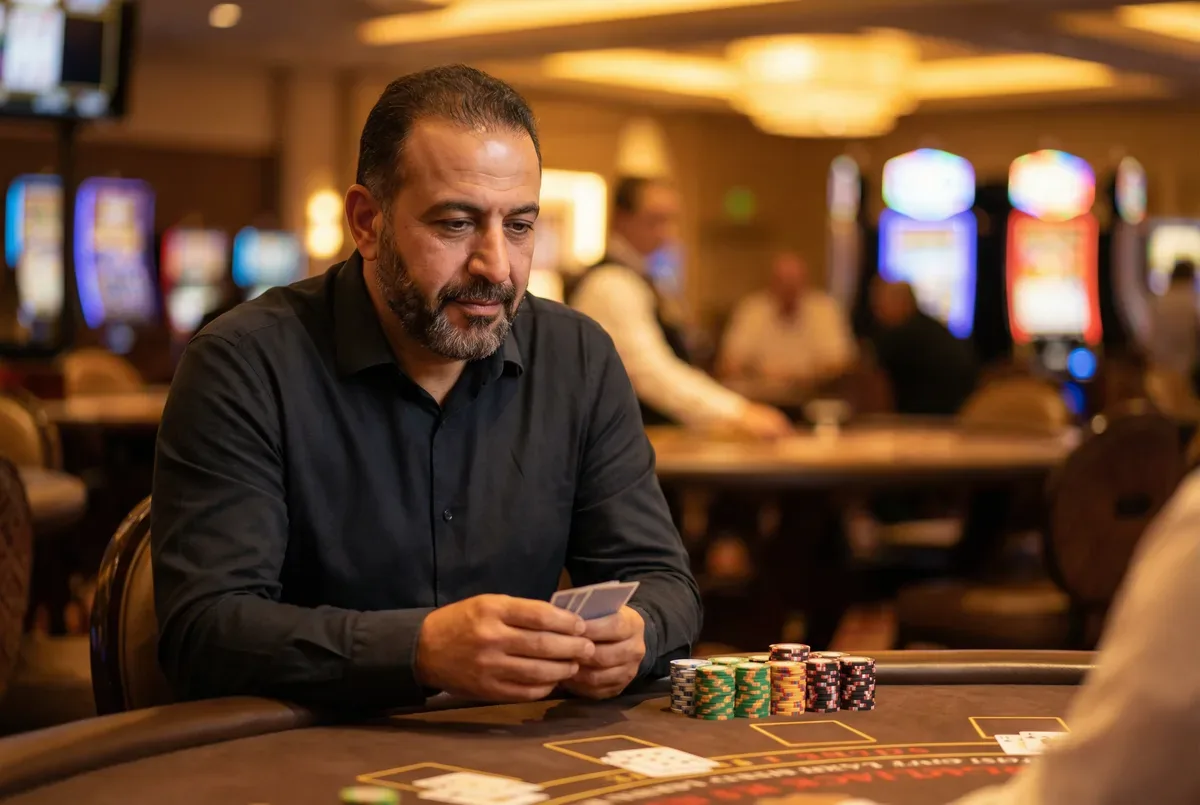
How to Stay Calm and Control Your Emotions at the Table
- Emotional Decisions at the Blackjack Table Cost More Than Strategy Errors
- How Do You Identify the Specific Errors Each Emotional State Produces?
- What Is the Practical Tools for Staying Rational Under Pressure?
- How Do You Apply This Principle Consistently at Real Tables?
- Training Emotional Control Before Stakes Are Real
Every blackjack strategy error has a calculable cost in expected value. Standing on a 12 against dealer 3 when you should hit costs approximately 2% of the bet. But emotional decisions chasing losses with oversized bets, refusing correct doubles because you are scared, standing on hands you should hit because you are on tilt can cost 5%, 10%, or more of every affected hand. The cumulative damage of a 30-minute tilt episode exceeds what most players lose to blackjack house edge in an entire session.
Emotional Decisions at the Blackjack Table Cost More Than Strategy Errors
Emotional control is not a personality trait you either have or lack. It is a set of learned responses to specific triggers, and those responses can be trained the same way blackjack basic strategy decisions are trained through repetition, self-awareness, and pre-established rules that remove the decision from the emotional moment.
The three primary emotional states that damage blackjack results are tilt (loss-induced anger or desperation), overconfidence (winning-streak hubris), and fear (scared money that refuses correct aggressive plays). Each produces distinct, predictable errors.
A decision made under emotional duress is not a strategy it is a reaction. Reactions are not calibrated to expected value.
Axiom
How Do You Identify the Specific Errors Each Emotional State Produces?
Tilt produces three identifiable error patterns: bet sizing that exceeds your planned unit size, refusal to follow blackjack basic strategy on close decisions because you feel the table is “against you,” and chasing sessions past your planned loss limit. Each of these is measurable. If you catch yourself thinking “I know the chart says hit but I have a feeling,” that is tilt talking, not strategy.
Overconfidence during winning streaks produces the opposite problem: inflated bet sizes that expose your accumulated winnings to variance, refusal to leave at your win target, and underestimation of risk because recent success feels like skill rather than variance. A player who won 20 units in the first hour and bets double units in the second hour is overconfident. The next hand has identical odds to the first hand of the session.
Fear manifests as skipping doubles on positive-EV hands because the doubled bet feels too large, refusing correct splits, and leaving the table too early during normal variance downswings that haven’t hit your planned loss limit. Fear-based decisions sacrifice expected value to reduce the emotional discomfort of larger bets a trade that costs real money to prevent imaginary catastrophe.
Common Myth
“Going with my gut is sometimes smarter than the basic strategy chart”
After watching dozens of hands, players develop a feeling about the shoe's behavior
The Reality
Basic strategy is derived from millions of simulation runs. Your gut is pattern-matching on a sample of 20–30 hands far too small to override mathematical optimization
Gut-based deviations from basic strategy add between 0.5% and 3% to the house edge per deviated hand, depending on the specific play
What Is the Practical Tools for Staying Rational Under Pressure?
The most reliable tool against emotional decisions is pre-commitment: establish your session rules in writing before you sit down and commit to following them regardless of session outcome. Rules that are decided in the calm before play are immune to the emotional state that develops during play. Write them down your unit size, session buy-in, loss limit, and win target. Put them on your phone. Consult them when you feel the urge to deviate.
How Do You Apply This Principle Consistently at Real Tables?
Physical resets work when emotional pressure is building. Standing up from the table, stepping away for five minutes, and returning with fresh perspective breaks the cognitive loop that sustains tilt. Most casinos interpret this as normal bathroom behavior. Use it deliberately.
Keep a small card in your pocket with your session limits written on it. When you feel the urge to bet more, look at the card. The act of consulting a physical object forces a pause in the emotional escalation. That pause is where rational decision-making lives.
Training Emotional Control Before Stakes Are Real
Emotional control under pressure can only be trained under pressure. At test this approach with real stakes tonight immediately, real money produces real emotional responses the sting of a losing streak, the temptation to press during a hot run all the triggers that distort decisions. Only play with funds you have budgeted for entertainment, and treat each session as an opportunity to observe your emotional reactions and test your pre-commitment rules rather than simply trying to win. The player who learns what their tilt looks like in a $50 session will be far better equipped when the stakes increase.
Frequently Asked Questions
Common tilt signals include betting larger than your planned unit size, playing faster than normal, skipping basic strategy checks, feeling anger or resentment toward the dealer or other players, and making decisions faster than usual. If you notice any of these, stop playing immediately, step away, and reassess before returning.
Yes, if you have hit your session win target. The win target exists precisely to prevent the overconfidence that follows a big run. Banking the session profit at the predetermined target is not weakness it is the strategy working as designed. The next session starts fresh.
No, and that is not the goal. Some emotional engagement is normal and healthy. The goal is to prevent emotional states from overriding pre-established strategy rules. Emotions are a signal they tell you something about your state. The discipline is in not letting them make decisions that should be mathematical.
Before you test these plays at a real table, run them through our free blackjack simulator practice unlimited hands at zero cost until every move becomes automatic.
Mathematical Risk Warning
Emotional decision-making in blackjack consistently produces suboptimal expected value. Tilt, overconfidence, and fear each add measurable cost per hand beyond the standard house edge. Emotional control is not optional for disciplined bankroll management.
Blackjack Academy is an educational resource. All strategy is based on mathematical expectation. Always play within your means.

Written by
Mark AnurakProfessional card counter since 2009 · 500,000+ hands logged · Former Macau advantage player. Studied under Thorp, Griffin & Wong methodology. Full bio →
Learn More
Continue your education with these related lessons.
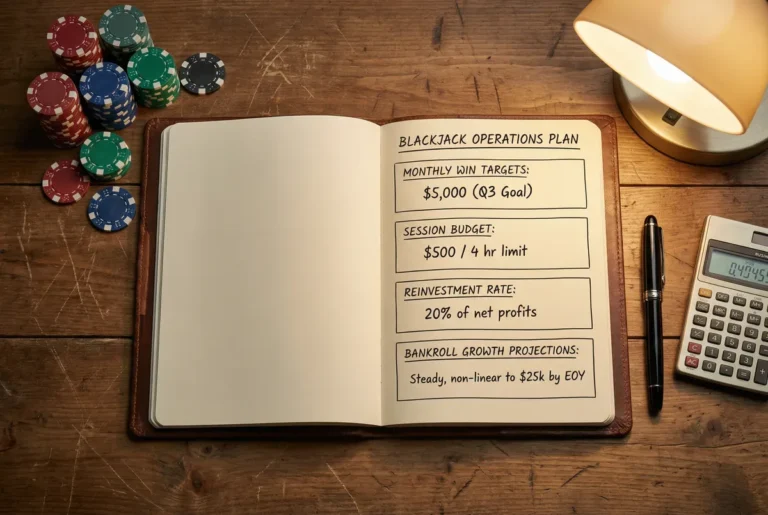
Why Treating Your Blackjack Bankroll Like a Business Beats Pure Gambling
Professional advantage players manage their bankroll with the same discipline as a small business separate accounts, profit-and-loss tracking, quarterly reviews,…
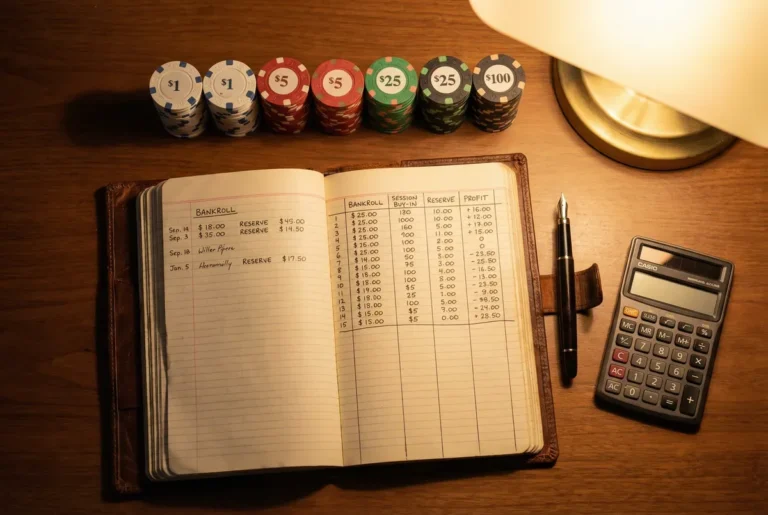
Bankroll Management Secrets Every Professional Blackjack Player Needs
Professional blackjack longevity depends entirely on disciplined bankroll management. Learn the exact unit sizing, session limits, and reserve rules that…
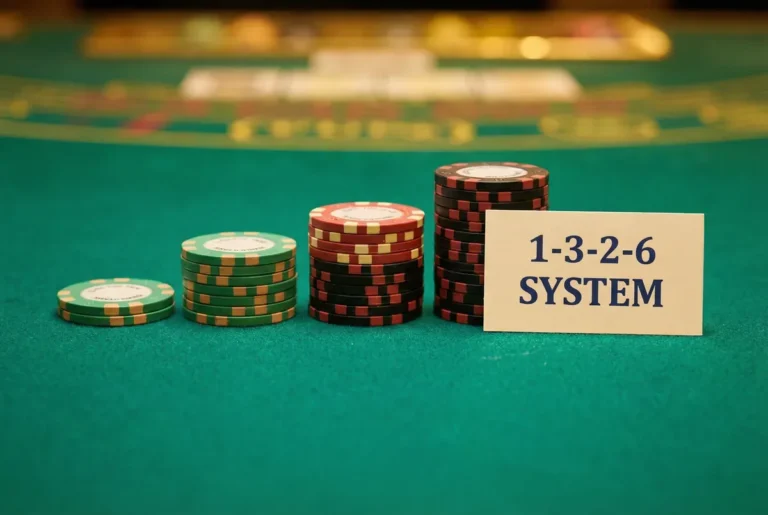
How to Use the 1-3-2-6 Betting System for Winning Streaks
The 1-3-2-6 system is a structured positive progression that locks in profit after two wins and attempts maximum gain on…