
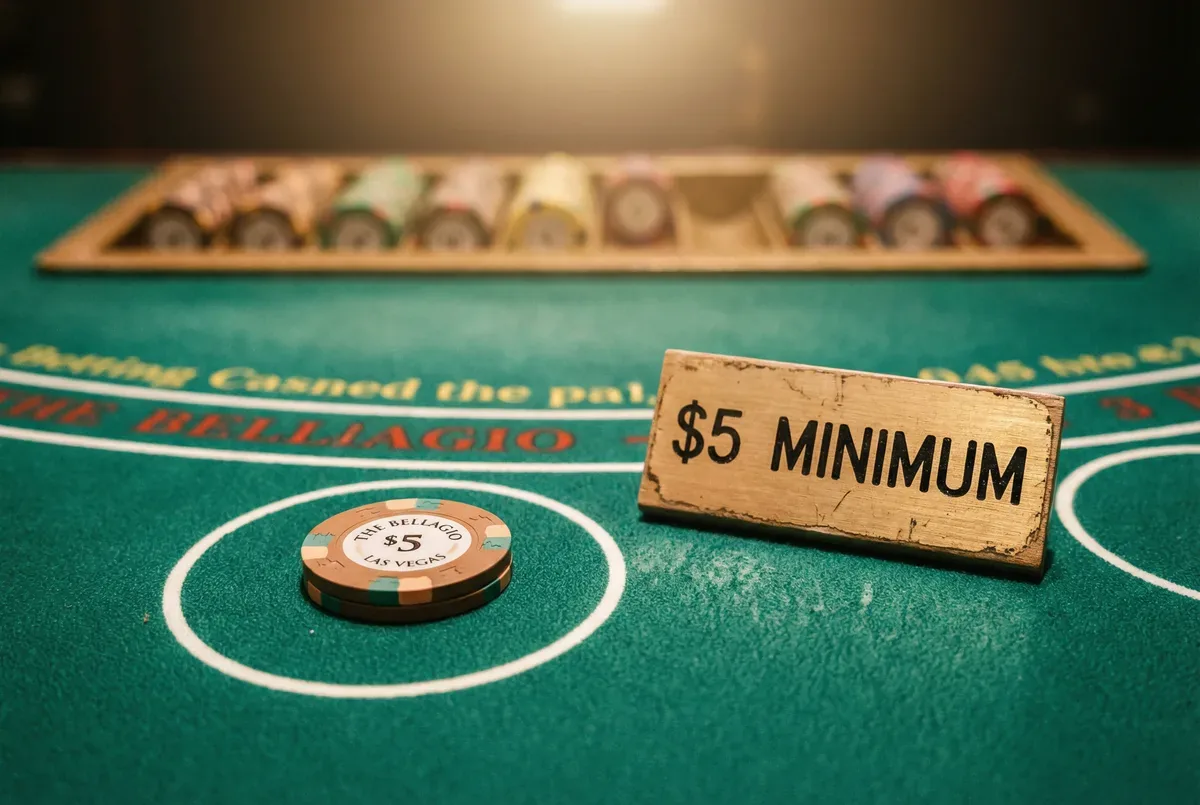
Why You Should Always Start at the Table Minimum Bet
Walking to a blackjack table and opening with a bet above the minimum is a decision that costs most players money in ways they never attribute to that choice. The early hands of any session carry full house-edge exposure with no informational advantage. For a blackjack basic strategy player, the first hand at a fresh shoe carries a 0.5% expected loss regardless of bet size but the variance is identical on a percentage basis whether you bet $10 or $100. Opening at minimum preserves capital for the hands where you have gathered session information, confirmed the dealer’s pattern of rule application, assessed table speed, and, for counters, and built a reliable count. Every dollar bet above minimum on the opening hand is simply purchasing more exposure to a blackjack house edge that has not yet been assessed or offset by any positional advantage.
The Minimum Bet Is the Most Efficient First Bet
The table minimum is the optimal opening bet for every player in every session. It is not caution it is capital efficiency.
Session Rule
What You Are Learning During Minimum Bet Hands?
The opening hands at minimum bet serve as a reconnaissance phase. You are gathering data that is unavailable before you sit down: how quickly the dealer shuffles and deals, whether the pit boss is actively watching this table, how other players at the table play their hands (which affects your splitting and doubling decisions indirectly through shoe composition in multi-deck games), and critically for counters what the initial count looks like as cards are revealed. None of this information is available pre-session. The minimum bet period lets you acquire it at the lowest possible cost.
For recreational players not counting cards, the minimum bet warm-up period also calibrates your execution under real conditions. Strategy decisions that felt smooth in practice sessions sometimes hesitate in live play when other players are watching. Opening at minimum lets you confirm your decision velocity and recall accuracy before material amounts are at stake. Any hesitation on a blackjack basic strategy decision spotted during minimum bet hands is a signal to slow down and verify your chart before increasing bet size.
- Dealer pace and shuffle method affects hands per hour calculation
- Pit surveillance intensity informs bet spread camouflage needs
- Count trajectory over first shoe sets up initial bet sizing decisions
- Table atmosphere noise, pace, and any player patterns
- Your own execution sharpness confirms strategy recall before scaling up
How Opening Large Distorts Your Session Variance?
Opening with a large bet introduces asymmetric psychological pressure. A player who opens at $100 and loses the first three hands is down $300 a loss that may represent a significant fraction of their session bankroll before they have gathered any useful information about conditions. This early deficit creates the exact psychological conditions most likely to trigger strategy deviations: the pressure to recover, the temptation to increase bets to get back to breakeven faster, and the loss aversion response that distorts risk perception. A player who opens at $10 minimum and loses the same first three hands is down $30. The same variance event carries zero threat to session objectives and generates no psychological pressure requiring active management.
Dealer Shows
Your Hand
You have 11 vs dealer 6 on the very first hand of the session. You started at table minimum $10. Do you double?
The minimum bet rule governs opening bet size, not strategy. Hard 11 vs dealer 6 is a positive-EV double regardless of when in the session it occurs. Opening at minimum does not mean playing differently it means spending less on the hands before you have session-specific information. Always double 11 vs 6.
When to Graduate From the Minimum Bet?
The trigger for moving above minimum varies by player type. For blackjack basic strategy players, graduating after fifteen to twenty hands once session conditions are confirmed and execution is verified is standard practice. The bet increase should be proportional to bankroll size: moving from $10 to $20 on a $500 session bankroll is conservative and appropriate. For counters, bet graduation is count-dependent: bets scale up when the running count indicates a positive player advantage, not on an arbitrary time schedule. The distinction matters because counters are responding to a real change in expected value, while blackjack basic strategy players are simply confirming conditions before deploying standard unit sizing.
Never graduate from the minimum in response to a positive outcome. Winning the first five hands does not mean conditions are favorable it means variance ran in your direction for five hands. The count, the game rules, and the table conditions determine whether scaling up is justified. Winning is not information about future outcomes.
Build This Habit Under Real Stakes
The minimum bet opening is one of the easiest professional habits to commit to in theory and one of the most frequently violated under the excitement of a real session start. Reinforce the habit at open at the table minimum at a live real-money game where real money ensures the discipline is genuine rather than academic. Open every session at the platform minimum, use the first fifteen hands as your reconnaissance phase, and log what you learned before scaling bets. Three consistent sessions with this protocol will make minimum-bet opening automatic and your bankroll will reflect it.
Frequently Asked Questions
No. Expected value per hand is determined by bet size, house edge, and strategy not by session progression. Starting at minimum reduces variance exposure during the information-gathering phase without changing your long-run EV per unit wagered.
For basic strategy players, fifteen to twenty hands provides enough data to confirm conditions. For card counters, bet size is driven by count rather than a hand threshold bet increases happen when count justifies them, regardless of how many hands have been played.
Yes. A fresh shoe provides no established count for counters and no informational advantage for anyone. Starting at minimum after a shuffle is especially appropriate since the first shoe contains pure house-edge exposure with zero informational benefit from prior hand history.
Before you test these plays at a real table, run them through our free blackjack simulator practice unlimited hands at zero cost until every move becomes automatic.
Mathematical Risk Warning
Blackjack sessions carry house edge exposure from the first hand. Minimum bet opening reduces early variance risk but does not change the mathematical expectation of any individual hand.
Blackjack Academy is an educational resource. All strategy is based on mathematical expectation. Always play within your means.

Written by
Mark AnurakProfessional card counter since 2009 · 500,000+ hands logged · Former Macau advantage player. Studied under Thorp, Griffin & Wong methodology. Full bio →
Learn More
Continue your education with these related lessons.
Why the Reverse Martingale and Parlay System Fails Most Players
The Reverse Martingale doubles bets after wins instead of losses. It protects your base bankroll from catastrophic loss. Here is…
Proven Risk Assessment Frameworks for Better Blackjack Betting Decisions
Professional gamblers do not rely on intuition for risk decisions. They use structured frameworks to quantify exposure before committing capital.…
House Edge of Popular Side Bets Like Blazing 7s
Blazing 7s, Lucky Lucky, and Royal Match all carry house edges far above the main game. This post gives you…