
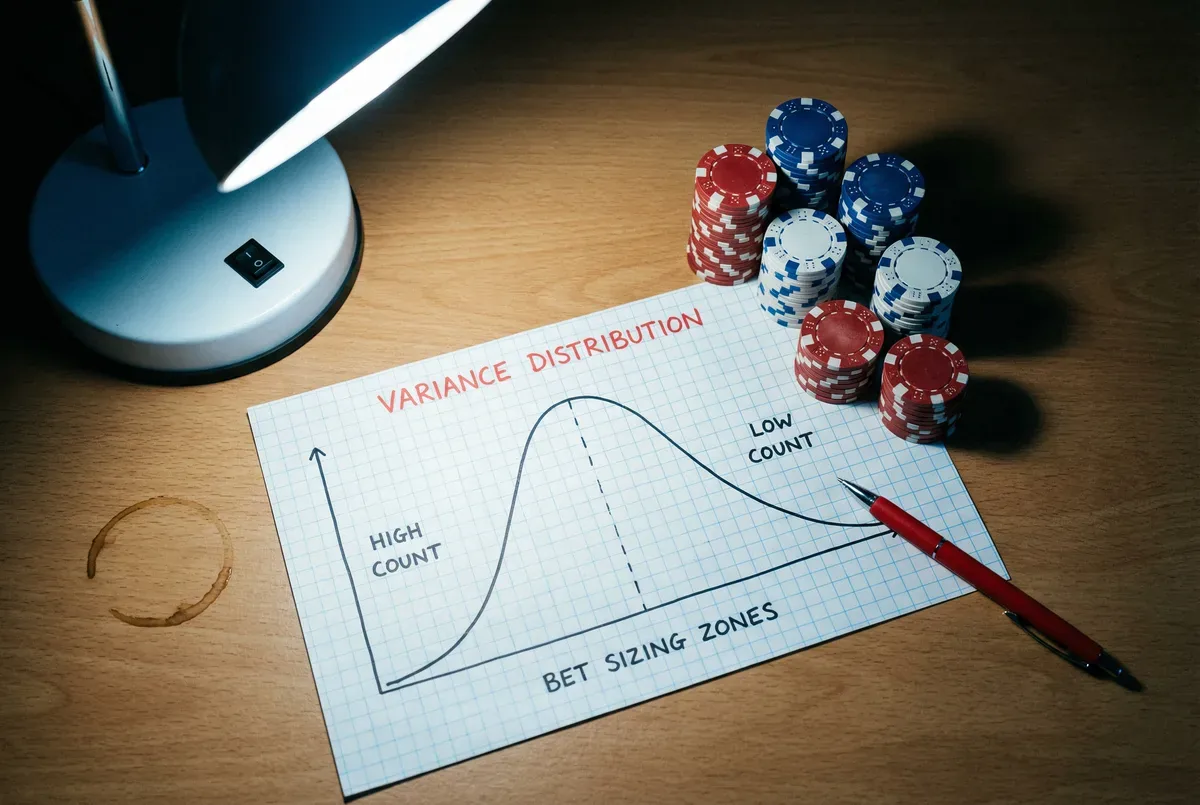
How Professional Counters Hedge Against Mathematical Variance
A card counter with a verified 1% edge over the casino is not guaranteed to profit from any given session, week, or even month. The standard deviation of blackjack outcomes is approximately 1.15 units per hand, meaning that over 100 hands the one-sigma swing is roughly ±11.5 units regardless of edge. A counter betting $50 per hand at base, spreading to $200 at high counts, can easily experience a $2,000 downswing in a session despite playing perfectly. This is not failure it is the expected statistical behavior of a high-variance game. What separates professional counters from recreational players is not immunity to variance but a precisely engineered system for surviving it without depleting the bankroll that funds future positive-EV play.
Why Edge Does Not Eliminate Variance Risk
Blackjack standard deviation per hand
units
Expected losing sessions at 1% edge in 100-hand games
%
1-sigma swing over 400-hand session at $50 unit
range
How Does Bankroll Sizing Work as the Primary Variance Buffer?
The standard recommendation for professional-level blackjack card counting is a bankroll of 200–400 times the maximum bet spread to achieve less than 5% risk of ruin. A counter spreading from $25 to $200 a 1:8 spread should carry $40,000–$80,000 in dedicated playing bankroll to sustain variance at that level. These numbers shock recreational players but are grounded in gambler’s ruin calculations. A smaller bankroll is not more conservative it is more likely to experience ruin during the inevitable downswings before the edge accumulates to profitability.
Fractional Kelly betting refines bankroll deployment within this framework. Full Kelly betting the mathematically optimal fraction of bankroll based on current edge maximizes expected growth rate but generates the maximum variance the edge can sustain. Quarter Kelly reduces variance by approximately 75% while surrendering only a fraction of expected growth rate, creating a much smoother equity curve. Most professional counters operate between quarter and half Kelly for precisely this reason: the growth rate sacrifice is worth the dramatic reduction in psychological pressure and ruin risk during extended downswings.
Kelly Fraction
Expected Hands to Double Bankroll
- ~800 hands
- ~1,600 hands
- ~3,200 hands
- Never (negative EV)
What Are Bet Spreading Mechanics and Variance Management?
Bet spreading the ratio between minimum and maximum bets based on count is where edge is actually extracted. At neutral counts, the counter bets minimum to minimize exposure to negative or marginally negative expected value. At high positive counts, bets scale up to capture the positive-EV hands. The spread ratio determines how much edge is extracted per hour of play. A 1:4 spread produces modest edge with low heat from casino surveillance; a 1:12 spread extracts substantial edge but creates conspicuous betting patterns. Professional counters calibrate spread to the balance between expected value extraction and the longevity risk of being identified and banned.
The bet spread is your edge delivery mechanism. Every restriction on your spread whether self-imposed for camouflage or externally imposed by pit boss limits reduces your expected hourly return by a calculable amount. Know your exact EV per hour at every spread ratio you operate under.
How Does Team Play Work as Variance Reduction Infrastructure?
Blackjack teams pioneered systematically by the MIT Blackjack Team represent the ultimate variance hedge. When multiple counters pool bankrolls and share profits, individual variance averages out across the group, dramatically smoothing the equity curve. With ten players contributing equally, the standard deviation of the group’s per-hand result is reduced by a factor of approximately 3.16 (the square root of ten) compared to any individual player. This mathematical pooling effect allows the group to operate at a lower bankroll-to-bet-size ratio than any individual counter while maintaining the same ruin probability target effectively multiplying capital efficiency.
Team logistics introduce non-mathematical risks: trust, accounting integrity, signal systems, and the elevated surveillance attention that accompanies multiple coordinated players at a casino. These practical constraints mean team play is reserved for the most committed professional setups rather than recreational or semi-professional contexts.
Execute Under Variance Pressure at the Live Table
Understanding variance intellectually is not the same as experiencing it without strategy degradation. The real test is whether your execution holds through a twenty-hand losing streak while maintaining count accuracy and bet discipline. At test your count at a real money table this week you will encounter the downswings that variance guarantees and real money ensures the psychological pressure that makes holding form difficult. Run sessions with a defined bankroll, fractional Kelly bet sizing, and a commitment to strategy integrity regardless of short-term outcomes. That is how professional variance management is learned: through deliberate exposure, not theory alone. Before committing real money to any bet spread, verify the exact bankroll requirement for your edge and spread ratio using our blackjack EV calculator.
Frequently Asked Questions
At a 1% edge, approximately 40–45% of individual 100-hand sessions will be losing sessions. The edge manifests over thousands of hands not individual sessions. This is why bankroll size and psychological resilience matter as much as counting accuracy.
The standard minimum is 200× your maximum bet to achieve below 5% risk of ruin. For a 1:8 spread with a $200 maximum, that implies a $40,000 dedicated bankroll. Undercapitalization is the primary reason aspiring counters fail despite correct play.
Quarter Kelly roughly halves expected growth rate compared to full Kelly, but reduces variance by 75%. Most professionals find this trade-off highly attractive the smoother equity curve allows better long-run execution compared to the psychological stress of full Kelly swings.
Before you test these plays at a real table, run them through our free blackjack simulator practice unlimited hands at zero cost until every move becomes automatic.
Mathematical Risk Warning
Card counting provides a mathematical edge but does not eliminate variance or ruin risk. Even professional counters experience extended losing periods. Adequate bankroll capitalization is non-negotiable before any professional play attempt.
Blackjack Academy is an educational resource. All strategy is based on mathematical expectation. Always play within your means.

Written by
Mark AnurakProfessional card counter since 2009 · 500,000+ hands logged · Former Macau advantage player. Studied under Thorp, Griffin & Wong methodology. Full bio →
Learn More
Continue your education with these related lessons.
Simple 5 Minute Strategy Check Before You Sit Down
A five-minute pre-session check is the single highest-return investment a blackjack player can make before risking a dollar. Most players…
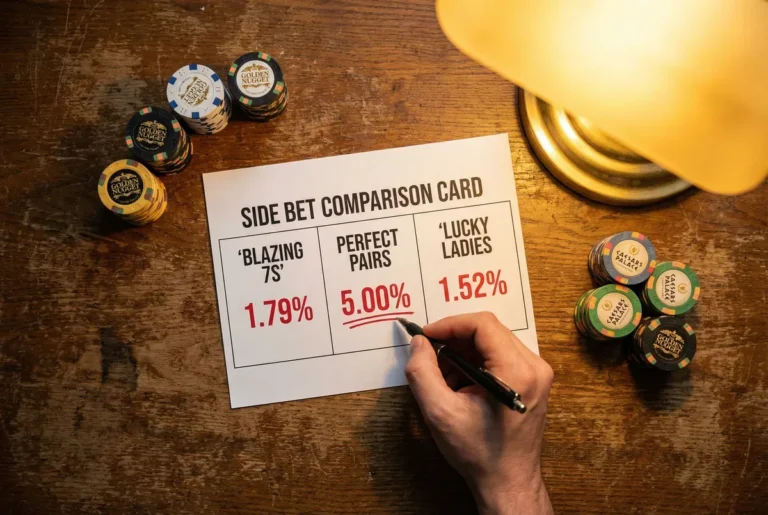
House Edge of Popular Side Bets Like Blazing 7s
Blazing 7s, Lucky Lucky, and Royal Match all carry house edges far above the main game. This post gives you…

Why the Martingale System is the Fastest Way to Go Broke
The Martingale sounds bulletproof just double after every loss and you must win eventually. But the math behind table limits…