
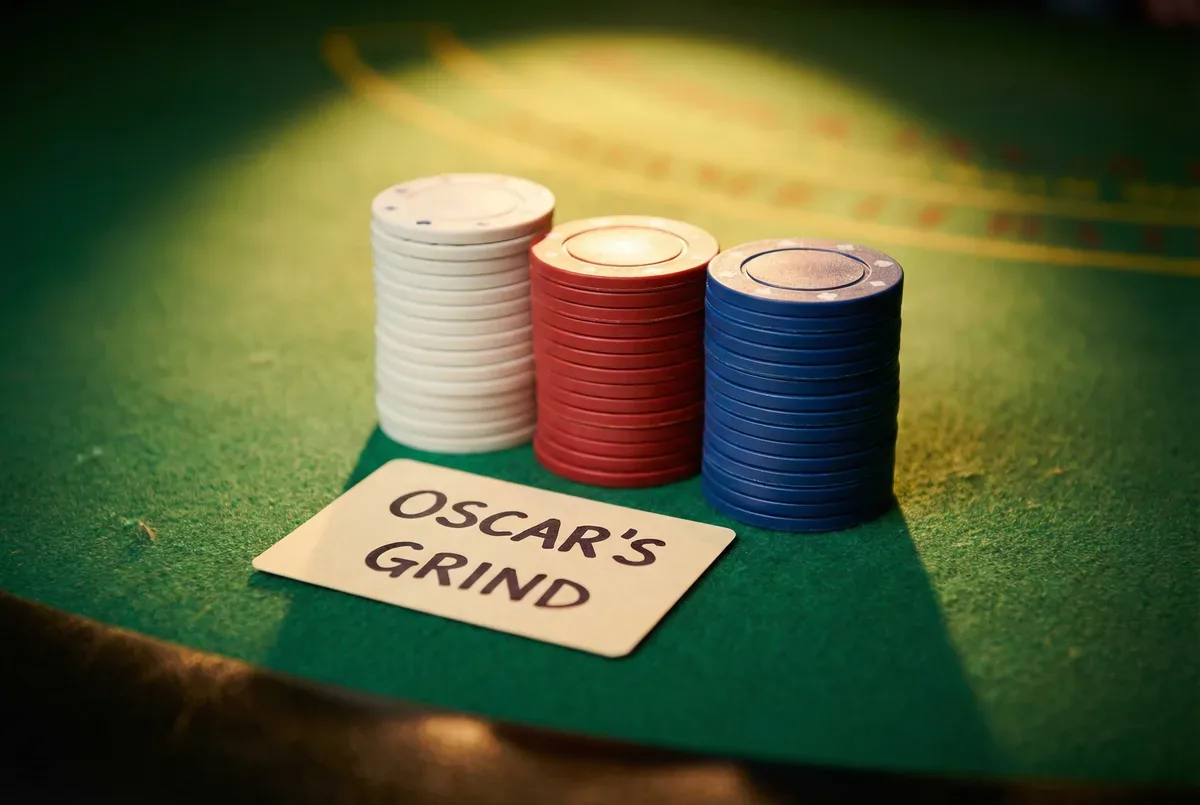
Systematic Approach to Steady Profits with Oscar’s Grind
Oscar’s Grind is a positive progression betting system that operates in cycles, each aimed at earning exactly one unit of net profit. You start at 1 unit, increase by 1 unit after each win, and reset to 1 unit whenever you complete a cycle by reaching a net plus-1-unit position. Losses do not increase the bet you hold at your current level after a loss. The result is a slow, grinding accumulation of modest wins, with individual cycles that rarely spiral into large losses.
Oscar’s Grind Targets Exactly One Unit of Profit Per Cycle
The system was popularized in the 1960s when gambling writer Allan Wilson documented it in his book on casino gambling. Its longevity is a testament to its logical structure: by only pressing after wins and always targeting a fixed profit exit, Oscar’s Grind avoids the exponential escalation that destroys Martingale players and the chase-the-sequence volatility of some positive progressions.
The critical rule many players miss: when a single bet would produce more than one unit of profit for the cycle, you reduce the bet to only what is needed to complete the cycle. The goal is one unit per cycle, not maximum profit. That constraint is what keeps the system disciplined.
- Hand 1Bet 1 unit, lose → Cycle total: −1
- Hand 2Bet 1 unit (hold after loss), win → Cycle total: 0
- Hand 3Bet 2 units (increase after win), win → Cycle total: +2
- Cycle complete at +1 net profit but hand 3 overshoots
- CorrectBet only 1 unit on hand 3 to net exactly +1, then reset
Why Does the Exact Rule of Oscar’s Grind in Practice?
Rule 1: Start every cycle at 1 unit. Rule 2: After any win, increase your next bet by 1 unit, unless doing so would produce more than 1 unit of net profit for the current cycle in that case, bet only what brings the cycle to exactly plus 1 unit. Rule 3: After any loss, keep your current bet size the same do not reduce, do not increase. Rule 4: When your net position within a cycle reaches exactly plus 1 unit, reset to 1 unit and begin a new cycle.
The holding-after-loss rule is the key differentiator from other systems. In the Martingale, losses trigger increases. In Oscar’s Grind, losses trigger patience. You wait for a win before stepping up, which means a losing streak costs exactly 1 unit per hand regardless of where in the cycle you are. This creates a linear loss profile during cold runs, as opposed to the exponential loss profile of negative progressions.
The downside is that cycles can take many hands to complete when losses interrupt the win-press sequence. A cycle that encounters a string of alternating wins and losses may require 10–15 hands to reach net plus 1 unit, while burning through 10–15 individual hand outcomes. Players seeking rapid profit accumulation will find Oscar’s Grind frustratingly slow. That slowness is the feature, not the bug.
Oscar's Grind
Martingale
- Hold bet size
- Linear 1 unit per loss
- Moderate increases slowly
- Exactly +1 unit
- Low-moderate variance
- Double bet size
- Exponential doubles each loss
- Can reach table limit in 7 hands
- Recover all losses + 1 unit
- Extreme variance
When Oscar’s Grind Works Best and When It Struggles?
Oscar’s Grind performs best in sessions where wins and losses cluster where you experience several consecutive wins, then several consecutive losses, rather than perfectly alternating outcomes. Clustering lets the system complete cycles efficiently during win runs and absorb losses without accumulating large deficits. In a perfectly alternating win-loss-win-loss pattern, cycles can take a very long time to close, and while the system never catastrophically fails, it grinds extremely slowly.
How Do You Implement Oscar’s Grind Without Exceeding Session Limits?
The system also struggles in very long sessions. Because the blackjack house edge operates on every hand, the expected loss rate over thousands of hands is the same as flat betting. The advantage of Oscar’s Grind is in its risk distribution it gives you a higher probability of ending a short session profitable, at the cost of slightly larger maximum losses in deep negative cycles. For a defined session of 200–400 hands, this trade-off is often worth it.
Keep a physical count of your cycle position during a session. A small notepad with your running cycle total takes 10 seconds to update and prevents the common error of resetting too early or too late. The system only works if the cycle boundary rules are followed exactly.
Experiencing the Grind Under Real Conditions
The grinding patience that Oscar’s system demands is far easier to read about than to execute when real money is at stake. Testing it at run this system at a real money table in your next session reveals exactly how long some cycles take and how tempting it is to abandon the hold-after-loss rule during cold runs. Real money produces real emotional pressure only fund live sessions with money budgeted entirely for entertainment, and treat cycle patience as the primary skill being developed, not the outcome of any individual hand.
Frequently Asked Questions
No. Like all betting systems, Oscar's Grind does not change the mathematical house edge. It changes how your bankroll behaves over a session spreading losses more evenly and giving you a higher probability of small session wins but the long-run expected value remains negative for non-counters.
Apply the same 1–2% bankroll rule. Bring 20–25 units to a session. The Grind's modest cycle goals mean you rarely bet more than 3–5 units at once, so bankroll requirements are similar to flat betting with comparable exposure.
Some counters use it as a cover for count-based bet variation the gradual press after wins looks like a normal progression rather than a counting tell. However, Oscar's Grind's cycle structure can conflict with the ideal bet spread a counter needs, so most serious counters stick to pure count-driven sizing.
Before you test these plays at a real table, run them through our free blackjack simulator practice unlimited hands at zero cost until every move becomes automatic.
Mathematical Risk Warning
Oscar's Grind and all positive progressions do not change expected value. The house edge applies to every hand regardless of your betting sequence. Systems that feel safer than flat betting are changing the distribution of outcomes, not the underlying mathematics.
Blackjack Academy is an educational resource. All strategy is based on mathematical expectation. Always play within your means.

Written by
Mark AnurakProfessional card counter since 2009 · 500,000+ hands logged · Former Macau advantage player. Studied under Thorp, Griffin & Wong methodology. Full bio →
Learn More
Continue your education with these related lessons.
Why Setting a Stop Win is a Critical Professional Skill
A stop-win rule is not pessimism about your ability to keep winning. It is the mathematical recognition that every hand…
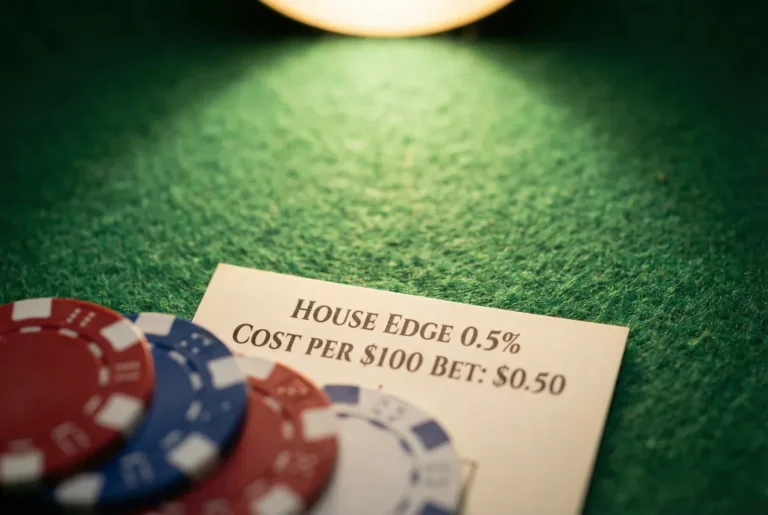
What the House Advantage Percentage Really Means for Your Bankroll
House advantage is not an abstract casino term it is the exact rate at which your money transfers to the…

How to Stay Calm and Control Your Emotions at the Table
Emotional control is a skill that directly affects your blackjack results. Tilt, fear, and overconfidence each cause specific strategy errors.…