
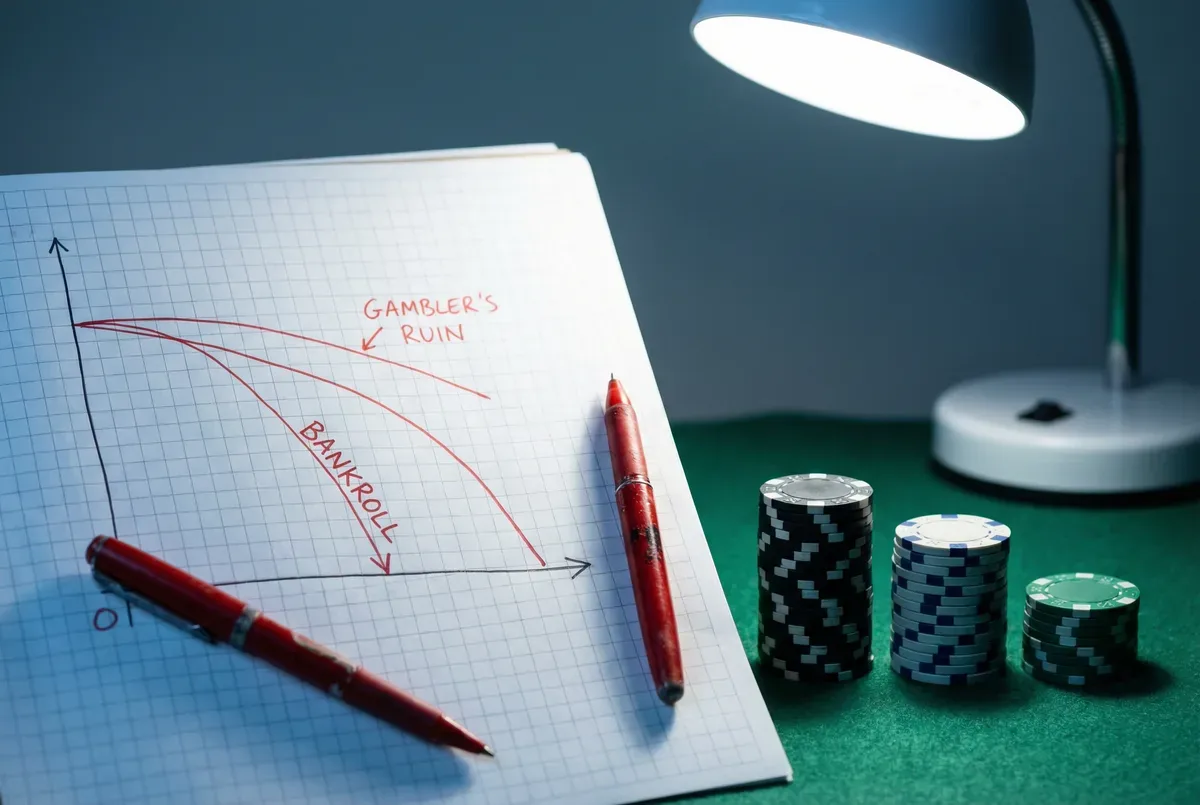
How Gambler’s Ruin Theory Affects Every Blackjack Player
Gambler’s ruin is a probability theorem stating that in a game with a negative expected value, a player with a finite bankroll will eventually go broke with certainty regardless of skill, strategy, or short-term luck. The casino, by contrast, is functionally infinite in capital. This asymmetry is not a business advantage; it is a mathematical inevitability. Even in a fair coin-flip game where both players have equal edge, the player with the smaller bankroll faces a ruin probability proportional to the capital ratio. Against a house with even a 0.5% edge, that probability climbs toward 100% as the number of hands played increases. Understanding this theorem does not make you pessimistic it makes you precise about how to structure your play to maximize expected outcomes within a finite financial life.
The Theorem That Every Casino Is Built On
Ruin probability vs infinite bankroll at 0.5% edge
% given infinite play
Ruin probability with 100-unit bankroll targeting 10 units
% before target
Ruin probability with 500-unit bankroll targeting 10 units
% before target
Why Do the Formula and What It Tell You Practically?
For a game with win probability p and loss probability q = 1-p, the ruin probability starting with n units and playing until either reaching a target N or going broke is given by a standard formula involving the ratio q/p raised to the power n. At a 0.5% blackjack house edge, p ≈ 0.4975 and q ≈ 0.5025, making q/p ≈ 1.01005. With a 100-unit bankroll targeting a 200-unit goal, ruin probability exceeds 73%. The practical implication is direct: larger bankrolls relative to bet size dramatically reduce session ruin probability, and modest win targets reduce exposure time and therefore cumulative risk.
This is why professional blackjack players size bets as a small fraction of total bankroll rather than a fixed dollar amount. Betting 1% of bankroll per hand means 100 consecutive losses are required to go broke a sequence with roughly 0.006% probability per 100-hand session. Betting 10% per hand requires only 10 consecutive losses, which occurs with approximately 0.17% probability 28 times more likely. The math rewards conservative unit sizing with a disproportionate reduction in ruin risk.
”Bet
”Approx
- ”
- 1%
How Do You Apply Ruin Theory to Session Planning?
The most useful practical application of gambler’s ruin theory is session stop-loss design. If you bring $500 to a session and your unit is $10, you have 50 units. The ruin probability over a four-hour session at 0.5% edge is calculable and it is far lower than most players intuitively fear for that bankroll size. Setting a stop-loss at 20 units (40% of session bankroll) captures the vast majority of that theoretical protection while keeping enough capital to continue playing when variance turns favorable.
Stop-win targets matter equally. Gambler’s ruin theory shows that the longer you remain at the table, the more hands the blackjack house edge accumulates against your bankroll. Locking in a profit and walking away at a 20-unit gain is not timidity it is recognition that continued play beyond a win target is additional exposure to a negative-EV game. Professionals quantify this exposure precisely and do not allow session momentum to override the math.
Experience Ruin Variance in Real Time
The most visceral way to internalize gambler’s ruin theory is to play through variance fluctuations with money that matters. At test this stake level at a live table tonight, real-money sessions will eventually expose you to the downswings that ruin theory predicts. Set a strict 20-unit stop-loss before you sit down, track every hand, and notice how often the bankroll approaches that limit before recovering. That lived experience is the most effective teacher of why conservative bet sizing is non-negotiable no simulation replicates the discipline pressure of real stakes.
Frequently Asked Questions
Against a house edge with a finite bankroll and infinite play, yes ruin probability approaches 100%. In practice, finite sessions with stop-loss rules and conservative bet sizing can keep expected loss very small relative to bankroll over a realistic playing lifetime.
For recreational play at 0.5% edge with a 1% bet size, a 200-unit bankroll gives session ruin probability below 0.5% for a typical 4-hour session. For semi-professional play, 300–500 units is the standard recommendation.
Yes, but with a positive edge the ruin probability is no longer 100% given infinite play. It becomes a finite, calculable number that decreases as bankroll grows. This is why counters require larger bankrolls than recreational players to withstand the variance before the edge accumulates.
Before you test these plays at a real table, run them through our free blackjack simulator practice unlimited hands at zero cost until every move becomes automatic.
Mathematical Risk Warning
Gambler's ruin guarantees that finite bankrolls face eventual depletion against any house edge over infinite play. Responsible bankroll management reduces session risk but cannot eliminate it entirely.
Blackjack Academy is an educational resource. All strategy is based on mathematical expectation. Always play within your means.

Written by
Mark AnurakProfessional card counter since 2009 · 500,000+ hands logged · Former Macau advantage player. Studied under Thorp, Griffin & Wong methodology. Full bio →
Learn More
Continue your education with these related lessons.

What the House Advantage Percentage Really Means for Your Bankroll
House advantage is not an abstract casino term it is the exact rate at which your money transfers to the…
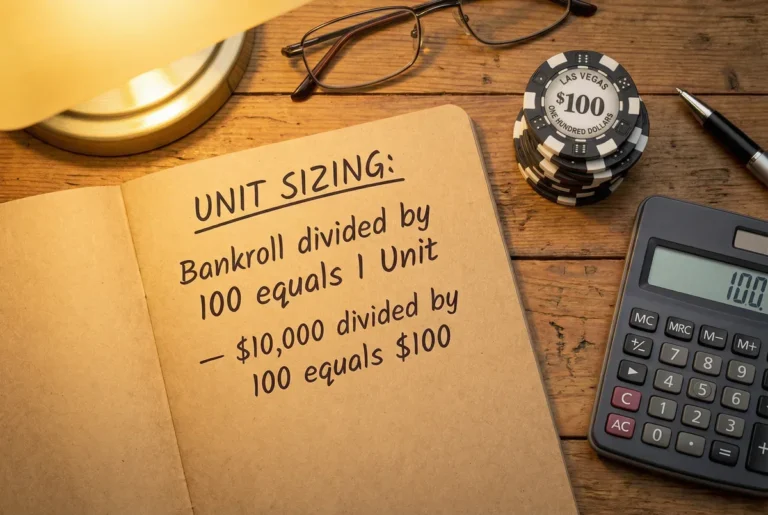
How to Size Your Units for Professional Blackjack Play
Professional unit sizing goes beyond the simple 1/200th rule. This post covers the Kelly Criterion, fractional Kelly, SCORE-based sizing for…
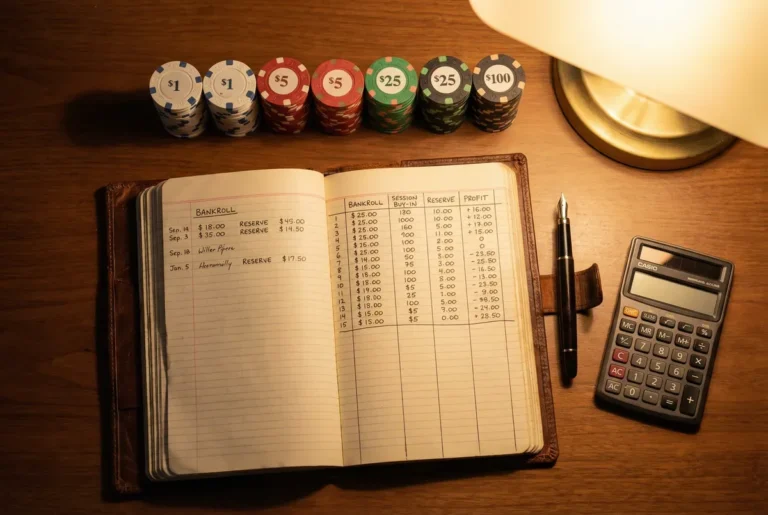
Bankroll Management Secrets Every Professional Blackjack Player Needs
Professional blackjack longevity depends entirely on disciplined bankroll management. Learn the exact unit sizing, session limits, and reserve rules that…